


How Moosbach implements the Green Deal
Field report: Challenges for SMEs with the goals of climate neutrality and sustainability

The Green Deal aims to make Europe the first continent to achieve climate neutrality by 2050. Major topics here are CO2 neutrality and the circular economy. Implementation requires extensive data material, which must be compiled with the help of digitization. All in all, considerable efforts are coming from the industry.
Climate neutrality and sustainability are the topics that will challenge us in the coming years. In 2019, Ursula von der Leyen presented the ten goals of the Green Deal, which aims to make Europe the first continent to achieve climate neutrality by 2050. Two of the ten goals are priorities for the industry and should be implemented promptly, not least because of the ongoing climate changes. These are CO2 neutrality and the circular economy. Their implementation requires extensive data material, which can be collected, evaluated and used for these and other topics with the help of digitization.
The CO2 footprint is a prerequisite for achieving CO2 neutrality. This is divided into three areas (see Figure 2), which are also referred to as Scope 1, 2 and 3 in the literature. The direct emissions, called Scope 1, are generated from fossil fuels - including the generation of heat or travel by company vehicle. Indirect emissions, Scope 2, come from energy sources such as electricity or district heating, the generation of which has already produced CO2. Other indirect sources of CO2, Scope 3, are attributable to production activities, transportation of products and raw materials, and not to forget employee travel to the workplace.
Free programs are available on the Internet for creating the CO2 footprint. A more comprehensive and precise CO2 footprint can be created by an energy consultant, if desired in accordance with DIN EN ISO 140641. A data collection, sensibly over three years, can usually be taken from the bookkeeping. It should be noted, however, that the existing programs work and evaluate differently, so that the results are only comparable with each other to a limited extent.

Call for industry-wide carbon footprint
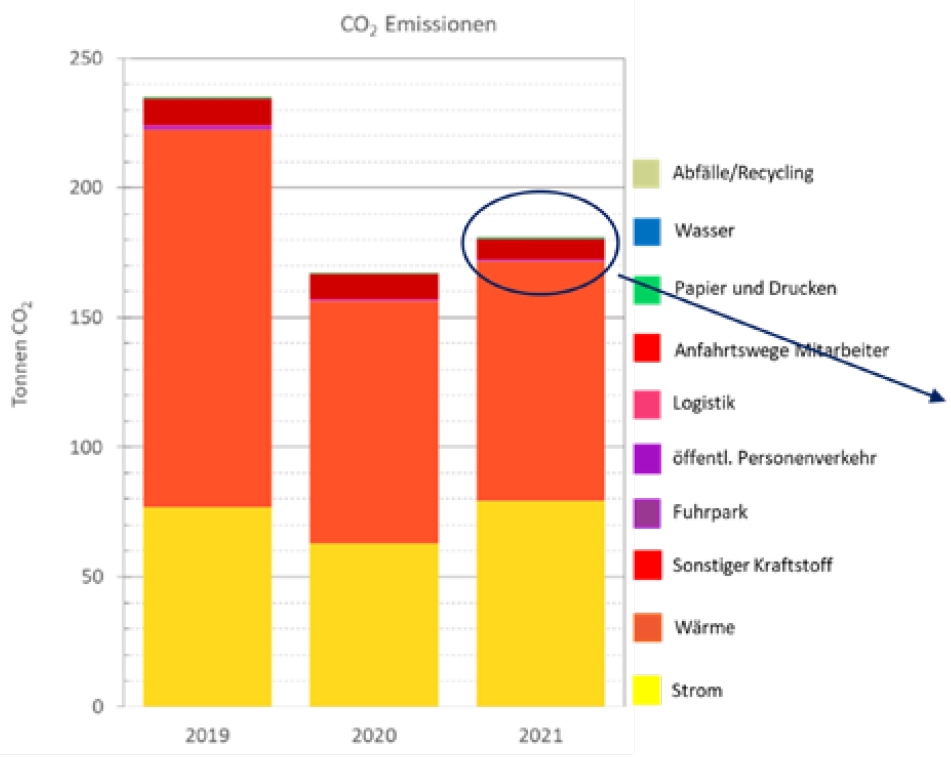
In the spring of this year, some member companies responded to the ZVO call for an industry-wide carbon footprint covering the years 2019 to 2021, with the option of an individual evaluation for the participating companies. The graph shown in Figure 3 is the result of this evaluation, exemplified by Lohngalvanik Moosbach & Kanne GmbH. As expected, the main share of CO2 emissions comes from electricity and heat, Scope 1 and Scope 2. Scope 3 is predominantly composed of employee travel.
While looking back at normal business operations in 2019, the corona-related lockdown required business operations to be shut down the following year, which is reflected in the emission levels. In 2021, business operations are normalizing, but emissions have not increased to 2019 levels. Energy and CO2 savings have been a focus at Lohngalvanik Moosbach & Kanne since 2015. The reasons for this are the installation of PV systems. Overall, technical changes, including the installation of LED lighting, the replacement of rectifiers, heat recovery from exhaust air, and the commissioning of a combined heat and power plant between 2015 and 2021, reduced CO2 emissions by a total of 205 tons per year.
If the primary goal of climate neutrality is to be pursued further, adjusting screws must be found to reduce CO2 emissions. These measures were implemented as part of necessary building and plant renovations and more effective use of the energy sources employed. To achieve further CO2 reductions, examples would be the replacement of intact but less efficient equipment and the use of green electricity for heat generation. The generation of "green electricity" from solar energy is not sufficient in our latitudes, and other sources such as wind power cannot be used at every location. What levers can be found to achieve the primary goal of climate neutrality in the foreseeable future?

How can climate neutrality be achieved?
The focus is on savings opportunities through changes in behavior and work habits that are cost-neutral. These include, in particular, heating and travel habits or the merging of production and logistics processes. Technical changes, such as roof, facade and window insulation, PV systems, heat exchangers, energy storage, tub and pipe insulation, lighting, e-mobility and process conversion, are associated with costs. In order to apply these adjusting screws in a meaningful way, data from the different work areas are first required.The analysis of this digitized data shows that stable processes with more process reliability, as well as the reduction of chemical consumption, have considerable potential to reduce CO2 emissions.
As an example, the bath management of a thick-film passivation process can be used here, which was accompanied at a galvanizing plant over five years and whose data were recorded (see Figure 4). With the help of digital recording and evaluation of the process data, it was possible first to reduce the intervention area and then to lower the process temperature, adjust the air injection and finally reduce the process and wastewater chemicals by 27 percent. Furthermore, by lowering the process temperature by 40°C from 60°C to room temperature, additional heat energy and thus CO2 could be saved. This is because heating one cubic meter of water from 20°C to 60°C requires 58 kWh, which corresponds to a gas volume of 5.4 m3 with CO2 emissions of 12.5 kilograms. Table 1 compares the CO2 equivalents of the energy sources electricity, petroleum and natural gas.
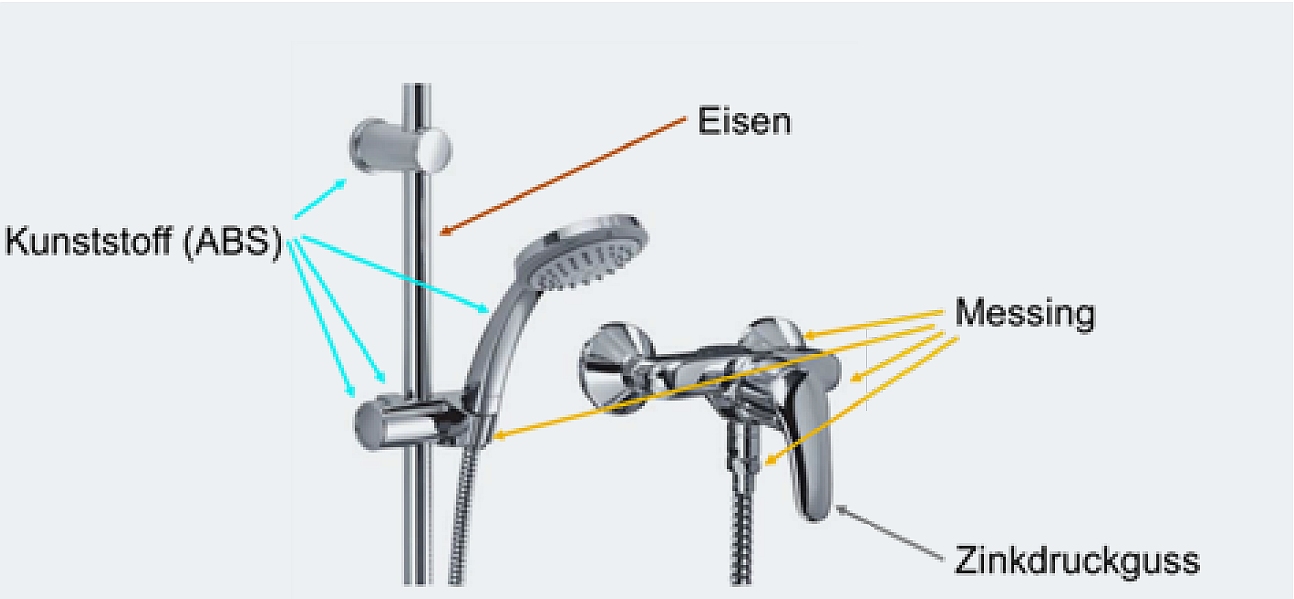
When considering the galvanic layers, requirements with regard to the circular economy are already fulfilled. They make a significant contribution to the sustainability of a product by extending service life, optimizing corrosion protection, improving durability in use and also protecting against environmental influences. Furthermore, electroplating allows an economically and structurally viable choice of base materials for the components of a product, which appears uniform due to the electroplated coatings. The sanitary shower fixture shown in Figure 5 consists of four different base materials, which is not apparent to the consumer in the overall picture.
Electroplated metal parts are recyclable and can be returned to the material cycle. In addition, results of new processes show that it is possible to break down electroplated plastics into the components plastic and metal and to reprocess the resulting plastic into injection molded parts. This process is already being used successfully in plastics electroplating shops. (OT22: "Circular economy through the use of recyclates in galvanized plastics", Dr. Felix A. Heinzler, BIA Kunststoff- und Galvanotechnik GmbH & Co. KG; "Recycling of metallized plastics by high-energy pulse treatment," David Zapf, Hansgrohe SE). Galvanic surfaces are produced with a high energy input, but this is offset by the sustainability benefits listed in the overall CO2 balance.
EU: Product passport only a matter of time
In order to provide consumers with information about the greenhouse gases produced during manufacturing and details about sustainability and recycling options, the EU launched the idea of the product passport. Every company activity generates large amounts of data in internal and external areas, which should be stored. Through internal networking and processing of the data, the data relevant for the product passport can be extracted. For the EU, the product passport is a done deal, even if there is currently no fixed date for it. Therefore, the recommendation to every manufacturer is to digitalize, evaluate and catalog all product and production-specific data internally already today.
Research on the Internet reveals that the few product passports that currently exist are far from the EU requirements, with no precise guidelines to date. What is certain is that complex supply chains, which include electroplating shops as a link or intermediate, should be actively involved in the guidelines for product passports in order to keep the effort as low as possible and the result as comprehensive as necessary. Trade associations such as the ZVO can and must act as a link between industry and politics. With regard to climate neutrality and sustainability, small and medium-sized companies in the surface industry are facing major challenges, which, however, can be mastered according to past experience if the technical possibilities are basically given, the energy suppliers and network operators play along and the bureaucracy remains manageable. Politicians and the authorities are called upon to ensure that applications are processed quickly and to provide the necessary funding. Because if the financing of measures to reduce the carbon footprint is not secured, or even if economic viability is not foreseeable, the transformation of businesses on a larger scale cannot be successful.
Dr. Elke Moosbach, Dr. Elke Spahn
Moosbach & Kanne GmbH www.moosbach-kanne.de
Gravitech GmbH www.gravitech.de