

Metalworking: Heraeus shows how light can save energy
Intelligent infrared systems save energy in metal processing

Countless heating processes are necessary before a product is made from a metal part. Some of these processes are solved by infrared heating technology. Used correctly, the necessary energy can be used particularly efficiently.
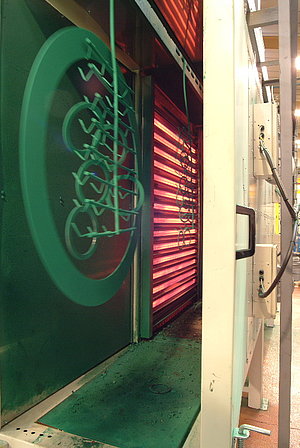
Metal conducts heat very well, so in the case of metal parts with a lot of mass, the heat is quickly conducted from the surface into the depths and is then not available for drying the paint. Medium-wave infrared radiation can specifically heat the paint and surface, the paint is dried and the metal part remains relatively cool on the inside. This accelerates the drying process on the one hand and significantly improves energy efficiency on the other.
Curing special coatings faster
Whitford Ltd in Cheshire, UK, offers high-performance fluoropolymer coatings and sol-gel anti-stick coatings for a wide range of applications. These include coatings for cookware and bakeware, small electrical appliances, and aerospace, automotive, and chemical process parts. The company is particularly known for its Xylan coatings, which are widely used in the offshore industry for their corrosion and chemical resistance and excellent visibility underwater. The Xylan range offers high bond strength to most metals, plastics, ceramics and wood. However, most coatings in the Xylan range require elevated temperature for curing. Until now, this was achieved with hot-air ovens, which was energy- and time-consuming because the entire mass of the part to be cured had to be heated to the target temperature. In addition, it was not possible to quickly control the temperature at the surface of the part. Whitford therefore considered using infrared technology and tested various IR emitters with different wavelengths at Heraeus Noblelight.
All emitters - medium wavelength carbon emitters, fast medium wavelength emitters with short response times, and normal medium and short wavelength emitters - proved to be suitable options for curing and repairing xylan coatings. However, there were particular advantages for curing large metal components because infrared selectively heats the surface of the substrate. Unlike convection ovens, this does not heat the entire metal part. This provides significant savings in process times and energy costs. Gareth Berry, the engineer responsible for research at Whitford, is very pleased with the results and explains, "We can now offer our customers a viable alternative to curing with hot-air ovens, and this also saves time and energy. "
Improving seal quality with infrared
Klinger UK Ltd. is one of the world's leading manufacturers of seals, for example for the oil, gas and petrochemical industries. An important step in the manufacture of a whole range of metal seals is the application and curing of an epoxy powder, which later protects against corrosion during use. Originally, the coatings were cured in a gas-fired hot-air oven, but this developed more and more drawbacks over time. The most annoying was the enormous energy consumption, which was mainly due to preheating and standby operation. The oven had to be preheated at least two hours before production started and then run without interruption during the entire shift, regardless of whether there was a product in it for curing or not.
Tests with infrared heat were so successful that a complete single-flue infrared oven with medium-wave emitters was installed at Klinger. The oven is divided into three zones, the first for preheating the components, the other two as holding zones where the powder coating is fully cured.
The new oven only needs to be switched on when it is needed and this has resulted in significant savings in energy costs. In addition, curing is now much faster and output has been increased because it is no longer necessary to wait for the oven to reach a certain temperature. Last but not least, the new infrared oven requires less than half the floor space than the previous convection oven.
Efficient energy transfer
Since the energy crisis, questions have been piling up about switching from gas-fired ovens to infrared systems for industrial heating processes. "We rely on the particularly efficient transfer of energy by technical light, by UV or infrared radiation. These act directly in the material and require no transfer medium. And the effect is demonstrable!", says Roland Eckl. So why don't all companies change over immediately? Often, there is not enough time and capacity in day-to-day operations to think about new technologies. Often, it is initially easier to continue with the tried and tested. However, experience shows that an intelligently planned changeover brings much more benefits in the long term. For example, compact IR boosters help to speed up a drying process enormously without having to dispose of the existing kiln. A booster can be switched on or off in a matter of seconds and can also be adjusted precisely to the product in question. This helps to make the drying line fit for the future.
Heraeus Noblelight has been working intensively on this topic. "We are in active exchange with an energy consultant who has calculated several cases for us," says Roland Eckl. "Switching from a gas-fired oven to an infrared oven running on a mix of green electricity can bring quite enormous savings in CO2 emissions."