

30 percent lighter
Erhebliche Materialeinsparungen bei Fahrwerkbauteilen durch Einsatz von Zinklamellenbeschichtung möglich
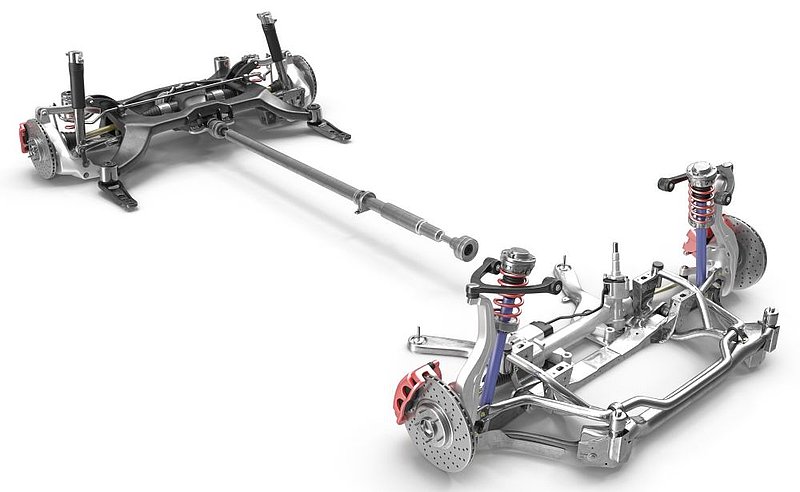
Tests have shown that improved corrosion protection with zinc flakes makes it possible to reduce the material thickness of chassis components without compromising safety.
Saving material and thus enabling lighter components plays an important role in sustainability in the automotive and commercial vehicle sectors. Chassis components where lightweight construction methods can save a particularly large amount of weight also include joints, brakes, springs, steering and wheels. As a recent study commissioned by Dörken shows, the amount of material required depends not only on the mechanical load on a component during operation. In particular, additional safety margins on structurally relevant components to account for expected corrosion damage during the component's service life drive up the component weight. Thus, in order to exploit all potentials, lightweight design with corrosion-sensitive materials always requires optimization of corrosion protection. An apt example of this are chassis elements in cars, which have to reliably transmit forces between the vehicle and the road surface even in extreme situations. The parts installed in this composite are subjected to extreme stresses in road traffic - for example due to dynamic driving maneuvers or u quickly driving over a speedbreaker or other road damage and obstacles.
High load on chassis components
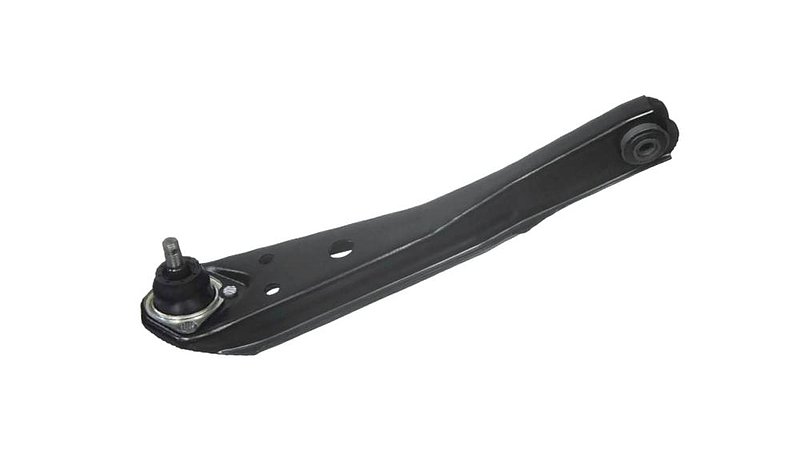
The sometimes complex axle structures of modern vehicles have numerous transverse, longitudinal and composite control arms. In the case of these components, which are made of steel or aluminum depending on the vehicle class, the design must exclude the possibility of buckling failure at minimum weight within the framework of the expected operating load and service life. Particularly in the case of steel chassis elements, the expected corrosion plays a decisive role in dimensioning. Generous wall thicknesses of 2.6 mm are therefore common for chassis control arms. If you take a look under a used vehicle, you can often discover an astonishing amount of rust in the area of the chassis parts after just a few years. The usual solution here is a cathodic dip coating, which is particularly well suited to complicated structures and interior geometries. However, a KTL coating is usually relatively thin and thus not very robust under mechanical loads. In addition, it only provides passive protection against corrosion. If damage occurs down to the substrate, corrosion will occur. Since the chassis elements are located in the underbody area, it is inevitable that sooner or later whirled-up stones and other objects will cause corresponding damage.
Reduction of wall thickness
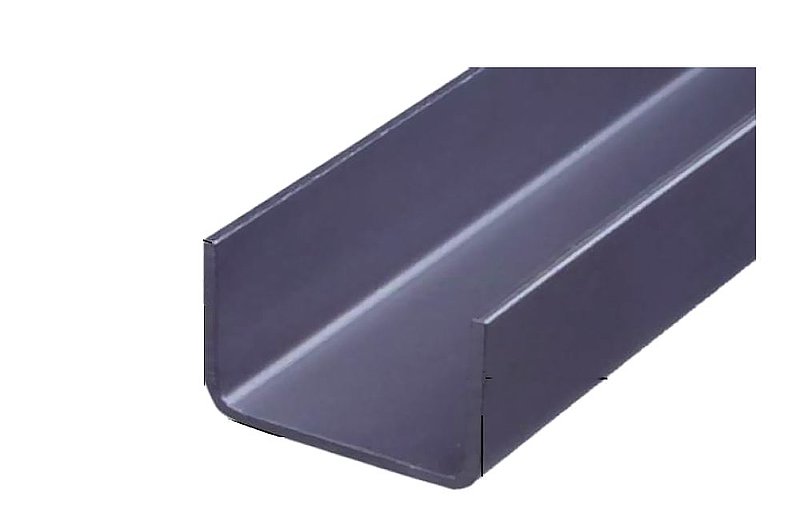
Against this background, Dörken asked itself the following question in the development of forward-looking corrosion protection systems for lightweight construction: What potential in terms of weight savings does wall thickness reduction offer, especially for chassis components? As part of a study carried out by ACS (Automotive Center Südwestfalen), this was investigated using a simplified model of a chassis control arm based on Euler's buckling cases. Using the finite element method, the first task was to determine how the simplified model of a chassis beam, in this case a steel U-section with a sheet thickness of 2.6 mm, behaves under buckling load. Buckling did not occur until 49.2 kN, whereas the OEMs' requirements - depending on the vehicle model - are around 35 kN. This safety margin of 15,000 newtons still corresponds to almost half of the required load. The next step was to use a finite element simulation to find out up to which plate thickness the U-profile can be reduced under the required buckling load. For this purpose, a plate thickness of the U-section of 2 mm proved to be sufficient. This results in a possible mass reduction of up to 30 percent. The next task was to test the influence of corrosion on the mechanical properties of the test specimen in practical tests using a 3-point bending test (based on DIN EN ISO 14125). For this purpose, it was first determined what the minimum bending stiffness of the profile must be. With a reference sheet thickness of 2 mm, the calculated bending stiffness was 3.1 kN/mm. In the following tests, 2 mm U-profiles with a high-performance zinc flake basecoat and topcoat from Dörken were pitted against 2.6 mm thick U-profiles with a phosphate coating and KTL surface. The test specimens were subjected to stone impact (DIN EN ISO 20567) in the buckling area as well as three corrosion stresses: the salt spray test according to DIN EN ISO 9227, the accelerated corrosion test II (ACT II) and the VDA test (according to VDA 233-102).
Zinc flake coating with best performance
In the case of the test specimen coated with a zinc flake system with a wall thickness of 2 mm, no red rust attack was detected in any of the three corrosion tests. Despite immense material savings, test times of 1,000 hours in the salt spray test and six cycles in each of the climate change tests were achieved. Furthermore, a bending stiffness of between 3.2 and 3.4 kN/mm was determined in the 3-point bending test - both loaded and unloaded. The KTL-coated 2.6 mm U-profile showed visible red rust infestation in the same test setup. Without corrosion, a bending stiffness of approximately 4 kN/mm was determined; in the coded condition, this dropped to values between 3.8 and 3.9 kN/mm. The study shows: The higher wall thicknesses planned in practice as a safety component can be saved with the aid of a zinc flake coating system. Effective corrosion protection can thus lead - with the same component performance - to weight savings of around 30 percent.
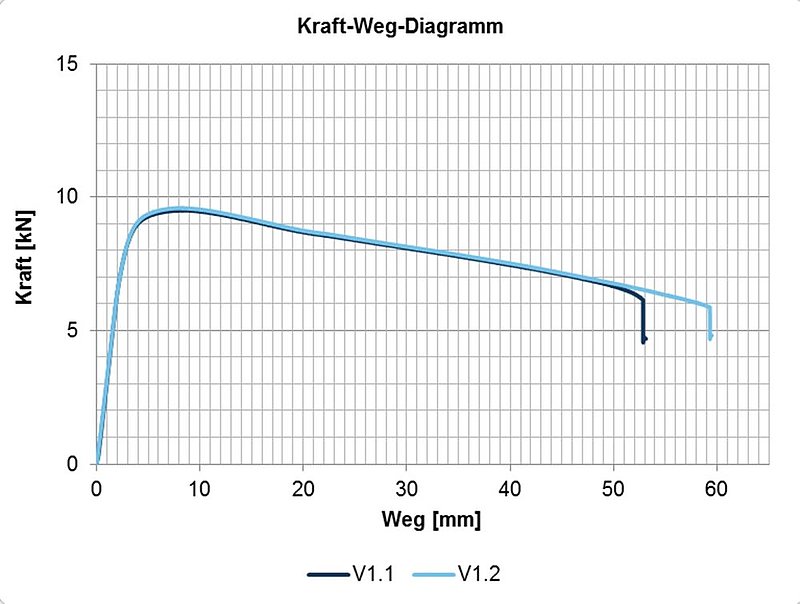
Conclusion: 30 percent weight saving possible
In addition to the weight savings, there is also a reduction in CO2 emissions. In the course of the project, it was possible to save around 800 grams of weight on one component group. With 3.1 million vehicles produced in Germany in 2021, this would correspond to 2,480 tons of steel. The emissions that could be saved as a result amount to around 3,720 tons of CO2. By comparison, a car consuming five liters of diesel per 100 kilometers would have to travel 16.2 million kilometers to achieve the same emissions.