
FiT: Films under control
FiT gibt wertvolle Handlungsempfehlungen für die Erreichung aktueller Anforderungen

When it comes to component cleanliness, residual film contamination is increasingly playing a quality-decisive role alongside particles. The challenge of classifying and defining permissible limit values has become greater here, analogous to the requirements.
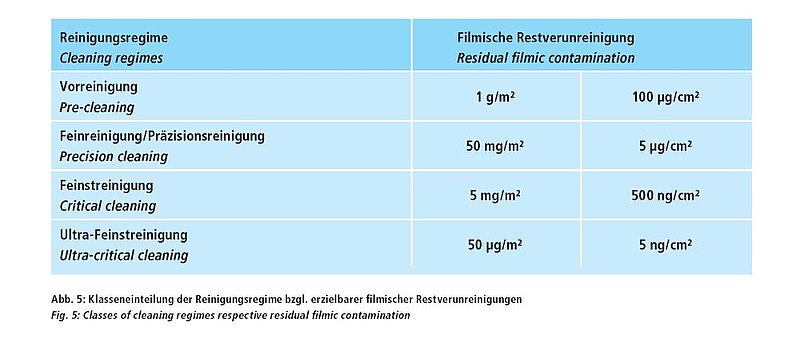
Due to changes in manufacturing, joining and coating processes, residual film contamination such as oils, greases, cooling lubricants, release agents or even hand sweat and fingerprints are increasingly becoming a quality factor in addition to particulate contamination. In many cases, the previously widespread, generalized specification "free of oil and grease" is not sufficient to define the level of filmic cleanliness required for downstream processes and/or flawless product function in terms of quality assurance and to achieve this in the cleaning process.
This development confronts parts manufacturers and processors across all industrial sectors with new and more demanding tasks. As a navigator of component cleaning, the Fachverband industrielle Teilereinigung (FiT) e. V. has been supporting users of industrial cleaning technology with basic and expert knowledge and practical recommendations for action since it was founded in 2004. These include the "Guidelines for quality-assuring process management in component cleaning" and the "Checklist for planning a cleaning process", which provide basic orientation for the design of cleaning processes. The FiT has delved deeply into the subject of undesirable film-like contamination with the guideline "Controlling Filmic Contamination". Using company-independent recommendations for action, it shows how the process chain of component cleaning can be set up and optimized to reliably meet requirements for residual filmic contamination on component surfaces.
Controlling filmic contamination
In just under 160 pages, the publication highlights all aspects that need to be taken into account in the definition of limit values and the design and optimization of corresponding production and cleaning processes to ensure reproducible quality of the end product, in line with the current state of the art. In addition to a definition of what counts as filmic contaminants from a cleaning technology point of view, their occurrence or sources as well as properties and effects are explained.
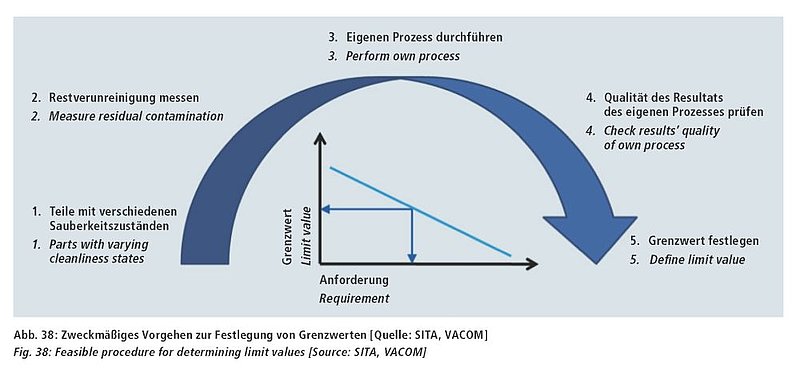
The next chapter looks at the process chain in component cleaning and examines the solutions currently available in terms of cleaning chemistry and processes. It is also shown that the fundamentally required knowledge of the degree of contamination or the cleanliness of the components along the cleaning process can only be obtained through the optimum use of suitable measuring, testing and analysis technology. For this purpose, the most common methods including their strengths and limitations are presented, as well as solutions and current approaches for monitoring the cleaning process. These fundamentals are combined in the chapter "Solution approaches to typical tasks in parts cleaning". On the one hand, it deals with a methodical procedure for determining limit values for sufficient filmic component cleanliness. On the other hand, concrete recommendations for action help to design cleaning processes systematically and in line with quality requirements, to make the necessary process adjustments and to react correctly to any process disturbances that occur. The monitoring of active substances and the degree of contamination in cleaning and rinsing baths, the inspection of component condition along the process chain and the cleanliness of functional surfaces are further tasks for which possible solutions are presented. However, since even a component that is clean in accordance with the specifications does not automatically remain clean, the guideline offers further recommendations for handling workpieces in a way that ensures cleanliness. This section also discusses basic rules for component design suitable for cleaning, which can be used to influence the effort and costs of cleaning as early as the product development phase. Information is also provided on what needs to be taken into account when handling samples for surface analysis.

With this content, the bilingual guideline "Mastering Filmic Contamination", which is available from the FiT office, also offers beginners to this topic a complete and comprehensible overview. The Fachverband industrielle Teilereinigung e.V. (FiT)is a competence network for industrial component cleaning. Its members include well-known companies from the fields of plant engineering, chemistry, measurement technology and analytics, as well as plant operators and research institutes.
The FiT offers the industry orientation as well as knowledge transfer and qualification through its technical committees, working groups, guidelines, checklists, symposia and seminars. It initiates progress and innovation, among other things, through cooperation with renowned research institutes, colleges and universities.
Fachverband industrielle Teilereinigung e.V. (FiT)
www.fit-online.org