

Energy-efficient ultrasonic deburring
Cooperation project with DBU funding
Conventional deburring processes, such as high-pressure water jetting, vibratory grinding, chemical, electrochemical as well as manual deburring or brushing, like to cause high costs, the removal takes place in an untargeted manner and there can be high environmental pollution or secondary burrs. A funding project aims to change that.
As part of a project funded by the Deutsche Bundesstiftung Umwelt (DBU), Weber Ultrasonics AG, LPW Reinigungssysteme GmbH, Hemo GmbH and Fraunhofer IPA have collaborated on the basis of an existing patent for ultrasonic deburring to develop a system for industrial application that is ready for series production and offers an effective, material-friendly and energy-efficient alternative to conventional processes.
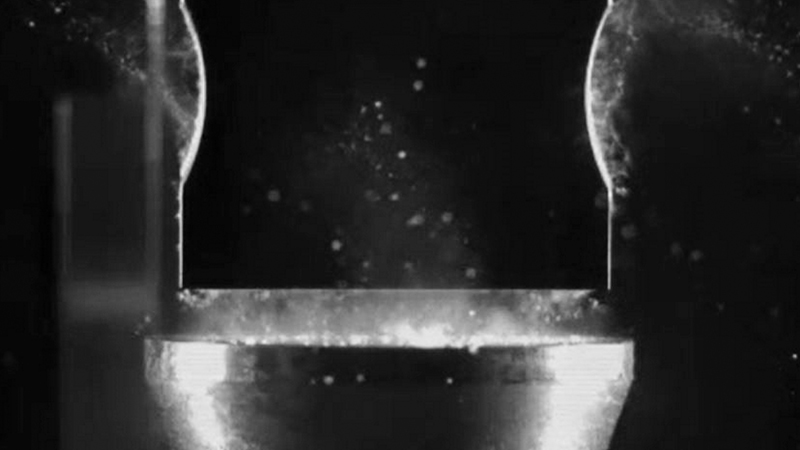
The basis of this new deburring technology is the combination of ultrasonic cleaning and welding as well as the use of the physical effect of cavitation. A sonotrode vibrates in a high-amplitude liquid bath, as in ultrasonic welding, and generates a zone of intense cavitation at the tip. The burr is exposed to this for a short time. When the locally confined cavitation bubbles implode, high forces and a strong current are generated. As a result, burrs can be removed and transported away in a targeted and at the same time gentle manner, without thermal stress and secondary burrs forming.
After numerous test and trial series by the cooperation partners in the laboratory, a rod and a knife sonotrode were finally developed, which guarantee reliable burr removal both selectively and over a wide area. The comparatively low connected load of only four kilowatts ensures an extremely efficient energy balance. In the next step, with the support of Hemo GmbH, the integration into a three-axis test facility was carried out in order to be able to carry out the further tests, which primarily related to the sonotrode shape and various sonotrode materials, with greater precision. The process proved to be particularly suitable for removing tinsel burrs from stamped, aluminum and zinc die-cast parts as well as components made of plastic injection molding.
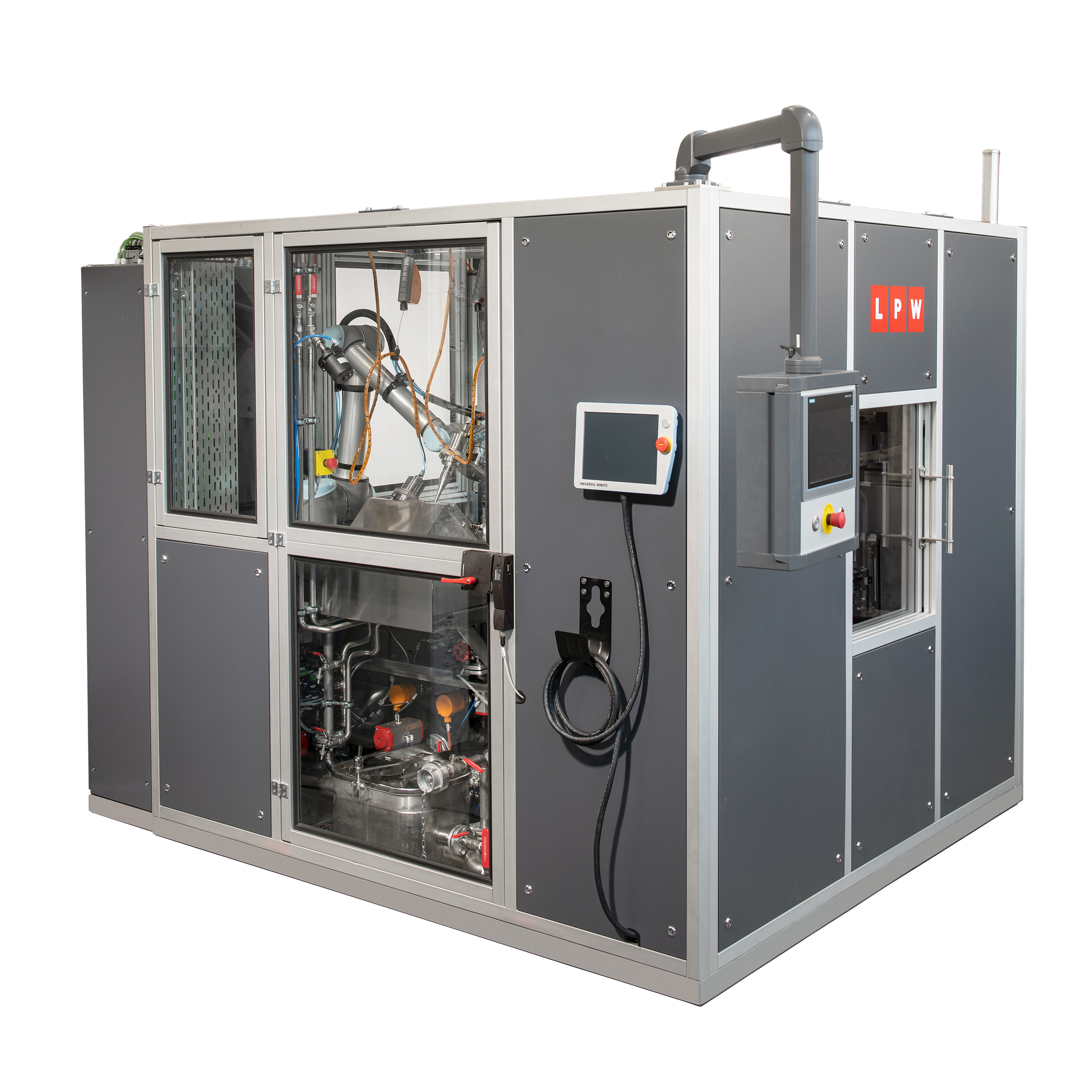
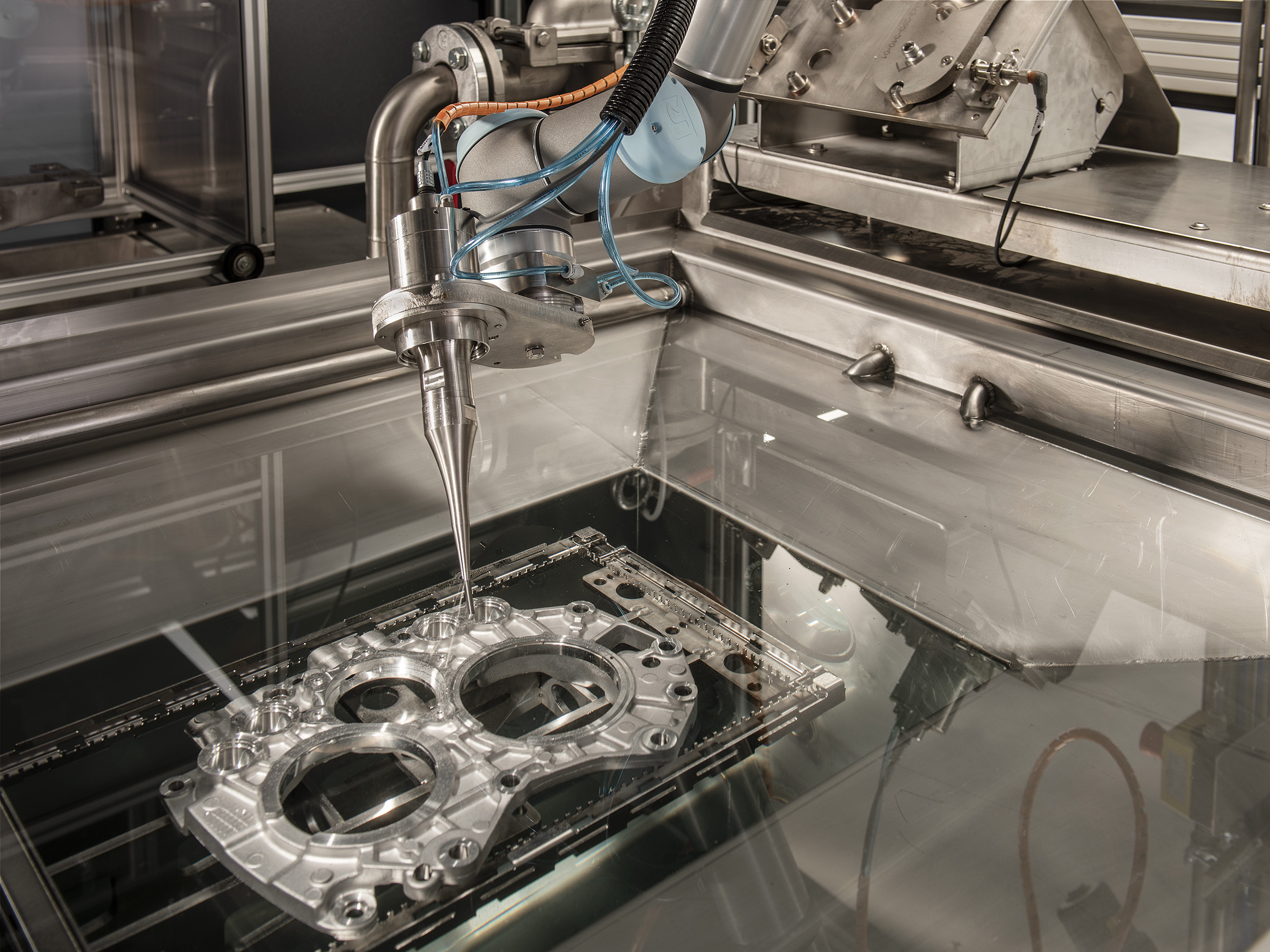
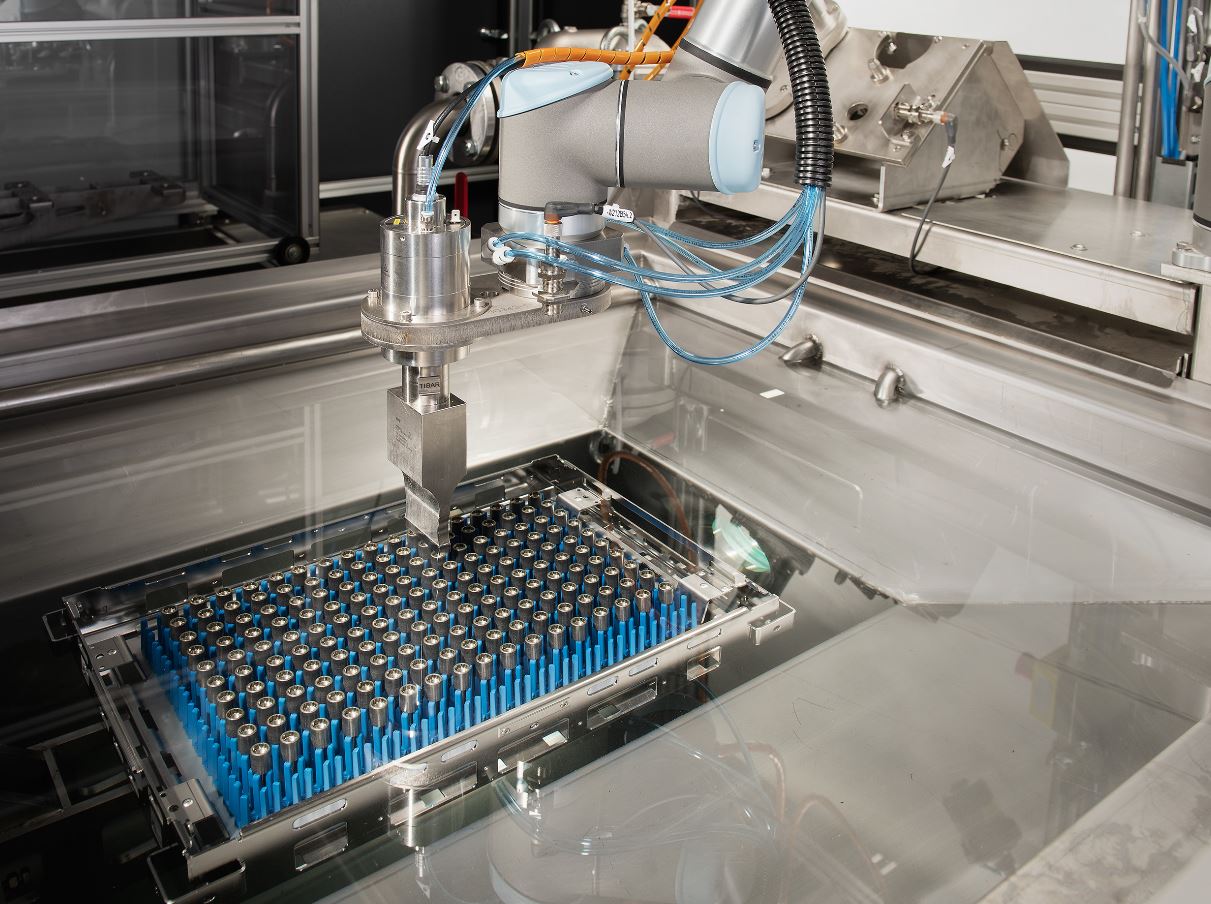
In the second project phase, LPW R designed and manufactured the series prototype, which is laid out as follows: By means of a robot, the respective deburring horn is targeted at a defined angle to the areas to be deburred of the workpiece placed in the liquid bath. A tool changer allows the combination of different tools/deburring horns. It also measures the process-related wear to achieve a long sonotrode service life and compensates the approach position fully automatically by the program.
The system is designed in such a way that it can be used either as a stand-alone deburring unit or as an integrated component of an ultrasonic series dipping system. The workpiece carrier with one or more workpieces is picked up at the loading station by a handler system and immersed in the liquid-filled tank. By means of the sonotrode, the deburring process starts below the water level. The immersion depth is adjusted by a lifting system and allows the processing of components up to a batch size of approximately 300 x 400 x 300 mm. During the deburring operation, the liquid is continuously (taken from the bottom of the basin or via the overflow and) filtered in the circuit.
After the deburring operation has been completed, in the case of the stand-alone solution, the fabric carrier is placed in a set-down position and the next fabric carrier is placed in the basin. Only then is the finished fabric transferred to the loading/unloading position. When integrated into an ultrasonic series dipping system, the fabric is transferred to the subsequent operation.
Present and future
The prototype is available to interested parties and customers in LPW's new test and service center in Riederich for trials or also for deburring small batches. Ultrasonic deburring is suitable for any machining burrs that occur during the manufacture of workpieces made of non-ferrous metals such as aluminum and zinc die castings, plastics and also stainless steel sheets. For other materials, good results can also be achieved for tinsel and grinding burrs. The maximum borehole depth is currently 60 millimeters. With deeper boreholes, the deburring result decreases.
In addition, a sonotrode with an exchangeable tip is currently under development in order to reduce tool costs and tool change times. In addition to improving and optimizing the tools in terms of service life and their geometric shape, the focus is on process optimization to increase the deburring performance and expand the range of applications with the aim of generating and utilizing the cavitation energy in the best possible way.
LPW Cleaning Systems GmbH
www.lpw-cleaning.de
Weber Ultrasonics AG
www.weber-ultrasonics.com