
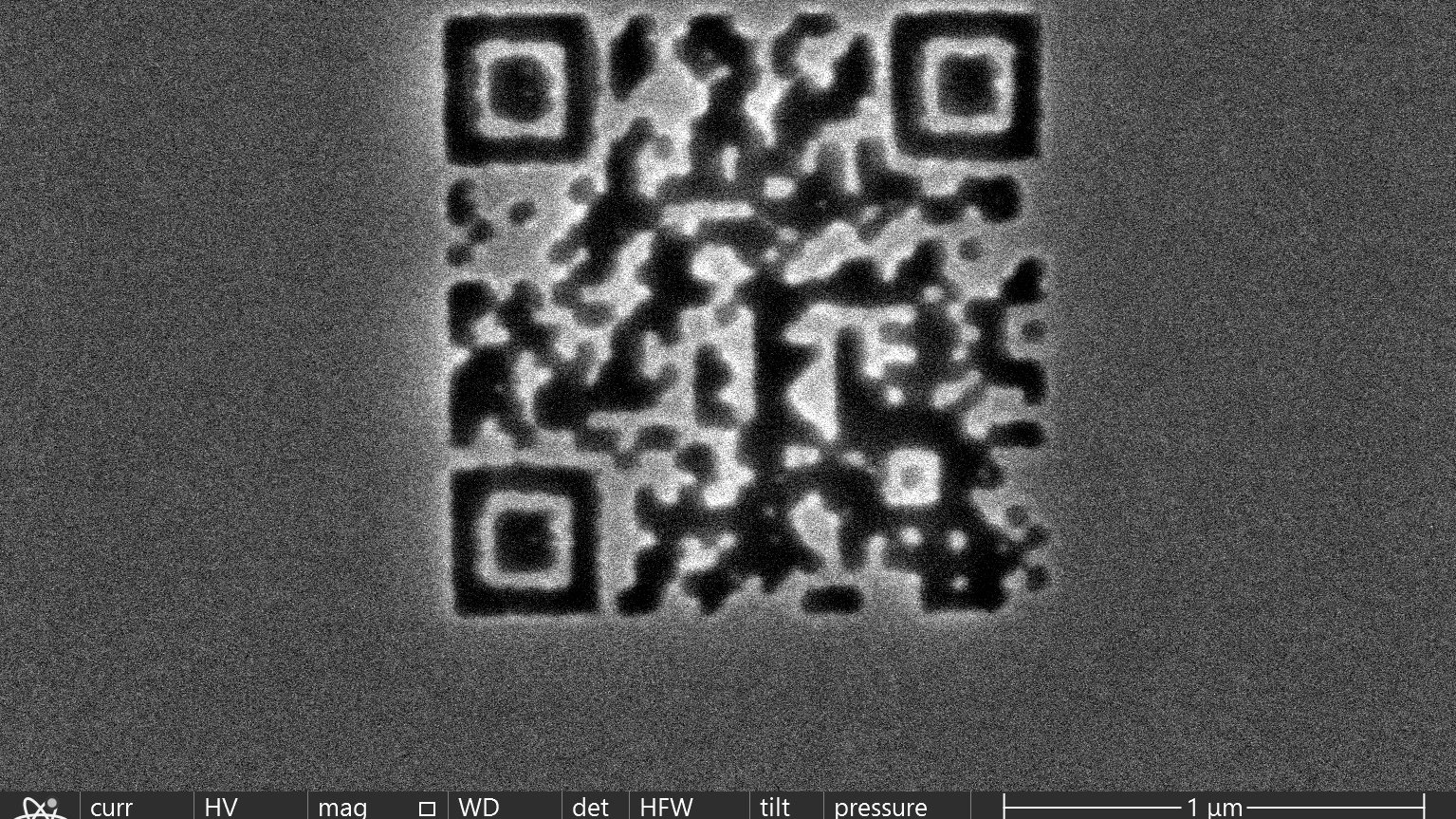
The QR code covers a surface of just 1.98 μm² — smaller than most bacteria, according to TU Wien. “The structure we have created here is so fine that it cannot be detected with light microscopes at all,” says Prof. Paul Mayrhofer from the Institute of Materials Science and Technology at TU Wien. The challenge, however, previously lay elsewhere: individual atoms can diffuse, moving to other positions so that vacancies are filled and the stored information is lost. “We have produced a tiny but stable and repeatedly readable QR code,” Mayrhofer explains.
Thin Layers Inspired by Tool Coatings
The key factor is the material. “We are researching ceramic thin films such as those also used for coating high-performance tools,” say Erwin Peck and Balint Hajas. Using focused ion beams, the team milled the QR code into a thin ceramic layer. The individual pixels measure only 49 nm—roughly ten times smaller than the wavelength of visible light. The code is therefore invisible, and its details cannot be resolved using visible light. However, electron microscope imaging showed that the QR code can be reliably read.
More than 2 terabytes of data could theoretically be stored on an area the size of an A4 sheet. Unlike conventional storage media, such ceramic storage systems are almost indefinitely durable and require no energy. “We live in the information age, yet our own era stores its knowledge on media that are surprisingly short-lived,” says Alexander Kirnbauer, a member of the Thin Films Materials Science research group at TU Wien. “With ceramic storage media, we are pursuing an approach similar to that of ancient cultures whose inscriptions we can still read today. We write information into stable, inert materials that withstand the passage of time and remain fully accessible to future generations.”
Data Remains Stored Without Energy Supply
It is also important that the data remains preserved without any energy input and without cooling—unlike today’s data centers, which require enormous amounts of electrical energy and thus contribute to global CO2 emissions.
The world record—including the readout process using an electron microscope—was jointly carried out by TU Wien and Cerabyte in the presence of witnesses and confirmed by the University of Vienna as an independent surveyor. TU Wien provided not only materials science laboratories but also the high-tech electron microscopes of its Electron Microscopy Center, USTEM. The record has now been reviewed for the Guinness Book of Records and officially recognized. The QR code measured here is only 37 percent the size of the previous world record holder.
“The world record marks only the beginning of a promising development,” says Kirnbauer. “We now aim to test other materials, increase writing speed, and develop scalable manufacturing processes so that ceramic data storage can be used not only in the laboratory but also in industry.”