


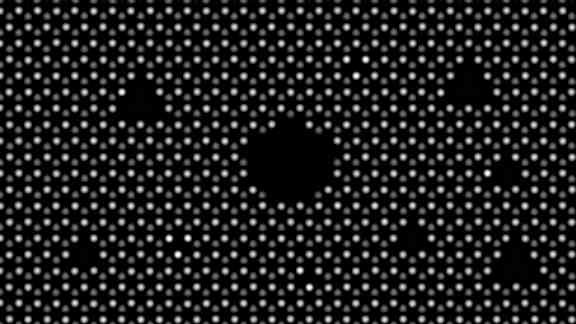
Two-dimensional hexagonal boron nitride (hBN) is an insulating material consisting of a single atomic layer. It forms a barrier that can also protect other two-dimensional materials, such as graphene, from their surroundings. Pores with a diameter of just a few atoms make this barrier permeable. A nanoporous membrane is formed through which molecules or ions can pass. Such membranes could be used to filter substances or to analyze DNA as it passes through a nanopore.
At this scale, the precise shape of the pore and the atoms at its edges influence how it interacts with the molecules passing through. At the same time, due to their small size, the pores exhibit quantum mechanical properties that make them useful for catalysis and quantum applications.
Electrons can image and modify atomic structures
One way to create such tiny pores is using the electron beam of a transmission electron microscope: The same electrons used to image two-dimensional materials down to the level of individual atoms can also knock atoms out of the material. With continued irradiation, these defects grow into nanopores. It has been known for nearly two decades that electron irradiation of hBN produces triangular pores. Their shape was generally attributed to the fact that boron and nitrogen atoms can be displaced with different ease. “We show for the first time that the shape of the pores is not solely due to the electrons, but is influenced by the atmosphere surrounding the sample,” says Umair Javed, first author of the study and a doctoral student in the Kotakoski group at the Department of Physics at the University of Vienna.
Electron microscopes operate under vacuum, but this vacuum still contains residual gas molecules. The Vienna team used a microscope with an exceptionally high vacuum and the ability to introduce selected gases into the sample environment. This allowed them to investigate what happens when the electron beam acts almost exclusively on hBN—and how the situation changes when gases are added.
Drilling and Etching Play an Equal Role
In the ultra-high vacuum, the electron beam removed boron and nitrogen atoms in roughly equal amounts, resulting in the formation of circular pores. However, even when only a small amount of oxygen was present, boron atoms were removed much more easily, and triangular pores formed with nitrogen at the edges. Oxygen alone was not sufficient: The results suggest that the electron beam breaks down molecular oxygen into reactive species that can chemically attack the material. The pore shape therefore results from an interplay between physics and chemistry: “Drilling” with high-energy electrons favors circular pores, while oxygen-mediated chemical etching favors triangular pores. By adjusting the atmosphere during electron irradiation, the researchers can control which pore shape is formed.