

Vermes Microdispensing is expanding its DVS drop-volume system to include the DVS+. The new version combines in-process measurement of dispensed volumes with optional closed-loop control. This allows dispensed volumes to be monitored during the process, deviations to be detected, and these deviations to be compensated for by automatically adjusting the valve opening time. The goal is to ensure consistent dispensing even under changing operating conditions.
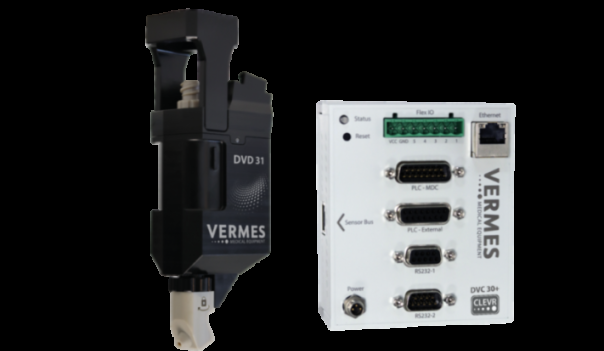
The system consists of the DVD sensor units DVD 31 or DVD 32—tailored to the respective dosing volume—as well as the DVD 30+ controller. For applications requiring absolute, practical volume values, the systems can be mass-calibrated using a reference measurement, such as a laboratory balance. Calibration improves the traceability of volume data and supports quality assurance as well as the traceability of measurement results.
Control in a Closed-Loop Process
The DVC30+ control unit extends the existing DVC functionality with an optional control function. The measured data thus serves not only for process evaluation but also for automatic process control. Volume deviations are corrected by adjusting the valve opening time in the microsecond range. In the event of sudden disturbances, the system returns to the setpoint in fewer than three triggers; dosing drifts are typically compensated for as early as the next trigger.
CLEVR, short for Closed Loop Exact Volume Regulation, offers Monitoring and Control operating modes, each available in RAW or Calibrated variants. In the RAW variant, volume measurement and control are based on relative process values. The Calibrated variant uses a reference measurement to evaluate dosed volumes directly in application-relevant units. This allows the system to be adapted to requirements in development, validation, and production.
Designed for time-critical dosing processes
For pulse-train dosing, the “Fixed Delay” and “Variable Delay” timing modes are available. In “Fixed Delay” mode, the time interval between triggers remains constant. In “Variable Delay” mode, the delay is automatically adjusted to the valve opening time, ensuring that the dispensing frequency remains constant within the pulse sequence. This operating mode is specifically intended for time-critical and synchronized dispensing processes.
“In microdispensing technology, it’s not just that every single drop has to be right. The process must also remain stable and controllable over long operating periods,” says Stefan Hirte, CEO of Vermes Microdispensing. “With the DVS+, we make measurement data immediately usable for process monitoring and optimization: for transparent evaluation during monitoring and, where necessary, for the automatic compensation of volume deviations during normal operation.”
The browser-based user interface visualizes relevant process data in real time. The system can be integrated into existing machine environments via standard interfaces. The DVS+ systems are compatible with current Vermes dispensing systems and can be integrated into existing production lines. The solution is designed for microdispensing applications in automation, electronics and semiconductor manufacturing, as well as in medical technology.