

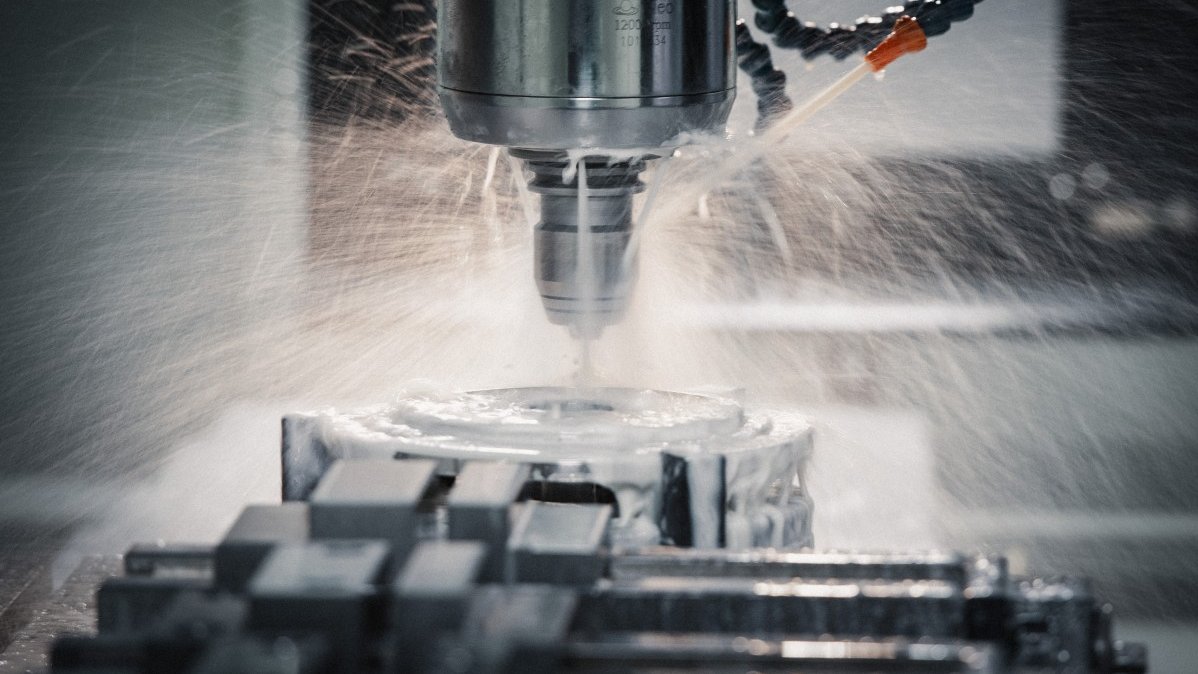
The milling cutter engages, coolant sprays, metal chips fly. With accuracy far exceeding a millimeter, the milling tool moves across a metal workpiece secured by vacuum in the production hall of Lorenz Hoffmann GmbH. The company, based in Kreßberg south of Würzburg and run in the second generation by Andreas and Christina Hoffmann, operates a modern machine park that includes CNC milling machines used, for example, to manufacture prototypes for mechanical engineering.
These CNC machines are controlled by programs written specifically for the production of individual workpieces. This enables Lorenz Hoffmann GmbH to manufacture mechanical components with tolerances so tight that they are smaller than the thickness of a human hair. The milling tools rotate at speeds of up to 40,000 min-1 while moving along the predefined contours. In the process, complex geometric objects are produced from metal blanks. To meet the required precision during milling, the workpieces must not shift by even 0.01 mm during machining. They are therefore fixed in place using vacuum. For this purpose, the employees use special vacuum clamping plates connected to vacuum pumps.
Prototypes, Small Series, and Installation-Ready Components
In this way, Lorenz Hoffmann GmbH and its 40 employees have been producing prototypes, small series, and installation-ready components for more than forty years for a wide range of industries, including mechanical engineering, the automotive industry, medical technology, as well as the wood and food industries. In order to meet all customer requirements flexibly, the company’s experienced engineers and technicians continuously refine their processes and methods.
The key factor behind the high quality that has made the company a leader in single-part, prototype, and small-series production is precision. Secure clamping of workpieces using vacuum technology from Busch Vacuum Solutions is indispensable for this, as the company from Maulburg reports. In addition, vacuum clamping reduces setup costs.
Previously, the company supplied vacuum to its four CNC milling machines by using a separate vacuum pump at each machine. Because Managing Director Andreas Hoffmann wanted to optimize the vacuum supply in his operation, he replaced the four oil-lubricated rotary vane vacuum pumps—on the recommendation of Busch—with a dry Cobra Plus screw vacuum pump connected to the four milling machines via piping.
“By installing the Cobra, we save 3,500 kWh per year compared with the four oil-lubricated rotary vane pumps previously in use—and we achieve even better holding performance,” Hoffmann says.
An Energy Efficiency Standout Thanks to Variable Speed Control
The Cobra Plus features variable speed control, allowing it to adjust its output to the actual demand and therefore consume less energy than an uncontrolled pump whose motor always runs at full speed.
“The Cobra always delivers exactly the capacity we need. For example, if only one milling machine is in use, the Cobra operates at a lower speed than when several machines are running simultaneously,” Hoffmann explains.
In addition, the Cobra Plus is a fully networked vacuum pump equipped with advanced control and monitoring functions. A color touchscreen displays parameters such as power consumption, vacuum level, and motor speed. Hoffmann appreciates being able to keep the vacuum supply under constant observation.
All Cobra screw vacuum pumps from Busch operate without contact between moving parts, meaning they require no oil in the compression chamber. “Since switching to the Cobra, we no longer have to change oil, air-oil separators, or filters. That saves around four working days of maintenance per year. The Cobra has run without any faults so far, and maintenance has not been necessary at all,” the managing director says.
In addition, operating a Cobra Plus generates significantly less noise than the four previous vacuum pumps. Since they were replaced by the Cobra, the production hall has become noticeably quieter. For employees, this represents a clear improvement in working conditions.
“Previously, up to four pumps were running at 72 dB(A) each. The Cobra produces 63 dB(A). That means it’s now only about half as loud, making the working environment much more comfortable,” Hoffmann says.
Waste Heat Used for Heating
Hoffmann places great importance on producing as sustainably and energy-efficiently as possible and is constantly looking for further improvements. The switch to the Cobra opened up the opportunity to use the new pump’s waste heat for heating. Together with his team, he developed a heat recovery system.
“The Cobra is water-cooled. The heated cooling water is routed through an air heater. That’s how we heat our production hall,” the managing director explains. This air heater contains a fan and a heating coil that cools the water so it can be reused to cool the Cobra. As a result, the company—otherwise heated with oil—now requires significantly less heating oil. “In summer, we direct the waste heat outside. In winter, it stays inside the production area. As a result, the production hall is noticeably cooler during the warmer months as well. Previously, it used to heat up considerably in summer,” he adds.
Because energy-efficient technology is subsidized in Germany, Busch experts assisted the company in submitting an application to the Federal Office for Economic Affairs and Export Control (BAFA). The authority reimbursed Lorenz Hoffmann GmbH for 40 percent of the purchase cost of the new vacuum pump.
However, Hoffmann is particularly pleased with the energy benefits and proud of his heat recovery system made possible by the Cobra Plus. “For us, investing in the Cobra has paid off twice over. We use less electricity than before, and in winter we can use the pump’s waste heat for heating.”