


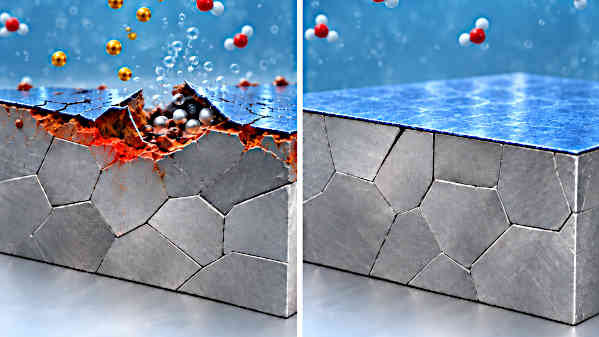
One problem with PEM water electrolysis is the cost of the highly corrosion-resistant components. Some of these components are coated with platinum. Experiments conducted by TU Wien have now taken a closer look at the electrochemical processes occurring on such platinum coatings. The results show that, if done correctly, significantly less platinum is needed than has been customary to date.
Chemical Environment in the Electrolysis Cell Corrodes Metals
The technical implementation of electrolysis is complicated: “During electrolysis, a chemical environment prevails that is harmful to many metallic components. Metal can dissolve, and at the same time, oxide layers can form that impede the flow of current,” explains Helmut Riedl-Tragenreif from the Institute of Materials Science and Materials Technology at TU Wien. If the system is to remain functional for a long time, the components must be properly matched. Of particular importance here are the bipolar plates, which account for up to 30% of the system costs.
These bipolar plates ensure mechanical stability, conduct electrical current, and enable the transport of water and gases. Titanium is a suitable material for this purpose, as it is highly corrosion-resistant even under aggressive conditions. However, an oxide layer forms on the titanium surface, which impedes the flow of current.
For this reason, bipolar plates are coated with a layer of platinum. It conducts electricity, is corrosion-resistant, and protects the underlying titanium. Researchers at TU Wien have now investigated how thick this platinum layer needs to be. The result: A platinum layer just 24 nm thick proved to be sufficient. With a layer thickness of 8 nm, however, problems arose.
88% Savings in Platinum Material Possible
Compared to a 200-nm-thick coating, as currently used in industry, approximately 88% of the platinum could be saved. To demonstrate this, it is also necessary to investigate how resistant the protective layer is under operating conditions. “We analyzed the layers before and after electrochemical stress using high-resolution methods,” says Riedl-Tragenreif. “The key question is whether microscopic defects occur in the layer.”
Such defects can lead to a vicious cycle: If the platinum protective layer is damaged in one spot, the underlying titanium can be attacked. It oxidizes, and small oxygen bubbles may also form at the interface. This can cause mechanical stress and further damage the platinum layer. Larger portions of the coating can peel off, exposing even more titanium—and the process accelerates.
The researchers found evidence of such damage in the 8-nm-thick platinum layer: After being subjected to stress, it exhibited larger defects, and at the same time, more titanium and platinum ions entered the electrolytes. The 24-nm-thick layer, on the other hand, remained largely intact and retained its electrical conductivity. The release of metal ions was limited to a very low level.