

This is what satellites look like: Two solar panels like wings and a body, wrapped in shimmering gold or silver foil. Researchers from the "Mechanics of Materials and Nanostructures" laboratory at Empa in Thun are working on this film, as reported by the Swiss Federal Laboratories for Materials Science and Technology. It is a superinsulation (multilayer insulation). It consists of several polymer layers with a metal coating - usually aluminum.
On board the spacecraft, the superinsulation protects the electronics from temperature fluctuations. "For satellites in low-Earth orbit, the temperature difference between the side facing away from the sun and the side facing the sun is around 150 K," says Empa researcher Barbara Putz. "However, electronics work best at a room temperature of 25 °C." As it is directly exposed to space conditions, the superinsulation itself must be able to withstand high stresses.
Polyimide is usually used as the polymer base for the thin-film structure. In addition to temperature and vacuum resistance, this plastic also offers good adhesion for the aluminum layer. "The reason for this is an intermediate layer just a few nanometres thick that forms between the polymer and the aluminum during coating," explains Putz. The researcher now wants to investigate this intermediate layer in more detail - and use it in a targeted manner. The layer should not only enable better superinsulation for future satellites, but also accelerate the development of flexible electronics on Earth.
Combination of materials exactly as in space
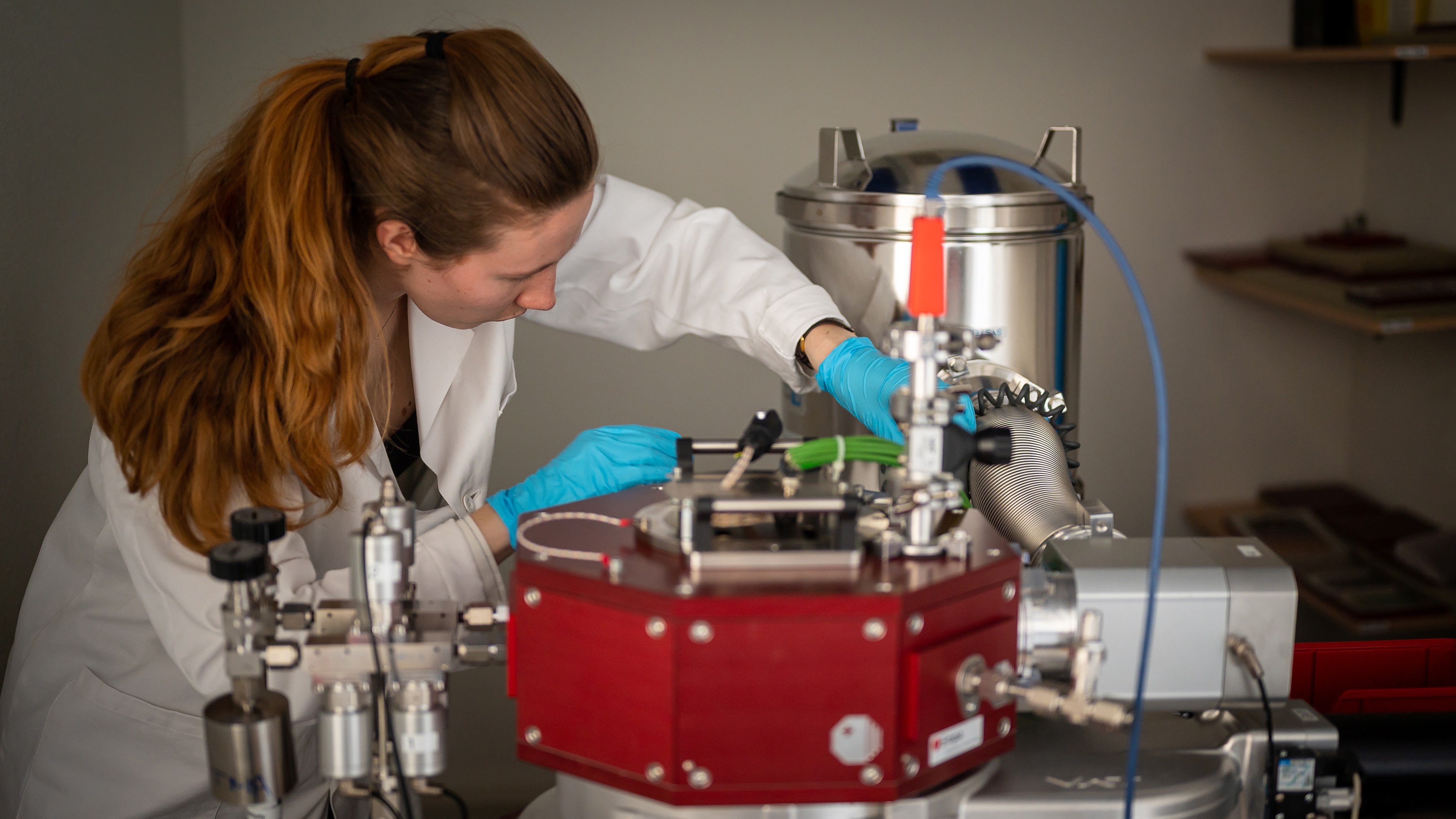
To gain a precise understanding of the intermediate layer and its effects on the material properties, Putz and her doctoral student Johanna Byloff opted for a simple model system: a 50 µm thick polyimide film coated with 150 nm of aluminum. Between the metal and the plastic, the researchers apply a 5 nm thick coating of aluminum oxide. To ensure clean processing, the researchers use a coating machine from Empa spin-off Swiss Cluster AG. The device makes it possible to apply several coating processes in succession to a workpiece without removing it from the vacuum chamber.
"Our combination of materials corresponds to that used for space applications, for example on the European Mercury probe Bepi-Colombo or the solar shield of NASA's James Webb Space Telescope," says Byloff. "Only there, the intermediate oxide layer forms naturally, whereas we produce it specifically, which allows us to adjust the properties."
From satellites to flexible applications on Earth
The researchers have thoroughly examined their model film. The result: the intermediate layer makes the material more stretchable and more resistant to tears and shear forces. Next, the researchers want to vary the thickness of the layer and apply it to other polymer substrates.
Satellite insulation is not the only area in which flexible multilayer systems are in demand. Putz and Byloff also see a large field of application for their research in flexible electronics, which are also based on metal-coated polymers.