
In the study, platinum and copper layers just a few nanometers thick were stacked to form a metallic lattice. After excitation by a laser pulse, the artificial crystal lattice began oscillating at approximately 1 THz: around one trillion times per second, the platinum nanolayers expanded while the copper layers were compressed. This oscillation starts immediately and is too fast to be explained by the transfer of thermal energy through electrons and the resulting expansion of the crystal lattice.
“That surprised us,” says Jan-Etienne Pudell of European XFEL. “The oscillation is not driven by the pressure of the heated lattice, but by electron pressure, particularly within the platinum layers.”
Hot Electrons Bombard the Metal
“What we are seeing here is not simply a metal heating up and expanding,” says Matias Bargheer, spokesperson for Collaborative Research Center (CRC) 1636, “Elementary Processes of Light-Driven Reactions at Nanoscale Metals,” at the University of Potsdam. “We observe the electrons themselves exerting pressure within less than a trillionth of a second, effectively bombarding the metal surface from within. This is highly exciting for chemistry on metals only a few nanometers thick because it sheds new light on the relationship between hot electrons, heat, atomic motion, and ultimately chemical reactions.” The findings also demonstrate that such processes can be tailored through the choice of materials and layer thicknesses.
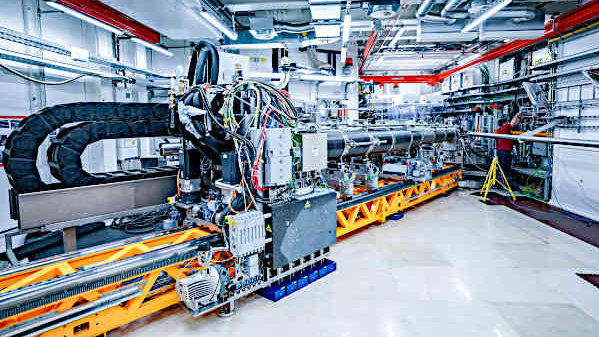
For its measurements, the international team used the Materials Imaging and Dynamics (MID) instrument at European XFEL. The platinum-copper lattice was excited with ultrashort laser pulses on the order of 10^-15 seconds and probed using equally short, high-energy X-ray pulses. These X-ray pulses can directly resolve structural changes within the material. As a result, the experiment provides both material-specific and depth-sensitive information, making it possible to visualize how the different metal layers shift following laser excitation.
“The MID instrument was built precisely for questions like these: How do atoms and electrons move in complex materials when light drives them out of equilibrium?” says Jan-Etienne Pudell. “In this case, we were not only able to observe the emergence of a terahertz oscillation, but also determine the physical mechanism driving it.”
New Insights at the Interface
The results are particularly relevant for CRC 1636 because the pressure exerted by hot electrons in platinum arises from their reflection at the surface and at the interfaces between the two metals. This pressure is a measure of the electrons bombarding the surface of the platinum layer, through which energy can be transferred to molecules bound to the surface.
“This creates a new experimental and conceptual link between plasmonic chemistry, the dynamics of energetic electrons, heat flow, and ultrafast structural change,” Bargheer explains.