
Saxonia-Franke specializes in the mechanical production of stamped and formed parts. The family-owned company based in Göppingen also demonstrates deep expertise in forming and injection molding technology, serving international customers particularly in the automotive, construction, and electrical industries. From the initial inquiry through series production, the specialists focus closely on both component quality and manufacturing processes.
High-strength steel causes severe tool wear
For the production of sheet metal components, high-strength stainless steel was formed and punched in a single operation using a punch and die. In this process, the tools are subjected to extreme stress from abrasion and adhesion because they must work against the material’s tensile strength of 1,000 MPa.
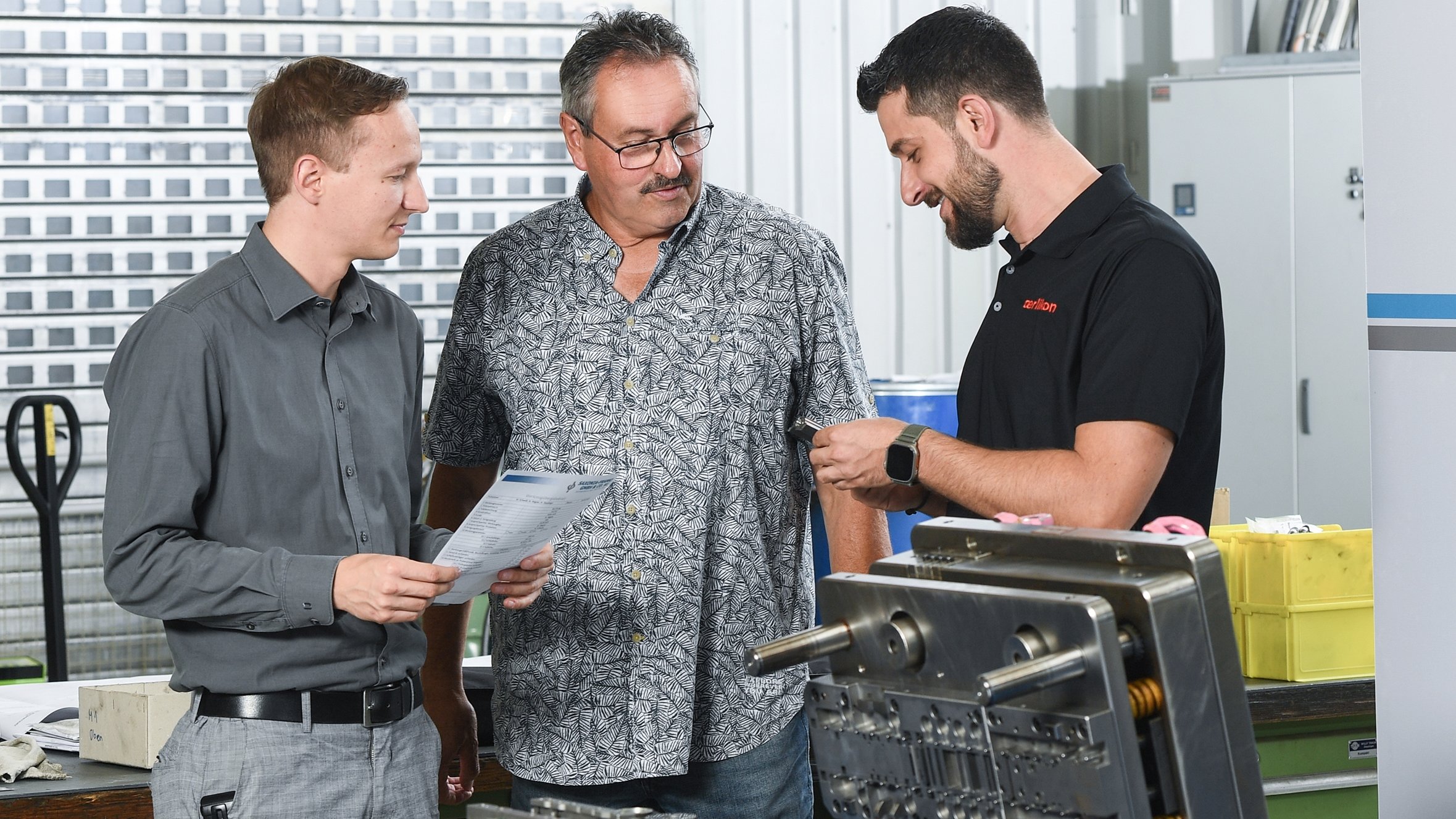
“Uncoated tools become unusable very quickly in this application,” explains Lucas Höer of Saxonia-Franke. The executive assistant was involved in the search for solutions under the leadership of tooling manager Andreas Ziller—now retired. After initial implementation attempts, Ziller also discussed the issue with Alexander Sulz of Oerlikon Balzers.
This led to the development of a tool made of high-speed steel with an AlCrN coating. The result of the application test: just over 140,000 parts produced. Economically this was acceptable, but still insufficient given the customer’s required production volumes and the high utilization of the machines. “There had to be a better way,” Höer recalls. The goal was clear: minimize downtime and scrap caused by maintenance and the run-in process for the tools.
Carbon coating suited to stainless steel
These requirements led Sulz to propose a coating with special properties: Balinit Mayura. The carbon-based coating offers a hardness of more than 65 GPa—higher than the AlCrN coating—making it particularly suitable for abrasive machining of stainless steel. In addition, this material tends to gall during processing. The coating counters this tendency with anti-adhesive properties resulting from its smooth surface. At the same time, the sharpness of the cutting edges is preserved for a long period thanks to the thin coating layer, in this case 0.8 µm.
The proposal proved to be exactly right. The newly designed tool, now made of carbide, was surface-treated by Oerlikon Balzers using a special process and coated with Mayura. The result: 600,000 parts produced—more than four times the tool life achieved with the previous coating. To ensure greater production reliability, Saxonia-Franke replaces the tools after 400,000 strokes. This performance increase also significantly reduced maintenance and setup times as well as machine downtime. For the two punches installed in one tool module, only one-third as many spare parts are now required.
Höer estimates the total savings compared with the previous coating—calculated across all applications and operating periods—at around €13,000 per year. This underscores how consulting expertise and application know-how contributed to increasing tool life and, ultimately, improving economic efficiency.