

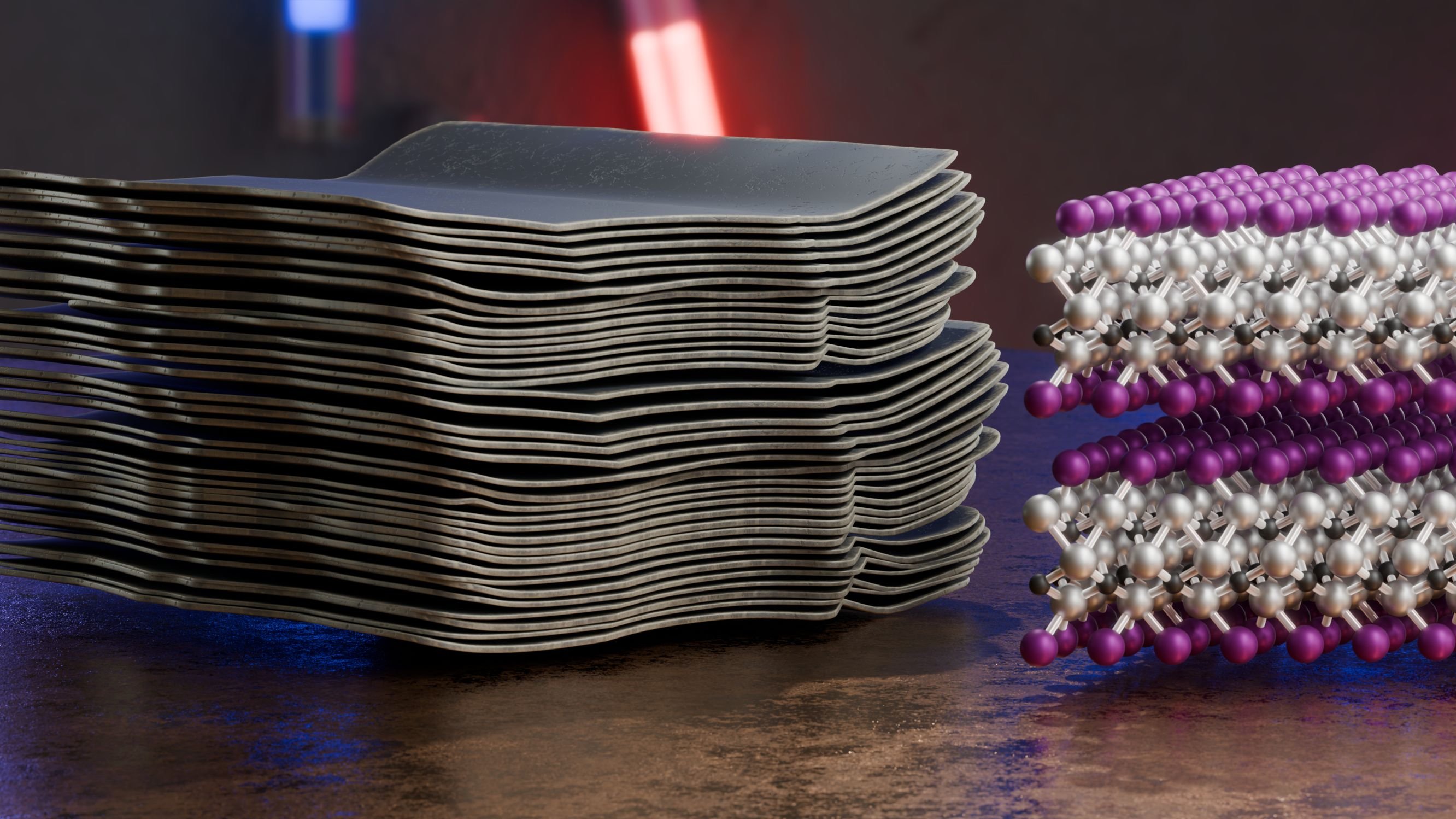
MXenes are a rapidly growing class of inorganic two-dimensional materials, according to the HZDR. Each structural unit consists of layers of transition metals combined with carbon or nitrogen and is terminated by atoms bound to the outermost surfaces. These surface terminations play a crucial role in determining the material properties. "They strongly influence how electrons move through the material, how stable it is, and how it interacts with light, heat, and chemical environments," says Dr. Mahdi Ghorbani-Asl from the Institute of Ion Beam Physics and Materials Research at HZDR.
Manufacturing process without etching chemicals
Until now, most MXenes have been produced using etching processes that result in random surface finishes with oxygen, fluorine, or chlorine. "This atomic disorder limits performance because it traps and scatters electrons, much like potholes slow down traffic on a highway," explains Dr. Dongqi Li from TU Dresden.
The new GLS (gas-liquid-solid) process avoids aggressive chemicals by using solid starting materials, known as max phases, with molten salts and iodine vapor to produce MXene films. Crucially, the molten salts and iodine work together to control which halogen atoms, such as chlorine, bromine, or iodine, attach themselves to the surface. The result is MXene with highly uniform and well-ordered surface finishes and a greatly reduced content of impurities. Using this approach, the team succeeded in synthesizing MXene from eight different max phases.
High conductivity due to precisely ordered surfaces
To illustrate the potential of the new method, the team focused on the titanium carbide MXene Ti₃C₂. When produced using conventional chemical methods, Ti₃C₂ typically contains a mixture of chlorine and oxygen end groups, which impair its electrical properties. In contrast, Ti₃C₂Cl₂ produced using the GLS method contains only chlorine, which is incorporated into a highly ordered structure with no detectable impurities.
"The results were impressive. The MXene variant, in which only chlorine atoms cover the surface, showed a 160-fold increase in macroscopic conductivity and a 13-fold improvement in terahertz conductivity compared to the same material produced using conventional methods. In addition, an almost fourfold increase in charge carrier mobility was observed, an important measure of how freely electrons can move through a material," Li summarizes.
The method also provides a platform for developing MXenes with customized surface properties. By mixing different halide salts, the researchers produced MXenes with double or even triple halide end groups and controlled ratios.