Praxisforum Industriebeschichtung 2026: AI, PFAS, and Robotics Are Shaping the Powder Coating Industry
Anzeige Top-Story | Created by CB
About 220 participants, a sold-out venue, a two-day program featuring presentations, an idea lab (Ideenschmiede), an innovation hub, and a coaters’ get-together: The 14th Praxisforum Industriebeschichtung (Industrial Coating Practice Forum) of the QIB, held on November 19 and 20 in Wetzlar, showcased a powder coating industry that is under cost pressure but is tackling its challenges in very concrete ways. Artificial intelligence has moved from theory to practice; PFAS restrictions remain the big unknown; and when it comes to robotics, coating systems, and pretreatment, the focus was on what can be implemented today.
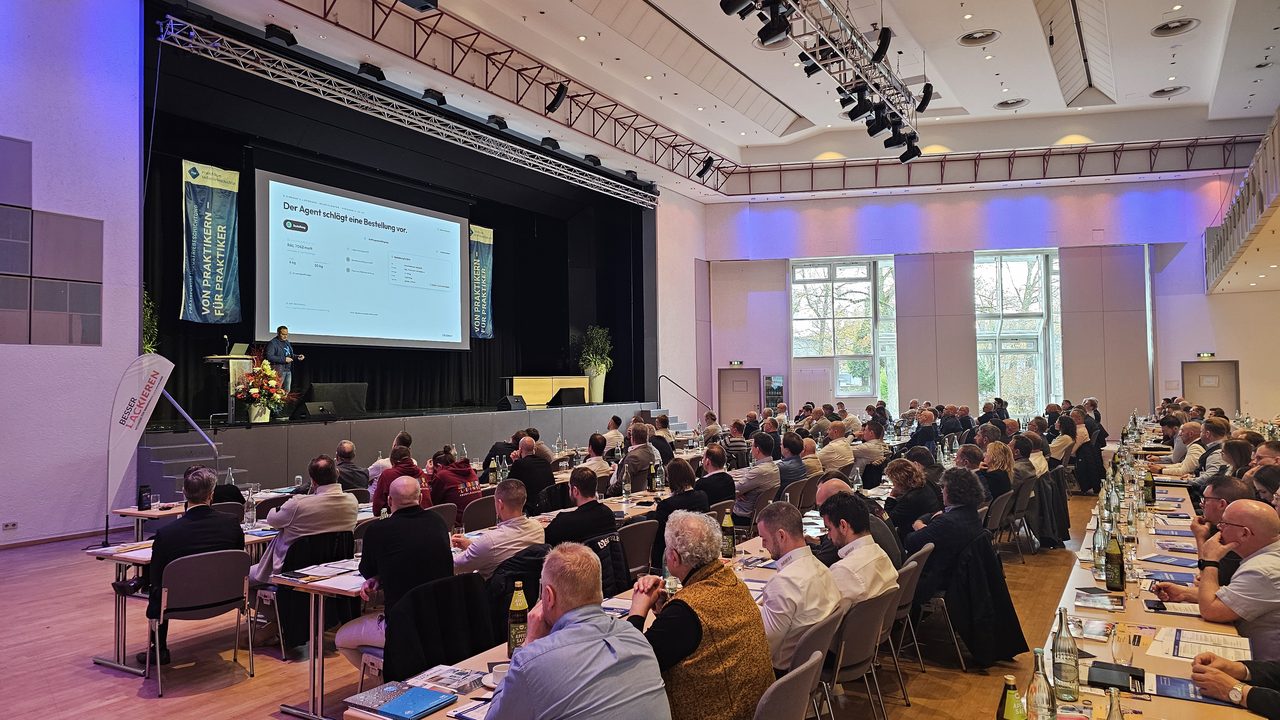
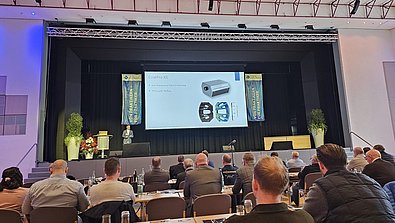
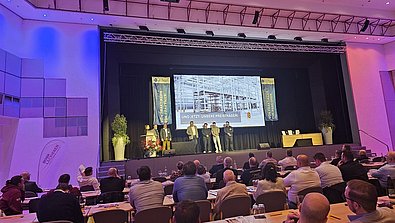
Rainer Gruber (Moonshot25) demonstrated to a packed audience what AI agents are already capable of in the offices of coating companies today. Image: CB
In his presentation, Michael Bartsch (Protech) described the mood in the industrial coatings sector as “mediocre at best”: raw material, transportation, and energy costs are weighing on the industry; competition for standard contracts is driven by price; and there is a shortage of skilled workers. This made it all the more striking that the Praxisforum was once again sold out. QIB Chairman Markus Kopp opened the event with a review of the past year; the association’s promotional video premiered; and the direction for 2027 has been set: a training program, a QIB app featuring fact sheets, videos, and monitoring test results in near real time, along with the generational transition now underway with QIB Next Generation.
AI: From Buzzword to Tool
The topic of AI ran through both days. Rainer Gruber (Moonshot25) set the stage with the “autopilot for the office”: In nearly every coating facility, employees are juggling email, ERP systems, cost calculations, and legacy software, manually transferring inquiries, orders, and delivery notes from one system to another. Specialized AI agents can bridge precisely this gap between systems without replacing existing programs—and, when implemented properly, without causing any data protection issues. This allows inquiries, including sketches or PDFs, to be automatically read and interpreted, and missing information to be requested. The concept presented by Gruber can also generate a 3D model for loading the racks and calculate multiple cost estimation scenarios. What used to take three hours to prepare a quote now takes 20 minutes, though final approval remains with a human. Since statistically only one in five quotes is accepted, this represents a valuable saving.
In the idea lab, Marco Schwarz and Max Weber (Informatikwerk)—non-experts in powder coating—approached the topic from an external perspective using AI and tested, among other things, how the AI handles the cross-cut test. Their finding: Without context, the AI provides only generalities; with details on the substrate, pretreatment, powder, oven profile, and test results, it identifies plausible causes and asks the right follow-up questions. Equally important was the second conclusion: which data can be safely included and which must remain off-limits. Defect patterns, test results, substrate, powder type, oven curves, and conductivity values are permissible; customer drawings and anything considered confidential between the customer and the contractor are not. The discussion also addressed the various AI subscription models and the issue of how providers reserve the right to further process the data. The division of labor remains clear: AI may perform preliminary work, summarize findings, and suggest the next inspection, but responsibility always lies with the human. An application at Kopp Oberflächentechnik demonstrated that AI has long since found its way into quality assurance: Trained neural networks are now successfully performing visual inspections of 5,000 parts per day.
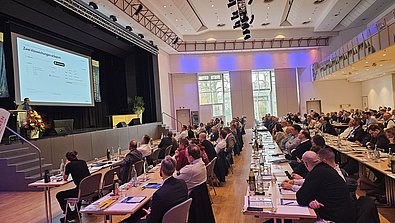
The AI agent detects discrepancies in order confirmations and suggests orders. Image: CB
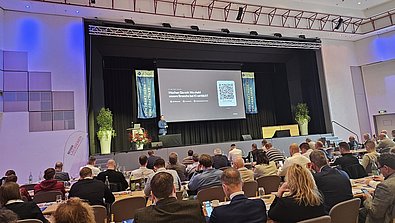
Live poll in the audience: Where does the industry really stand on AI? Image: CB
Automation: The Case for Robots Is Decided at the Hanger
Eike Krebs (3D.aero) demonstrated the current state of robotics using a customer project: Gas compressors are scanned using a stereo camera; the paint path is generated from the point cloud; and no human ever touched the robot program. The cell runs in automatic mode; instead of four coaters, only one remains on the line for touch-ups. For contract coaters handling one-off parts, the practical dialogue revealed an interesting conflict: The robot requires more space around the part to be coated than a manual coater, yet the shift supervisor wants the hanging rack as full as possible. So, if you can only hang half as many parts for the robot, you might end up losing more than you save on labor costs. Even the expert speakers doubted that AI would be able to close this gap very soon.
The Innovation Hub provided the counterpart to the robot: the measurement technology that makes it possible to control processes in the first place. Dr. Philipp Fuchs (AIM Systems) used the example of cathodic e-coat to demonstrate why measurement saves money. Contactless photothermal measurement is accurate to within half a percent, even on wet paint and plastic. Laser curing can boost productivity by essentially heating only the paint layer rather than the entire component; in one project, the curing oven was reduced from 80 to 20 meters. However, not every color works equally well with this method. Black cures in seconds, while white and red require additives. A presentation provided insights into modern powder storage systems: A traditional storage lift offers quick access to 950 cartons in a 9.5-square-meter space but requires a height of 15 meters; a flat-storage system with mobile robots accommodates 740 cartons in 46 square meters with a ceiling height of three meters and costs 10 to 15 percent more. Both reduce search times, picking errors, and the need for employees to balance 20-kilogram cartons on ladders.
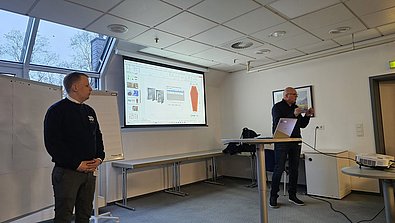
Martin Berghoff (CMA Roboter) and Eike Krebs (3D.aero) in a practical discussion on robot integration. Image: CB
Innovation Hub: Dr. Philipp Fuchs (AIM Systems) on photothermal film thickness measurement. Image: CB
PFAS-Free Products: No Equivalence in Sight
Michael Wehnhardt (Akzo Nobel) first dispelled the rumor that coatings manufacturers might have failed to influence the restriction process vis-à-vis the ECHA: “No coatings manufacturer can file an objection to an ECHA restriction; the procedure simply does not provide for it,” he stated. The current dossier remains a proposal, and extensions for critical applications have not yet been decided. Technically, solutions certainly exist, and PTFE-free textured powders are feasible and have been proven. However, according to Wehnhardt, what is clearly missing is equivalence. The disadvantages range from color shades and cleanability to a lack of long-term weathering data. Michael Bartsch added the downside: Fluoropolymer powder—the best option available for outdoor use—could be phased out in Europe, even though it protects components longer than any substitute.
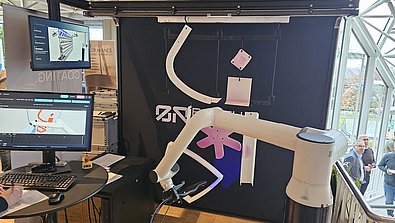
Robot demonstration at the exhibition. Image: CB
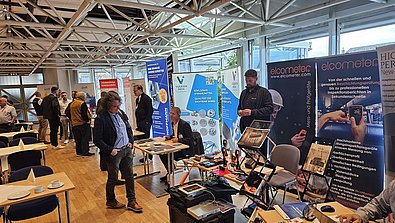
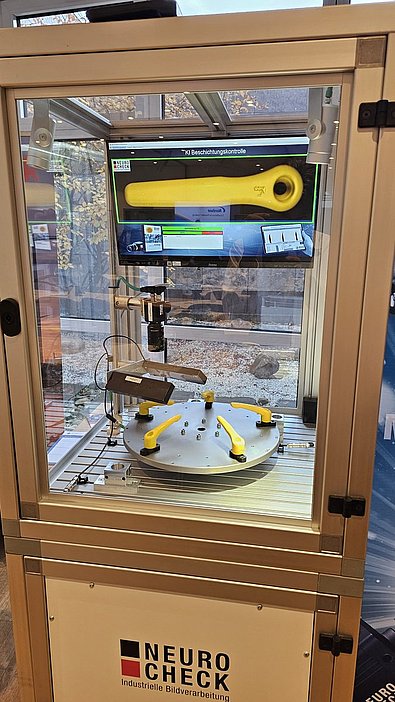
The accompanying exhibition featured, among other things, measurement and testing technology. Image: CB
Coating Systems and Pretreatment: Added Value Instead of a Price War
Sascha Lemmerz (Eurolacke) asked 40 coaters what makes a powder super-durable, and nearly half believed that a UV absorber in standard polyester was sufficient. It isn’t, and the result is visible on every street: In Dortmund, according to Lemmerz, every other fence is chalking. The premium for Class 2 is just under one euro per kilogram; in his area, super-durable powders already account for 30 percent of sales. Dr. Paul Förster (Dr. Herrmann Gutachterlabor) ultimately investigated whether cold galvanizing plus powder coating could replace hot-dip galvanizing. Ethyl silicate primers delaminated, zinc-dust-filled epoxy liquid coatings held up, and zinc flakes caused outgassing. The result: better than any pure powder primer, but not controllable without a degassing pre-bake and not a match for hot-dip galvanizing. No company has dared to try it yet because procurement specifications do not recognize the system.
In pretreatment, the trend was clear: away from phosphating and toward zirconium and nanoceramic systems that treat steel, hot-dip galvanized and electrogalvanized steel, and aluminum on a single line. For contract coaters with a varying mix of parts, this is the real benefit: a single process for all substrates, with approvals up to Corrosivity Category C4 High, no sludge, and service life of several months. With aluminum, the development goes one step further: pickling and passivation take place in the same bath, so that a single line with five zones is sufficient, less water is consumed, and the sensitive passivation zone is protected against introduced salts and biofilm.
Bullshit Bingo: Routine Is the Biggest Mistake
Markus Völlers and Ernst-Hermann Timmerman (DFO) presented 20 industry adages, each backed by a real-world failure case. For example, a coater spent 20 years performing the cross-cut test with a fixed spacing and cutting deep into the substrate—until he lost a major customer as a result. Or a solid aluminum profile came out of the oven at 180 degrees for 45 minutes with uncured powder because the oven temperature is not the same as the object’s temperature—the part actually would have needed two hours. The salt spray test, which customers regularly request for aluminum, is meaningless. And anyone who burns off the hangers once a year still hasn’t ensured proper grounding as long as the trolleys and conveyor systems have been coated along with the parts for years. The common denominator: Most quality and cost problems do not stem from the technology, but from habits that no one questions anymore.
Resources and the Next Generation
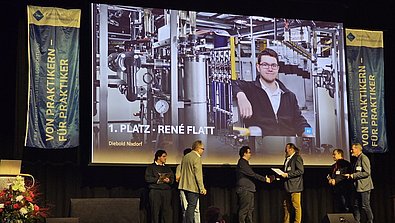
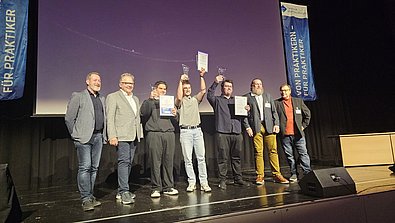
Robert Weil (SPI Weil) illustrated the current cost of energy using his contract coating business as an example: The price of electricity rose by 48 percent at the turn of the year, prompting an investment of 300,000 euros in photovoltaics, storage, and a new combined heat and power plant. An AI system that controls the storage unit every quarter-hour based on spot market prices reduced grid consumption by 42 percent and the electricity bill by 43 percent. At the coaters’ get-together (Beschichtertreff), the “Jeder braucht Pulver” (Everyone Needs Powder) trainee award went to René Flatt (Diebold Nixdorf), ahead of Fynn Ebermann (CoatingPoint) and Kristof Pozsar (Kaeser Kompressoren).
1st place: René Flatt (Diebold Nixdorf) at the award ceremony. Image: CB
The 2026 award winners: René Flatt, Fynn Ebermann (CoatingPoint), and Kristof Pozsar (Kaeser Kompressoren) with the jury. Image: CB
The Praxisforum showcased an industry that doesn’t sugarcoat its problems but seeks practical solutions. 2027 will be a milestone year: 25 years of QIB and the 15th Praxisforum, taking place for the first time in Wernigerode on November 4 and 5. You can read a detailed follow-up report with information on the presentations in mo 1/2027 and on oberflaeche.de.
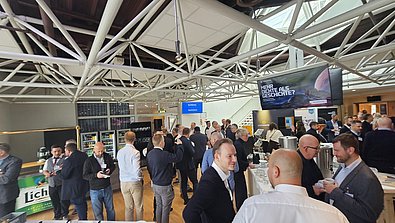
Coffee break in the foyer: About 220 participants took advantage of the breaks to network. Image: CB
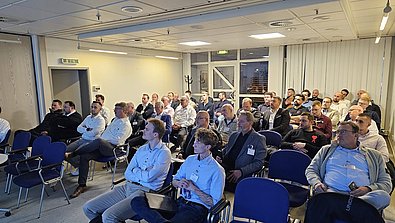
A full house at the workshop on robot integration. Image: CB
Evening event in the Stadthallen Wetzlar: Presentation of the “Jeder braucht Pulver” award. Image: CB