


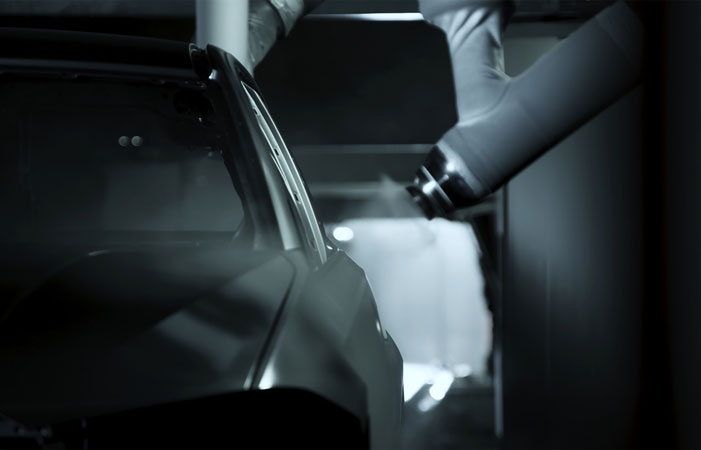
Every freshly painted car body passes through an automatic surface inspection in the paint shop. The data from this inspection serves as the basis for building a comprehensive database for dust particle analysis. To match live data from dust particle sensors in the paint booths and dryers with this database, the specialists now use AI algorithms. Despite state-of-the-art filter technology, the proportion of ultra-fine dust grains (particles) in paint lines fluctuates, depending on the ambient air drawn in. If the dust level is above the limit, the still-moist paint could trap particles and thus visually impair the painted surface.
Artificial intelligence (AI) specialists from the planning department and the Munich plant have now found a way to avoid this situation. "Data-based solutions help us to safeguard and further expand the high quality requirements in the interests of our customers. Smart data analytics and AI provide our employees with important decision-making aids for process improvements. We have filed several patent applications for the innovative dust particle analysis technology," says Albin Dirndorfer, Head of Painted Body, Finish and Surface at the BMW Group.
Two specific examples underscore the benefits of this new AI application: if dust levels rise due to the time of year or in the event of prolonged dry weather, the algorithm detects this trend in good time and calculates an earlier time for filter replacement, for example. In combination with other analysis tools, additional patterns can be identified. Another analysis result could be that the system that uses ostrich springs to remove dust particles from the car bodies needs to be fine-tuned.
BMW Group AI specialists see great potential in dust particle analysis. Fed by information from numerous sensors and data from surface inspection, the algorithm monitors over 160 features of the car body and can predict the quality of the paint application with great accuracy. A prerequisite for later series use of this AI application is an even broader database for the algorithm, for which additional measuring points and even more precise sensor data are needed in particular when cleaning the car bodies. The AI experts are confident that they will be able to use the dust particle analysis in other vehicle plants once the pilot phase in the main Munich plant has been completed.