

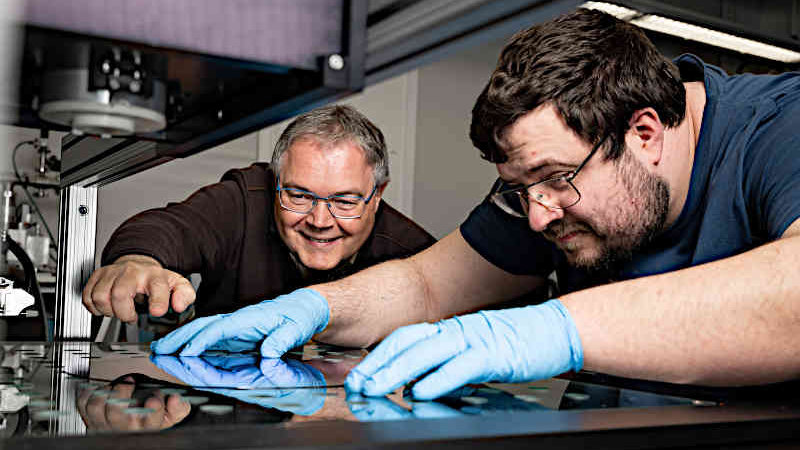
The homogeneity of polycrystalline diamond coatings is a key quality factor affecting their functionality and service life. However, conventional measurement methods reach their limits, particularly with large-format substrates such as silicon wafers with diameters of up to 300 mm.
The Fraunhofer Institute for Surface Engineering and Thin Films IST therefore combines two measurement techniques. Spectral photometry is used to analyze how strongly a surface reflects or transmits light at different wavelengths. This is complemented by angle-resolved ellipsometry, which measures how the state of polarized light changes after reflection at different angles of incidence, enabling the determination of the refractive index, extinction coefficient, and coating thickness. Because the two techniques are based on different measurement principles, they exhibit different sensitivities to the coating parameters.
At Fraunhofer IST, the measurement data from both methods are analyzed simultaneously. “By evaluating all measurement data together, we achieve greater accuracy than with conventional standalone measurements,” explains Dr. Volker Sittinger, Head of the Diamond-Based Systems Department at Fraunhofer IST. Once the dispersion and optical properties have been determined, it is no longer necessary to recalculate all parameters at every measurement point. Instead, a simple and fast reflectance measurement at multiple locations across the surface is sufficient to determine, for example, the coating thickness.