

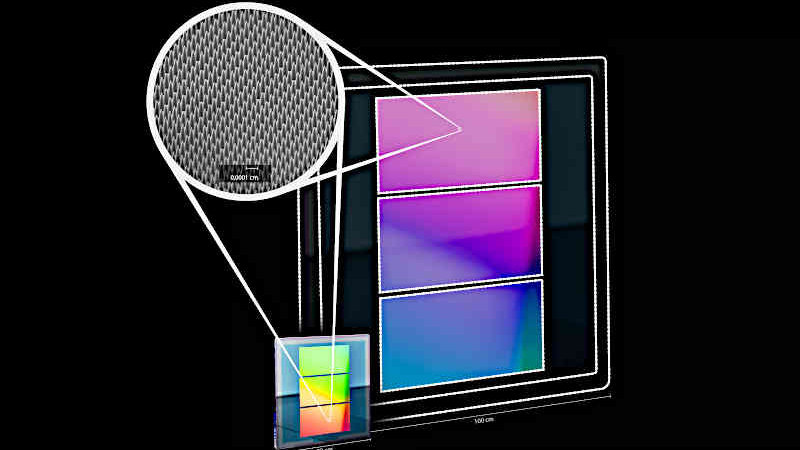
The researchers aim to develop a new 3D nanolithography and nanometrology system that will enable the machining and measurement of photonic components measuring up to 1 × 1 × 0.2 m. This represents an increase of roughly a factor of three over what current methods can achieve. The development effort has now been launched as part of a project funded by the German Research Foundation (DFG) by researchers from the Fraunhofer Institute for Applied Optics and Precision Engineering IOF in Jena, the Institute of Applied Physics (IAP) at Friedrich Schiller University Jena, and the Technical University of Ilmenau.
Nanostructuring on a New Scale
"The availability of machines capable of structuring large-area components is not unusual in itself," says Prof. Uwe Zeitner, project leader at Fraunhofer IOF. "However, scientific applications require highly precise nanostructuring. Many emerging research fields depend on larger optical components—for example, nanostructured high-performance mirrors with a diameter of 1 m that also deliver the highest possible precision in light reflection."
According to Zeitner, this level of precision—alongside the increase in size—is the defining feature of the planned machine. "We aim to produce nanostructures with positioning accuracy of up to 20 pm across the entire surface," he explains. The goal is to develop and build a machine unlike any other in the world, enabling researchers to manufacture new high-performance optical components at the limits of current technological capabilities. "This is why we have defined these exceptional accuracy requirements for the new machine. In addition to the positioning accuracy already mentioned, we are targeting a maximum structuring deviation of less than 10 nm across a three-dimensional surface area of 1 m²."
Nanolithography from Jena, Positioning and Metrology from Ilmenau
Achieving these dimensions requires fundamentally new approaches. Fraunhofer IOF and the Institute of Applied Physics in Jena are contributing their expertise in 3D nanolithography, while the Technical University of Ilmenau is providing its expertise in nanopositioning and nanometrology.
The new machine offers significant potential for manufacturing large-area photonic components for energy and fusion research, as well as for gravitational-wave research. Fraunhofer IOF is already active in both fields. For example, the institute has developed and manufactured highly sensitive sensors for the planned Einstein Telescope, which is intended to become the world's most sensitive gravitational-wave detector. In the field of laser fusion, the institute is also conducting research on highly reflective, durable coatings.
During the initial three-year project phase, the researchers will first develop an overall system concept. Based on this concept, individual subsystems will be designed and built, and compliance with the specified performance parameters will be demonstrated. The fully operational machine is expected to be available at Fraunhofer IOF by 2032.