

Polymers that generate a permanent electric field are particularly interesting as coatings. They incorporate an electrical function into the component without the need to apply a continuous voltage. Until now, researchers had to additionally polarize the layers to achieve this. In addition, many of the polarized polymer films used to date contain PFAS.
Researchers at Christian-Albrechts-University of Kiel (CAU) have now found a way to eliminate this additional polarization step. Dr. Stefan Schröder, who leads a subgroup in Prof. Franz Faupel’s department, and his team have used initiated chemical vapor deposition (iCVD) to polarize certain polymers during their very production. This effect was previously unknown.
Surface potential without an external electric field
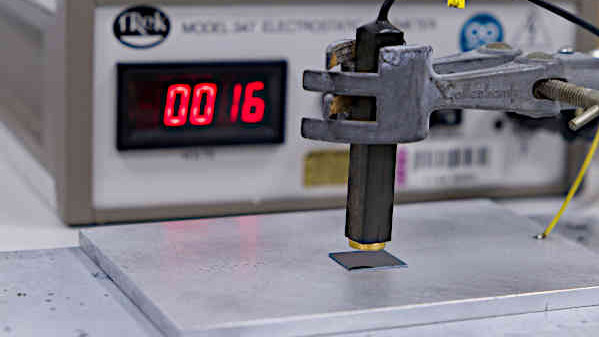
The discovery was made in the course of work on electret thin films. Electrets are materials that permanently generate an electric field. The team worked with various molecules suitable as starting materials for polymer coatings. When Schröder and his colleagues produced polymer films from these molecules and examined their surface potential, they made an unexpected observation: The films generated a surface potential of up to 24 V, even though no one had previously applied an external electric field. Apparently, the polymer films had polarized themselves during their fabrication.
A key factor here is the structure of the molecules: Their electrical charge is often unevenly distributed, causing them to adopt a specific electrical orientation. Equally important is the manufacturing process: Using iCVD, researchers combine these gaseous molecules into a thin layer of macromolecules or polymers. In this particularly gentle process, polarization occurs spontaneously. In contrast, when the same starting materials were processed into polymers by other methods, the team observed no electrical potential.
Layers reach up to 100 V
The researchers can control the strength of the surface potential. They are now able to produce layers with up to 100 V. The layers are only 10 nm to 1 ㎛ thick and thus invisible to the naked eye. The surface potential increases with the thickness of the polymer layer. Schröder and his colleagues were also able to alter the direction of polarization by selecting different starting materials.
Another advantage of the method is that polymerization stabilizes the state: Once aligned, the molecules cannot simply move freely again and are held in place. As a result, the electric potential is maintained under ambient conditions. At higher temperatures, such as 90 °C, the coating loses its polarization again.
The new method opens up many possibilities for future applications. The self-polarizing polymer films could, for example, be used in electronics, sensor technology, energy technology, or at biological interfaces. One advantage of the process is that it can uniformly coat even complex surfaces.