

The Fraunhofer Institute for Thin Film and Surface Technology IST has expanded its research infrastructure and established a platform for localized electrochemical surface processing. The combination of electroplating processes, Electrochemical Jet Processing (EJP), and intelligent robotics is intended to enable precise and resource-efficient processing of complex workpieces. The institute cites electronics, energy technology, medical technology, and aerospace as fields of application.
Electroplating is relevant to numerous future technologies because it imparts specific functional properties to components and improves their durability and performance. By extending their service life, these technologies can also help conserve resources and reduce CO₂ emissions. Against this backdrop, Fraunhofer IST is further developing electrochemical manufacturing technologies and combining established electroplating processes with selective approaches to surface treatment.
EJP Platform for Selective Processing
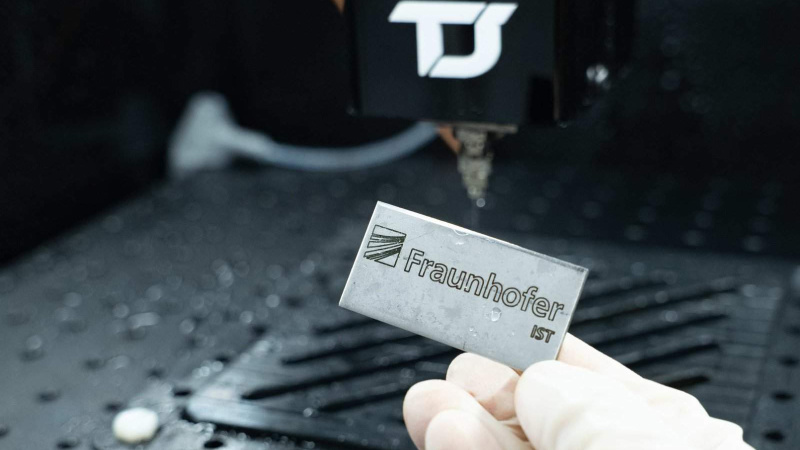
At the heart of this expansion is a new EJP platform that brings together various selective electrochemical processes for the localized machining and functionalization of surfaces. These include Electrochemical Jet Machining (EJM) for non-contact, micrometer-precise material machining, as well as Electrochemical Jet Deposition (EJD) for the localized deposition of functional layers. This allows surfaces to be structured, smoothed, repaired, or coated.
Unlike traditional electroplating processes, in which entire components are treated in process baths, the platform operates using a movable electrochemical jet. This jet acts only at the locations where material is to be processed or layers are to be deposited. As a result, even complex or large-scale components can be processed flexibly in the future. Restrictions imposed by the dimensions of process baths, as well as masking and demasking steps, are eliminated. At the same time, the use of chemicals, energy, and raw materials—as well as the generation of waste—is minimized.
Robotics and Future Development
The platform is complemented by a robotics and automation infrastructure. In addition to high-precision industrial robots, autonomous mobile robots are used to support material and tool logistics and navigate their environment independently. This results in reproducible processes that adapt to different component geometries and can be integrated into automated production lines.
“With our new system design, we combine selective electrochemical processes and robotics into a comprehensive system. Unlike with conventional systems, the process adapts to the component and its requirements—not the other way around,” explains Rowena Duckstein, a research associate at Fraunhofer IST.
As examples of applications, the institute cites the material-friendly fabrication of microstructures with high deposition rates, as well as more targeted filling and thus improved coating of micro-holes. Localized deposition eliminates the need for stencils and masking.
In the future, the EJP platform is to be more closely integrated with robotics, sensor technology, and data-driven control methods. The goal is an adaptive manufacturing system that continuously optimizes processes and reduces resource consumption and scrap.