


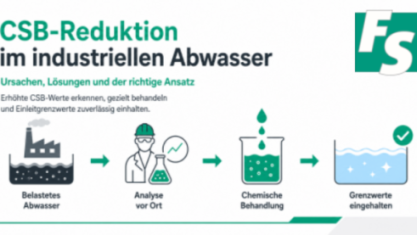
Chemical oxygen demand (COD) is an important parameter for assessing industrial wastewater. It indicates the amount of oxygen required to chemically oxidize organic compounds in water. High COD levels indicate substantial organic contamination and can lead to noncompliance with discharge requirements, higher wastewater charges, or municipal wastewater treatment plants reaching their capacity limits.
For manufacturing companies that treat process water or discharge wastewater into sewer systems or receiving waters, a reliable approach to COD reduction is an operational necessity.
Causes and Treatment Methods
Elevated COD levels occur when organic compounds enter wastewater. Industries affected include food and beverage production, metal surface treatment, chemicals, paper manufacturing, and textiles. Typical sources include cleaning and rinsing water, production wastewater, cooling circuits, and process leaks.
Various mechanisms are available for treating wastewater with elevated COD levels. Flocculants and coagulation aids cause dissolved and colloidal organic substances to aggregate into flocs and settle. Precipitating agents convert certain compounds into insoluble forms that can subsequently be separated mechanically. Different approaches are used depending on the wastewater matrix, pH range, and organic load. A combination of several treatment steps is often necessary to reliably meet the required discharge limits.
Adapting Treatment to Existing Systems
Effective COD reduction depends not only on the product used but also on correct dosing, the optimal point of application within the process, and compatibility with the existing treatment system. The company offers products for treating industrial wastewater with elevated COD levels. Its portfolio covers applications ranging from single-dose treatment in batch processes to continuous treatment concepts for ongoing operations.
As a first step, chemical engineers visit the facilities, analyze the processes and wastewater conditions, and develop recommendations tailored to the specific treatment system. The aim is to ensure that the selected product achieves the desired effect not only in the laboratory but also under actual operating conditions.