

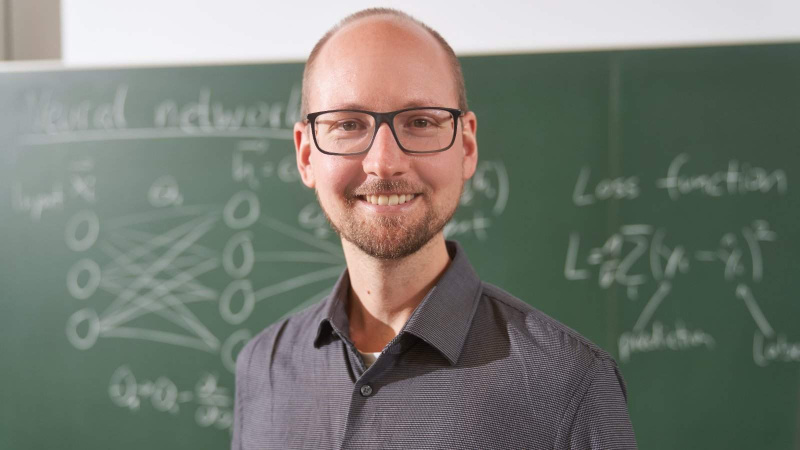
The ODDITY (On-Demand Discovery by Molecular Ingenuity) project takes a systematic approach to identifying, from among more than a trillion possible molecular structures, those that specifically meet certain requirements. Professor Pascal Friederich of the Karlsruhe Institute of Technology (KIT) secured the ERC Synergy Grant together with partners at the Jülich Research Center and the University of Oxford.
Technological progress depends largely on the materials available. The development of photovoltaics, light sensors, and electronic components requires materials that meet several requirements simultaneously: Among other things, they must possess certain optical and electrical properties and be stable and easy to process. One example is the ultra-thin layers in solar cells that absorb light and transport charges.
Modular System for Molecules
“Using AI, we’re combining accelerated chemical synthesis with reversible reactions,” says Friederich from the Institute of Nanotechnology at KIT. Much like in a modular system, molecules are to be assembled from individual building blocks within a few seconds or minutes, and then disassembled and recombined. Their properties are also to be investigated at this pace. “We want to use high experimental throughput to shorten the search for suitable materials from years to weeks,” says Friederich.
AI Controls Experiments
Friederich and his research group are developing AI models designed to identify suitable molecular structures based on desired properties—structures that can actually be synthesized. The plan is to integrate data from computer simulations, laboratory measurements, and component testing. Generative AI is also intended to suggest new chemical building blocks, thereby expanding the range of possible materials.
The research group led by Professor Iain McCulloch at the University of Oxford is developing methods for assembling and modifying molecules, including reversible reactions. Professor Christoph Brabec’s team at Forschungszentrum Jülich is contributing autonomous laboratory platforms. These are used to produce and characterize thin films, as well as to test components using an ultra-high-throughput process.