
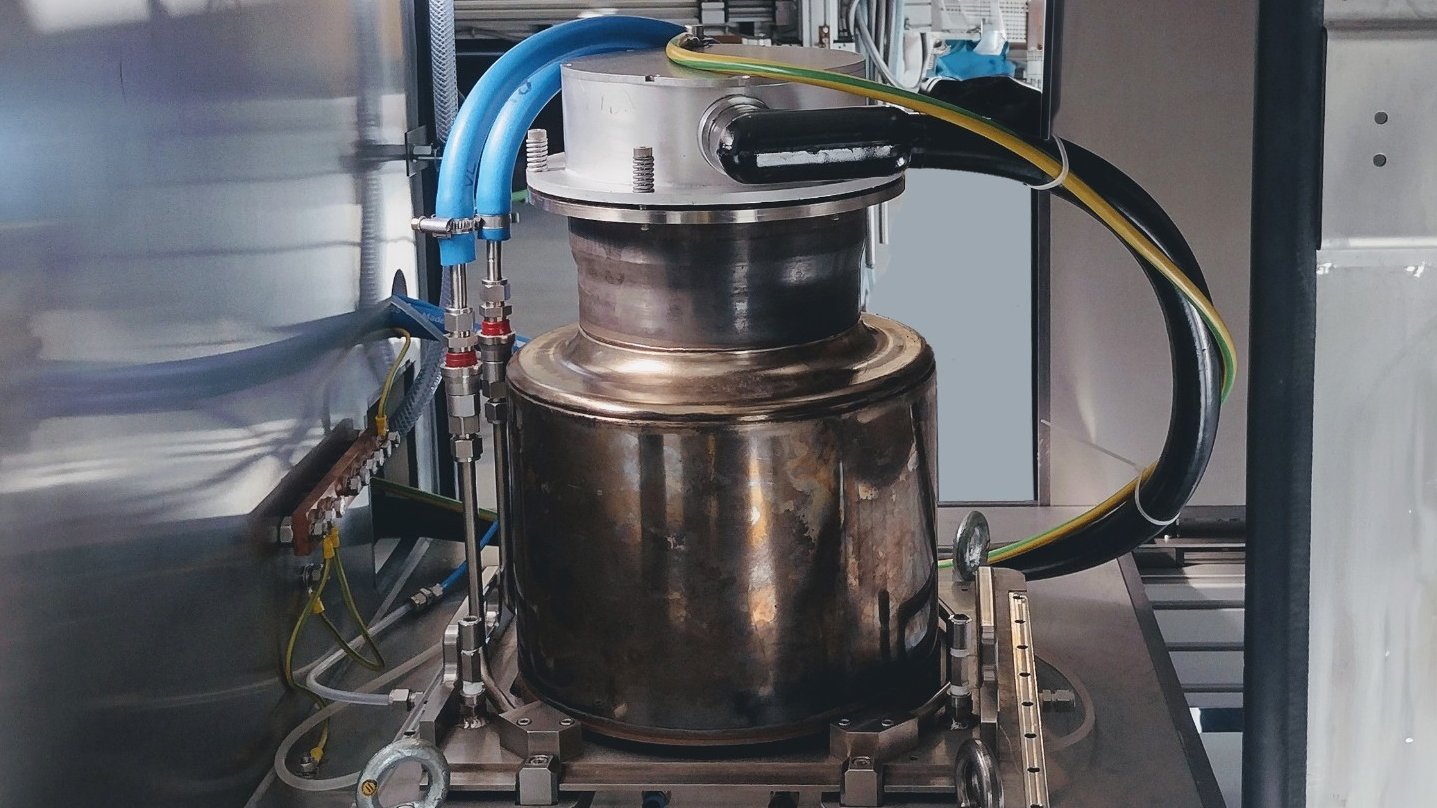
The hybrid system developed at the Fraunhofer Institute for Electron Beam and Plasma Technology (FEP) influences biological processes in real time using accelerated electrons. This combination builds on Fraunhofer FEP’s core expertise in electron beam technology and expands its application spectrum to include biotechnological processes.
The hybrid system enables energy-efficient treatment of different liquid volumes. Control of dose, dose rate, and penetration depth allows precise influence over bioprocesses. Installation and operation are space-saving and safe, making the system suitable even for sensitive application areas. Thanks to its modular design, the system is scalable and can be adapted for larger bioreactor types.
Electron beams accelerate bioleaching
One application example is bioleaching, the microbial extraction of metals from ores and residual materials. Microorganisms are used to dissolve metals such as copper, indium, or vanadium from poorly soluble metal sulfides or industrial residues. Bioleaching is considered particularly environmentally friendly, as it does not generate toxic or climate-damaging emissions and requires significantly less energy than conventional processes.
Fraunhofer FEP’s hybrid system sets new benchmarks in this field: initial studies showed that irradiating microorganisms with low-energy electrons increased the efficiency of copper bioleaching by 10%. The results indicate that low radiation doses do not impair bacterial growth rates—on the contrary, the yield of dissolved copper increased compared with untreated samples. This makes the recovery of valuable metals from low-grade ores or recycled materials more economical and sustainable. Project lead Prof. Dr. Simone Schopf explains: “What fascinates me most is that we use tiny organisms as miners and give them an extra boost with electron radiation. In this way, we recover metals from material that was previously considered waste.”
Application potential not yet fully explored
In addition to metal extraction, the hybrid system is also suitable for other bio- and environmental technology applications, such as wastewater treatment, the production of biopolymers, or the sterilization of sensitive products. Schopf sees considerable potential in the development: “The combination of electron beam and bioreactor opens up new ways to precisely control biotechnological processes and increase their efficiency.”
Fraunhofer FEP offers companies support in further developing and implementing the hybrid system. Services include feasibility studies for specific applications, the establishment of test regimes for treating microorganisms with accelerated electrons, validation of process efficiency using recognized methods, and investigation of electron effects on biological systems.
The new hybrid system and its potential applications will be presented at German Biotech Days 2026, taking place April 21–22 at the Kongresshalle am Zoo Leipzig, at the Fraunhofer FEP booth (G 09).