
The various final assembly technologies are being planned and combined as part of the NEXT.assembly concept. It includes components for conveyor, assembly, filling and testing technology as well as associated consulting services. The aim is to create an end-to-end final assembly process with coordinated system areas.
The new plant in Košice is intended as a production site for electric vehicles. With the investment, Volvo Cars is expanding its European manufacturing capacity and adding further capacity for the electrification of its model range.
Filling Technology Designed for Future Fluids
For the filling processes, Dürr is installing systems with special handling equipment and five parallel consoles. Comparable systems are already in use at Volvo’s plant in Torslanda, Sweden.
The technology in Košice is designed to accommodate new operating fluids in the future. These include coolants with low electrical conductivity as well as new refrigerants for air-conditioning systems. This allows the filling technology to be adapted to changing technical and regulatory requirements without redesigning the basic system structure.
Cooling circuits for batteries, power electronics and other vehicle components are becoming increasingly important in electric vehicles. Precise and reproducible filling is therefore a key part of final assembly.
Testing Technology Measures Chassis and Headlights
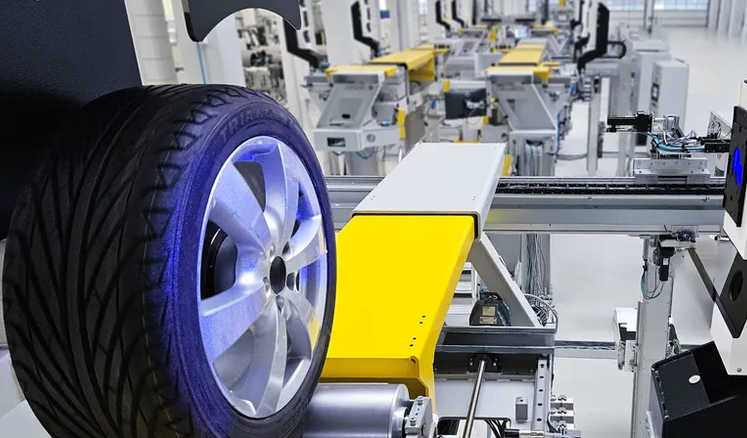
At the end of the assembly line, testing technology is used to measure and adjust the vehicles. The x-wheel test stand measures and adjusts the chassis. The non-contact x-3Dsurface sensor uses surface-based measurement and can be used with different tire and body shapes.
“Volvo Cars has extremely high requirements for measurement accuracy. We are very familiar with these requirements, as Dürr equips all Volvo sites worldwide with technology for vehicle geometry and headlight adjustment,” says Jörg Neumann, Director Product Line EOL at Dürr in Germany.
The thrust axis determined during chassis measurement then serves as the reference for aligning the headlights or the LED modules integrated into them. The x-light measuring and adjustment system is used for this task. The camera-based measurement technology checks low-beam, high-beam and fog lights and enables semi-automatic adjustment in accordance with ECE and SAE standards.
As the number of individually controllable LED modules increases, so do the requirements for light measurement and precise alignment of headlight systems. The testing technology is therefore a key component of quality assurance at the end of the line.
More Than Three Kilometers of Conveyor Technology
Dürr is supplying the complete conveyor technology for final assembly to connect the individual process steps. Vehicle bodies and doors are transported along more than three kilometers of conveyor line.
The systems used include electrified monorails, push platforms and plastic belt conveyors. They transport vehicles and components between the various assembly, filling and testing stations, forming the logistical basis of the automated production process.
“Our fully automated final assembly system represents a significant advance in automotive manufacturing and combines precision engineering with state-of-the-art automation to achieve excellent quality and efficiency,” says Andreas Hohmann, CEO of Dürr in Italy and Vice President NEXT.assembly.
With this project, Dürr is combining several final assembly technologies in a single system concept. The new plant in Košice will therefore feature integrated processes ranging from in-plant vehicle conveyance and filling to final geometry and lighting tests.