


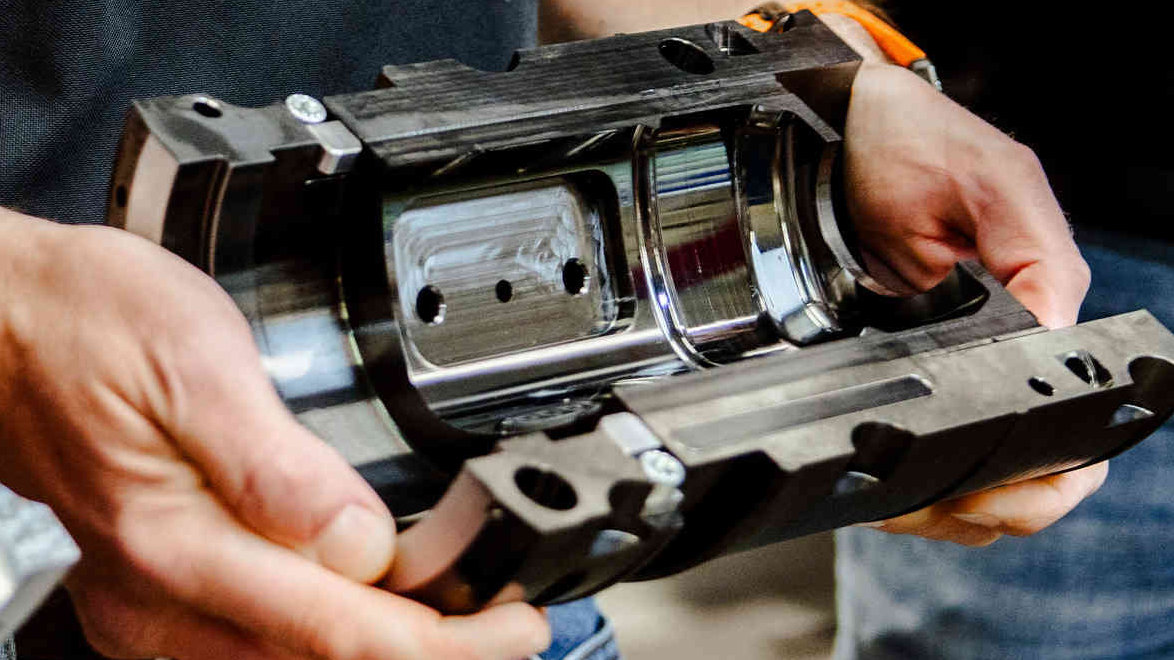
Fruit juices, iced teas, sports drinks, smoothies—these and other non-carbonated liquid foods are often filled at temperatures between 85 and around 100 °C. This hot-fill process preserves the beverages and neutralizes most microbial contaminants. The containers must withstand both this process and the vacuum that forms after sealing during cooling. PET (polyethylene terephthalate) offers excellent properties for this purpose and can be processed via stretch blow molding into geometries that are stable under both temperature and vacuum. This places corresponding demands on the blow molds in which preformed and heated PET preforms are shaped into their final form under high blow pressure and elevated temperatures.
Mechanical engineering supports blow mold production
This is where the mold-making experts at Röders GmbH apply their expertise. Headquartered in Soltau, Lower Saxony, the company has helped shape the development of PET blow mold technology from its beginnings in the 1970s to the present day. Founded around 1800 as a pewter foundry, today’s Röders GmbH has been family-owned for six generations and operates in its main business areas of milling and grinding machines, blow molds for PET bottles, and pewter goods manufacturing. With around 600 employees worldwide, Röders also has subsidiaries in China, France, Canada, Taiwan, the United States, and Vietnam.
In Soltau, the company operates a technology center for the development of blow mold technology and process optimization, for example through quick-change systems or by reducing blow pressure and energy consumption using low-pressure mold bases. Röders collaborates with blow molding machine manufacturers and bottlers; its bottle and blow molding lab is certified by PepsiCo and authorized by Coca-Cola Europacific Partners. Since the 1970s, several hundred thousand blow molds have been delivered to customers worldwide; current capacity stands at 7,000 per year, with typically very short lead times. The backbone of this is Röders’ largest business segment: the production of HSC (High Speed Cutting) machines, which enable the manufacture of blow molds with high-gloss surfaces (Ra < 10 nm) without manual polishing.
Only one machine stop per shift
Surface quality is fundamental for Röders—especially for steel blow molds used in stable hot-fill processes. Critical factors include very smooth mold areas and a design that ensures optimal cavity filling and demolding. Coatings such as Balinit Dylyn Pro from Oerlikon Balzers, which Röders recommends to its customers, provide added value. According to the surface specialist, the carbon-based DLC (diamond-like carbon) coating with the layer material a-C:H:Si was specifically developed for the food and medical industries. It is chemically inert, certified by the Food and Drug Administration (FDA), and therefore offers a globally recognized advantage over other coatings. It also provides protection against corrosion and wear.
The coating is applied using a PACVD process, in which a chemical reaction is initiated through plasma excitation and ionization. For coating quality and performance, it is essential that application takes place in a clean environment under vacuum and that the parts and components to be coated are properly treated. The coating is also used for cavities and forming applications in medical technology as well as in the packaging industry (particularly for the production of caps and PET bottles), and for all moving and sliding elements of injection molds.
Its non-stick properties, with a dry coefficient of friction versus steel of 0.05 to 0.2, significantly reduce friction and abrasion at the interface between the mold and PET material. This minimizes the stick-slip effect: the heated plastic adheres less, does not jerk to a stop, and does not tear. The result is improved material flow, more uniform cavity filling, easier demolding, and higher visual quality of PET bottles, particularly in critical areas. Above all, however, production efficiency and cost performance benefit.
Measurable cost advantages with DLC coating
Thanks to Balinit Dylyn Pro, a Röders customer in the United States now needs to stop its machines only once during an 8-hour shift for mold cleaning—previously, multiple stops were required. Cleaning time itself has also been reduced, as deposits can now be removed more quickly from the molds. “Assuming large production lines with 20 blow stations and an average output of well over 30,000 bottles per hour, significant cost effects can be extrapolated for continuous operation in mass production,” explains Steffen Lühning, Sales Manager Blow Molds at Röders. Reduced machine downtime has a direct impact on overall equipment effectiveness (OEE), unit costs, and delivery performance, enabling a rapid return on investment with respect to coating costs.
The coating’s improvement of material flow and cavity filling is also economically beneficial, adds Helge Heuer, Technical Sales Manager Blow Molds at Röders: “In some cases, this makes it possible to reduce blow pressure and thus energy consumption—a major advantage in regions with high energy costs.” Not least, Balinit Dylyn Pro demonstrates its non-stick properties in the processing of recycled PET. Variations in rPET quality can promote deposits on molds if the blow molding process is not adjusted accordingly. Coated mold surfaces counteract this effect.