


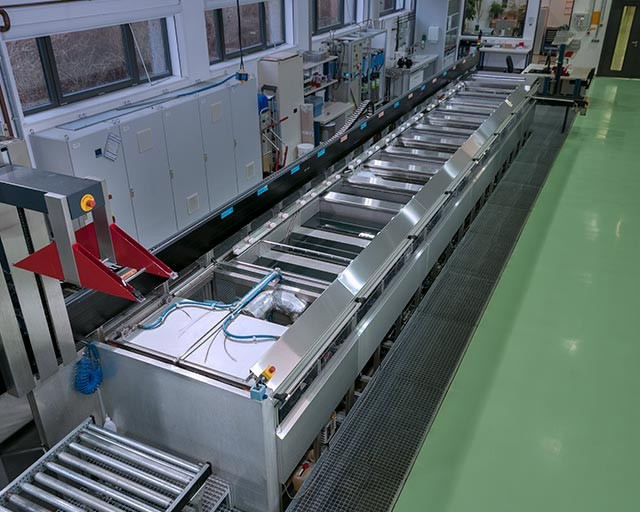
The CleanGreen collaborative project was launched with a kickoff meeting in September 2026. The goal of the project is to make industrial component cleaning more energy- and resource-efficient. To achieve this, energy, water, and chemical consumption in aqueous cleaning systems will be better tailored in the future to the actual degree of contamination of the components and the condition of the cleaning baths.
In many manufacturing processes today, cleaning systems are designed and operated in such a way that components with varying degrees of contamination can reliably achieve the required level of cleanliness. However, the actual degree of contamination of the parts is often not factored into process control. This is precisely where CleanGreen comes in: Different data sources are to be consolidated and made usable for intelligent, demand-driven process control. The plan is to link information from system control, bath monitoring, and production planning with newly developed optical measurement methods.
Research Platform for Process Data
An industrial cleaning system at the Fraunhofer Institute for Surface Engineering and Thin Films IST in Braunschweig serves as the technical basis; this system is being gradually expanded to include additional measurement and sensor technology. On this research platform, the project partners intend to collect data and investigate various approaches to process evaluation and optimization. In a later phase, selected developments will be tested as prototypes at industrial partners’ sites. This will also address the question of how well the concepts can be transferred to existing and new cleaning systems.
Optical Measurement and AI Analysis
One focus is on detecting organic contaminants on component surfaces. To this end, drawing on the expertise of the Fraunhofer Institute for Physical Measurement Techniques IPM, an automated fluorescence measurement system using an F-scanner will be developed and integrated into the research platform. The project participants aim to examine the extent to which this information can be used both to assess the degree of contamination prior to cleaning and to evaluate the success of the cleaning process afterward.
The measurement data obtained will then be incorporated, along with other process and sensor data, into AI-supported evaluation methods. The goal is to better understand the relationships between component condition, the cleaning process, and the cleaning result, and to derive recommendations for needs-based process control. The project is thus intended to lay the groundwork for digital, data-driven decision-making processes in industrial cleaning.
In the long term, CleanGreen aims for automated and demand-driven control of cleaning processes. Integration into existing facilities is also planned for the future. In addition, the information obtained is to be made available for subsequent manufacturing steps such as painting, electroplating, coating, bonding, or soldering processes.
The full title of the collaborative project is “CleanGreen – Energy-Efficient Cleaning Based on Quantified Component Contaminants and AI-Optimized Wet-Chemical Cleaning Processes.” It is coordinated by B+T Oberflächentechnik. Other partners include Fraunhofer IST, Fraunhofer IPM, the Institute for Machine Tools and Manufacturing Technology at the Technical University of Braunschweig, GNS Systems, and G&M Galvanik. The project will run from July 2026 to June 2029. It is funded by the Federal Ministry for Economic Affairs and Energy under grant number 03EN2151D.