

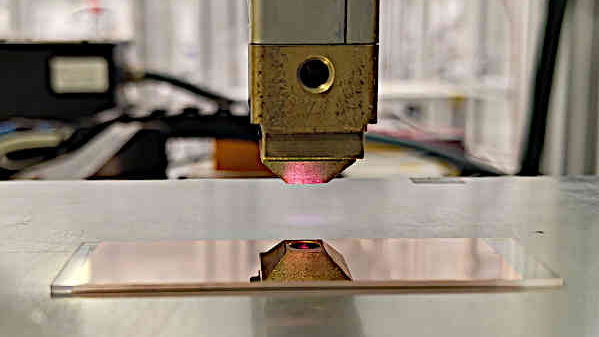
Oxide and sulfide layers can form on copper and silver surfaces, impairing electrical conductivity and solderability. Their removal is often technically demanding using conventional methods. Against this backdrop, researchers at Innovent investigated the extent to which such surface layers can be selectively reduced using a plasma operated at atmospheric pressure.
Oxide and Sulfide Layers Reduced to a Fraction of Their Original Thickness
The focus of the study was an atmospheric-pressure plasma jet of the Tigres CAT600 type, operated with forming gas consisting of 95% nitrogen and 5% hydrogen. Researchers evaluated its suitability for reducing oxidized copper layers and silver sulfide deposits on silver coatings. For this purpose, metal layers were deposited on glass, silicon wafers, and plasma-chemically oxidized aluminum substrates and subsequently oxidized or sulfided. The copper oxide layers were generated by thermal treatment in air, while the silver sulfide layers were produced through exposure to hydrogen sulfide formed in situ.
Ellipsometric measurements of the copper samples showed that the thickness of the oxide surface layer was reduced from approximately 95 nm to about 6 nm. At the same time, the sheet resistance returned close to the original level of the metallic copper layer. Within the area scanned by the plasma, the dark oxide layer was removed, revealing a metallic, shiny copper surface.
Comparable results were observed for the silver samples. The generated silver sulfide layers, with thicknesses of up to approximately 70 nm, were reduced by plasma treatment to a residual thickness of about 7 nm. XPS analyses further confirmed the chemical modification of the surface. After treatment, the sulfur content decreased significantly, while the silver content increased and approached the composition of the original metallic surface. The restoration of a functional silver surface was thus demonstrated both visually and analytically.
Layer Removal Benefits Industrial Applications
The process is of particular interest for industrial applications where clean and functional metal surfaces are a prerequisite for reliable soldering, bonding, and contacting processes. These include printed circuit board manufacturing (for example, metal-core PCBs), power electronics, leadframe production, and other semiconductor manufacturing processes. Potential users include manufacturers and suppliers of electronic assemblies, circuit carriers, contact components, and interconnection systems. Because the process operates at atmospheric pressure and does not require vacuum infrastructure or chemical etchants, it offers potential for more resource-efficient and inline-capable production processes. In the future, the approach could also be extended to other metallic systems such as tin, where oxide formation likewise affects the reliability of interconnections.