
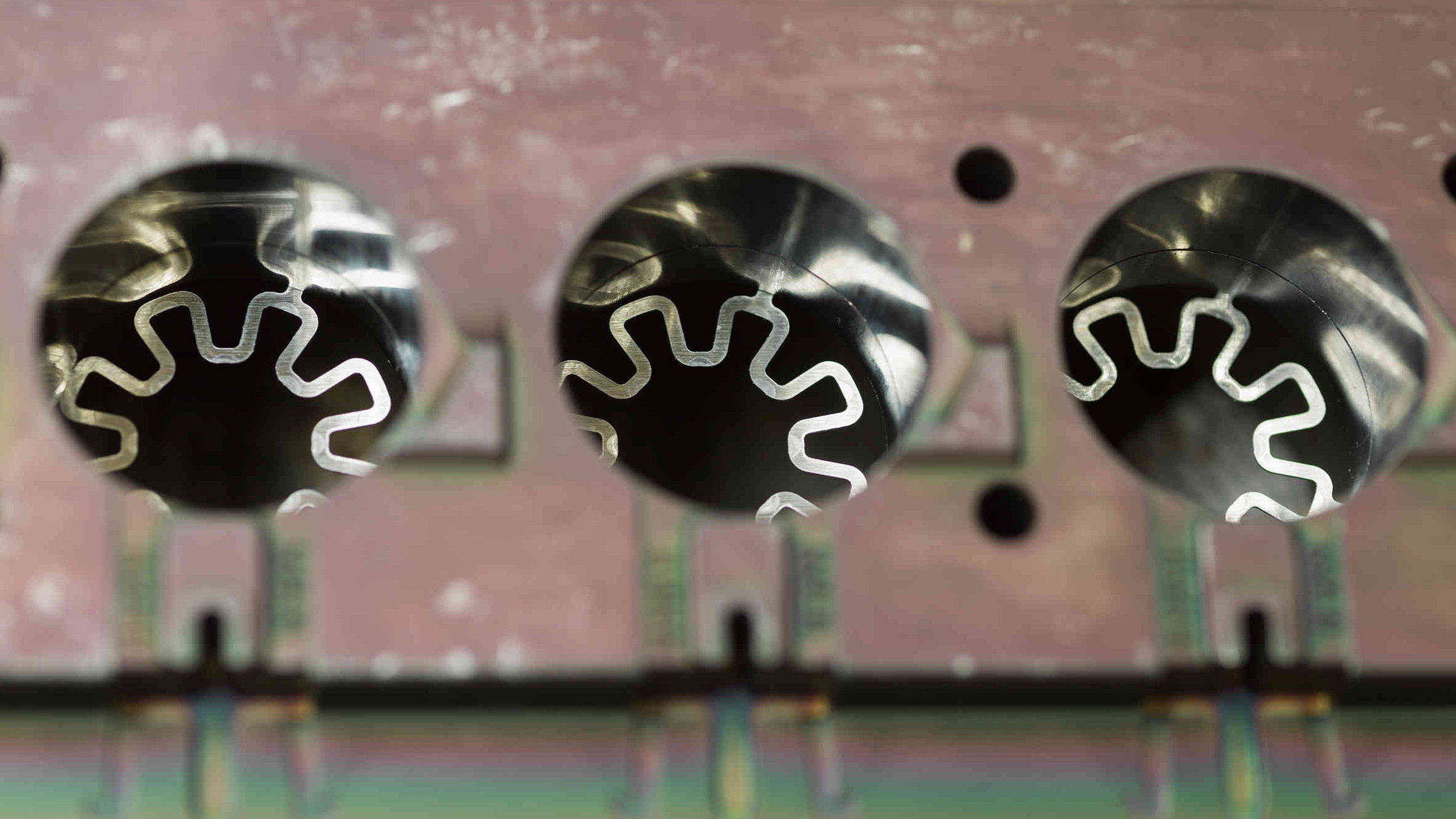
Sometimes small things have a big effect: when you accelerate while driving, a sensor electronically transmits the exact position of the accelerator pedal to the engine control unit. The vehicle then accelerates more or less accordingly. Accelerator pedal sensors with this inductive sensor technology contain, among other things, rotors made of metal conductor loops encased in plastic carriers. FWB Kunststofftechnik from Pirmasens manufactures these coin-sized hybrid parts using a reel-to-reel process.
Precise processes ensure high productivity
This automated progressive injection molding process combines two production steps in one machine: the processing of a thin aluminium strip and partial overmoulding through to the finished component. In the production process, the aluminum strip with pre-punched rotors runs into a multi-cavity tool. First, eight rotors are completely punched out in one go using movable cores or cutting punches. The punched parts are then pushed onto the second level and overmolded with plastic.
It is part of the expertise and 45 years of experience of the FWB injection molding specialists to design and manufacture tools for such economical and complex processes themselves. "The main aim of this task is to achieve high dimensional accuracy and precise positioning of the parts in the tool so that they can be punched accurately and cleanly and then overmolded," explains Regis Marseu, Senior Tooling Expert at FWB Kunststofftechnik. For example, no flakes from the aluminum punching must get into the plastic part later.
Cold welding with consequences: Rejects, downtime, delivery delays
However, the aluminum field of expertise required more attention in other areas. This is because the fast cycle times and the high pressing pressure when stamping the adhesive material increased the thermomechanical stress on the tools. As a result, cold welds formed on tool components. Cores jammed and regular production became increasingly difficult. "We had to clean the cores and dies every eight hours and stop the machine for half an hour to an hour to do so. Once a week, we completely dismantled and cleaned the tool," says Marseu. The consequences were a lot of rejects, downtime and delivery delays. A good application was therefore also needed for the customer Forvia Hella, FWB's parent company and also an international automotive supplier that manufactures accelerator pedal sensors, among other things.
In the search for possible solutions, the surface specialist Oerlikon Balzers was consulted. Michael Bilo, Key Account Manager Plastics, recommended the carbon-based ta-C coating Balinit Mayura, which minimizes material adhesion with its hardness of 60 to 70 GPa and low coefficient of friction (dry 0.1 to 0.2 against steel).
Coating for machining non-ferrous materials
Oerlikon Balzers has developed this coating especially for the machining of non-ferrous materials, for example aluminum alloys with up to 12 % silicon content, copper alloys such as phosphor bronze or brass and polymers. It is applied using arc evaporation (arc PVD) and is 0.3 μm thick. When stamping and forming aluminum, for example, it can reduce the tendency for adhesion, burr and flitter formation. The coating also looks beautiful when it shimmers in rainbow colors. At the same time, the coating color can be used as a wear indicator.
A proposal that could eliminate the challenges posed by cold welding. The treatment of the cores alone, including a reduction in the cutting gap between cores and inserts, immediately led to better results: no more cold welds. Following this success, other components such as inserts, dies and guide sleeves were also coated with Balinit Mayura.
In addition, the moving parts on the ejector side of the tool were coated with the DLC layer Balinit Dylyn. This protective layer is applied by means of PACVD; during the PACVD process, a chemical reaction is caused by plasma excitation and ionization. Its layer hardness is between 15 and 25 GPa and it can even achieve a coefficient of friction of 0.05 (dry against steel). This coating is used particularly in mechanical engineering, plastics processing and the semiconductor industry.
Production has been running smoothly for months with Balinit Mayura
Thanks to the new coating, production has been running smoothly for several months. So far, around 360,000 parts have been produced in 3-shift operation. A brass brush is now sufficient for cleaning every 36 hours. "We are considering increasing the interval to 48 hours," reports Marseu, who appreciates one thing in particular about Oerlikon Balzers: "We can always rely on this coating partner to have a professional technical background for our complex business." FWB Kunststofftechnik is one of the leading companies in Germany with special expertise in stamping and injection molding tools. Plastic parts with a shot weight of 2 to 650 g are manufactured and partially pre-assembled here. Another FWB tool set for rotor production is already being processed at the Oerlikon Balzers center in Bielefeld. The Balinit Mayura variant used for this is only 0.3 μm thin, but keeps production running.