

Scientist from TU Darmstadt receives Peter Dornier Foundation Award
Award for new findings on reducing noise and surface heat on aircraft and space capsules

Scientist Lara De Broeck has been awarded the Peter Dornier Foundation Prize 2023. The doctoral student from TU Darmstadt received the prize for her work on the influence of the surface structures of aircraft and spacecraft on their noise emissions and surface temperature. Her pioneering findings could help to reduce the noise of aircraft and the high surface temperatures of space capsules on re-entry into the Earth's atmosphere.
When an object moves through the air, a physical phenomenon known as boundary layer flow occurs close to its surface. It occurs on the wings of airplanes as well as on the outer walls of space capsules on re-entry into the earth's atmosphere; it also occurs on the surface of wind turbine blades, cars and trains. "The boundary layer flow is only a very thin area, but it is crucial for many flow phenomena," explains Lara De Broeck. The young scientist at the Chair of Fluid Dynamics at TU Darmstadt is investigating such flow phenomena in the boundary layer flow. This also involves the question of how the surface properties of aircraft and space capsules affect the boundary layer flow.
PhD student De Broeck received the Peter Dornier Foundation Prize 2023 at the end of October for her work on the influence of surface structures on boundary layer flow and how these can be used specifically to reduce noise and friction in aircraft and spacecraft. The jury of the prize, which is endowed with 5,000 euros, recognized the 31-year-old's master's thesis entitled "Noise suppression in boundary layer flows through optimized acoustic wall impedance". In her acceptance speech at the Dornier Technical Center in Lindau in front of around 100 invited guests, prizewinner De Broeck said: "I am truly honoured and delighted that the jury of the Peter Dornier Foundation Prize has recognized a fundamental analytical work like mine."
Analytical groundwork for aerospace companies
In her master's thesis, De Broeck was able to derive an analytical equation for the aforementioned problem description "for the first time", according to her doctoral supervisor Prof. Dr.-Ing. Martin Oberlack from TU Darmstadt. According to De Broeck, their analytical calculations could provide fundamental insights into how aerospace companies can design the inner walls of aircraft turbines or outer walls of space shuttles in future, for example, in such a way that acoustic and thermal disturbances in the boundary layer flow are even better damped. "The noise and frictional resistance of aircraft, space capsules and other high-speed vehicles could be reduced as a result," says De Broeck.
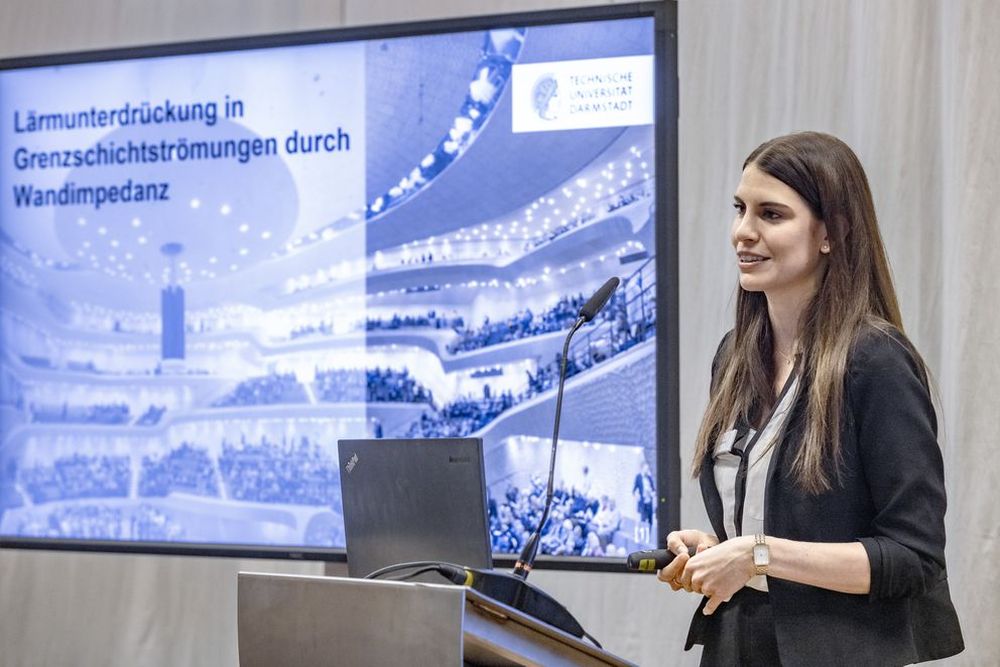
Noise protection was an important topic for founder Peter Dornier
In her laudatory speech, Maja Dornier, Chairwoman of the Peter Dornier Foundation, said that De Broeck's master's thesis dealt with a topic that was very close to the heart of the founder of the foundation, Peter Dornier (1917-2002): "Pleasant sounds were important to him throughout his life - this included classical music in his study as well as issues of noise protection in the construction of new aircraft and weaving machines." For the qualified mechanical engineer and aircraft designer, who founded the machine and plant manufacturer Lindauer Dornier in 1950 and successfully managed it for many decades, questions of acoustic quality were central to the design of new aircraft, machines and plants. Peter Dornier designed the "encapsulated" weaving machine back in the 1950s, when the Dornier family business had just entered the field of weaving machine construction. As it could be as loud in a weaving mill as on an airport runway at the time, he wanted to protect the operating personnel from the noise of the machines with the idea of an encapsulated weaving machine. Dornier, today Germany's largest weaving machine manufacturer, later realized the encapsulated weaving machine together with a world-leading weaving mill in Italy.
Award-winning work could improve heat protection for space capsules
In future, the findings from De Broeck's master's thesis could also help to reduce frictional resistance on the surface of space capsules during re-entry into the atmosphere and thus reduce surface heating. In space travel, re-entry into the Earth's atmosphere is an extremely critical phase. Here, the capsules reach speeds of up to 30,000 kilometers per hour. The external temperatures rise to over 2500 degrees Celsius. For comparison: lava is 700 to 1200 degrees Celsius hot.
To withstand these temperatures, the space capsules are equipped with special heat protection tiles. These are often made of glass fiber composites, which are also produced on Dornier's air and gripper weaving machines. "If we succeed in adapting the surface structures of space capsules so that they generate less friction and therefore less surface heating, we could save material in the heat protection tiles," explained De Broeck. How this could be achieved motivated her to write her master's thesis, according to De Broeck, as such weight savings could increase the payload of space capsules. An interesting side note: the parachutes on which space capsules glide safely to earth are also woven on Dornier looms.

Famous equations from mathematics as a basis
For the calculations in her master's thesis, which was awarded the Peter Dornier Foundation Prize, De Broeck also used simplifications of the famous Navier-Stokes equations. The equations, named after the mathematicians Claude Louis Navier and George Stokes, are used to describe flows and are among the most important equations in fluid mechanics. Calculations for the aerodynamics of airplanes are based on them, as are weather and climate forecasts. They are also among the so-called "Millennium Problems" - seven unsolved mathematical puzzles for the solution of which the Clay Mathematics Institute offered a prize of one million dollars each in 2000.
De Broeck, who was privately involved in helping refugees and schoolchildren during her studies, also attracted interest at the renowned Stanford University with her work. The young scientist was invited there for a research stay co-financed by NASA. According to De Broeck, participants there were delighted to be able to supplement their own research work with De Broeck's analytical calculations. "It was great to meet luminaries from the field of fluid dynamics and turbulence research whose books you normally only read at university," reported De Broeck in a relaxed atmosphere following the award ceremony.
About the Peter Dornier Foundation Prize
The idea of the Peter Dornier Foundation Prize goes back to Peter Dornier (1917-2002), the founder of Lindauer Dornier GmbH. Since 2021, the prize has been awarded annually for outstanding scientific work by young people in the fields of textile, film and fiber composite technology as well as aerospace. Promoting medical research is just as much a part of the foundation's purpose as supporting hospices for a self-determined and dignified life until the end.