

Stable at high currents
HVOF sprayed insulation layers for power electronics applications
Current technological developments are leading to increasing thermal alternating loads, where classic copper sandwich structures are increasingly reaching their limits. The investigation of 20 spray powders shows: There are alternatives!
For applications in the field of power electronics components, electrically insulating layers with high dielectric strength, high electrical resistance and high thermal conductivity are required. In the following, therefore, the potential of HVOF-sprayed coatings for power electronics components is investigated using 20 different powders. These powders are alumina ceramics, which contain admixtures of chromium, titanium and magnesium oxides. The main result of this work is that, in principle, both pure aluminum oxide and spinel (Al2O3-28MgO) meet the requirements for electrical insulation. However, in order for the volume resistivity to be high enough, these insulation layers should be subsequently sealed and the amount of impurities such as Na2O or Fe2O3 must be less than 0.1 percent.
Electronic components are now substantial components of modern vehicle technology and are the focus of further engineering development. This is particularly evident in the hybrid or electric vehicles with integrated electric drive systems that have been developed to production maturity in recent years. However, extensive power electronic and mechatronic system components are also being developed or are already state of the art in modern vehicles powered purely by combustion engines. In some cases, these electronic components must be able to withstand high currents of up to several hundred amperes. The current assembly technology with prefabricated substrates made of Cu/Al2O3/Cu sandwich structures (so-called DCBs, direct-copper-bonded) and soldered heat sinks reaches technical limits. Assemblies often fail after only a few cycles due to the high thermal alternating loads. Furthermore, production is complex, inflexible, and material- and cost-intensive.
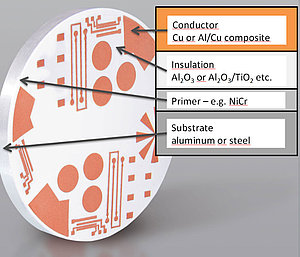
A new production concept is the manufacture of power electronic circuit carriers using a combination of thermal spraying and cold spraying (see picture on the left). These circuit carriers can be applied directly to the substrate, for example a heat sink made of an aluminum alloy, and thus enable more highly integrated solutions that dissipate heat more effectively. In this production concept, the components consist of a base material and an adhesive base on which an electrically insulating ceramic can be applied, followed by metallization such as conductor tracks and solder bonding areas.
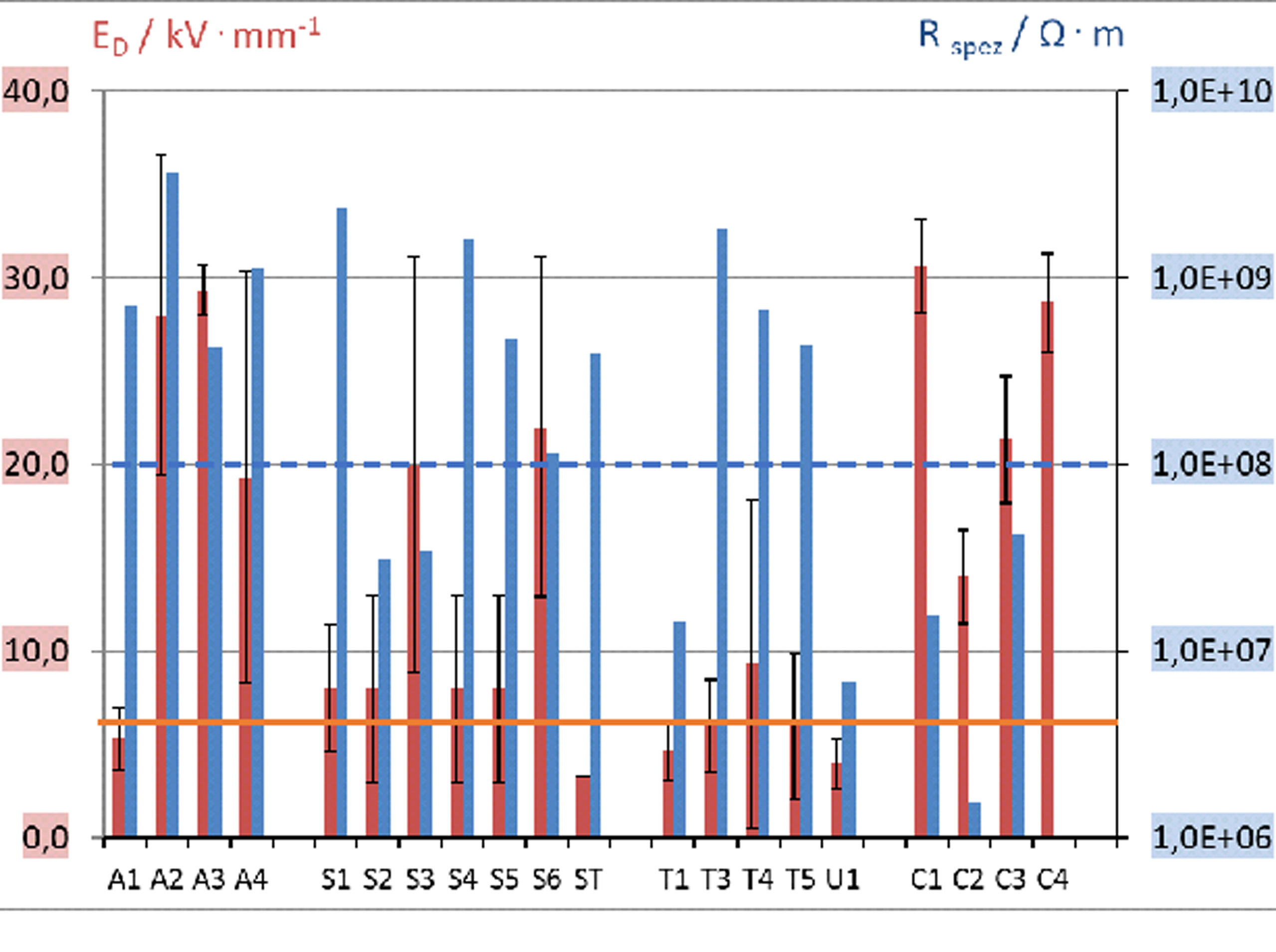
Most of the used powders of the material systems Al2O3, spinel (Al2O3-28MgO) and Al2O3-TiO2 97/3 have, after a final sealing, a Rspez above the minimum required 108 Ohm*m, which are considered as prerequisite for the use in power electronics. With the exception of Al2O3-Cr2O3 60/40, the materials Al2O3-Cr2O3 and Al2O3-TiO2 94/6 show a contact resistance that is too low.
In these cases, the admixture of materials with significantly better conductivity than aluminum oxide, such as chromium oxide and TiOx, which forms from TiO2 during spraying, ensures a reduction in Rspez. The graph on the right summarizes the electrical properties of the insulation layers. For an application in power electronics, in addition to the requirement of Rspez > 108 Ohm*m, the dielectric strength ED must also be high enough. An important voltage class for converters with IGBT is 600 V. For safety reasons, this voltage class requires a resistance to punctures of up to 1200 volts. Since the insulation layers must remain as thin as possible to ensure adequate thermal conductivity, the dielectric strength should be > 6 kV/mm. As the graph shows, the combined RSpez and ED requirements are met by about half of the sealed Al2O3 and spinel layers examined.