


Dense Flow Powdercoating for motorcycle frames
Coating of complex parts in high numbers with a soft cloud and robots
Welco can coat up to 500 motorcycle frames per day in high quality. The contract coater from Wackersdorf relies on dense phase technology, automation and certified processes.
The Welco GmbH plant in Wackersdorf is recognizable from afar as a modern greenfield. Right next to the handsomely designed hall, there is still room for future expansion on the lawn next door, and electric charging columns are also an indication that the company is prepared for the future. In the entrance area, exhibits underscore the company's core competence: complex components, finished with a high-quality powder coating. On display are impeccably coated BMW motorcycle frames; these and some of the engines are powder-coated at Welco. In-house processes also include an anodizing and a cathodic dip coating system.
The roots of the powder brazing service at Welco go back to 1994, when the Schabmüller Group bought the former location of the Sedlmayer company in Bruck and founded ZBG Zerspanungstechnik. At that time, in a small corner of 150 square meters in an old factory building, there were a few manual systems for powder coating. Initially, the company coated mainly for its own needs, but the interest of external customers in powder coating grew quickly.
From the powder corner to large-scale production
"As a consequence, in 1996 they were looking for a master craftsman for the emerging surface technology department. I was looking for a job at the time and applied," reports Richard Nuber, a master mechanical engineer in his own right and now Welco's managing director. "In the beginning, we were just six employees in the powder coating department - so I learned very intensively myself how to do it, a skill that would later serve the company's further development very well." Orders from BMW in the area of machining and in the surface area, especially from BMW Motorrad, increased rapidly in the following years and soon required an overall expansion of capacities. In 2003, Schabmüller therefore founded ZMT Automotive, a specialist for CNC machining, under whose umbrella, in addition to the growing machining production, ever larger batches were powder-coated. In 2005, 25 employees were already working in powder coating and it was foreseeable that growth would pick up speed. Against this background, the FS group of companies spun off the entire surface technology from ZBG Zerspanungstechnik in 2006 and transferred it to Welco GmbH.As the present shows, this was a good decision, because Welco is now a showcase company when it comes to the automated coating of very complex parts in large quantities.

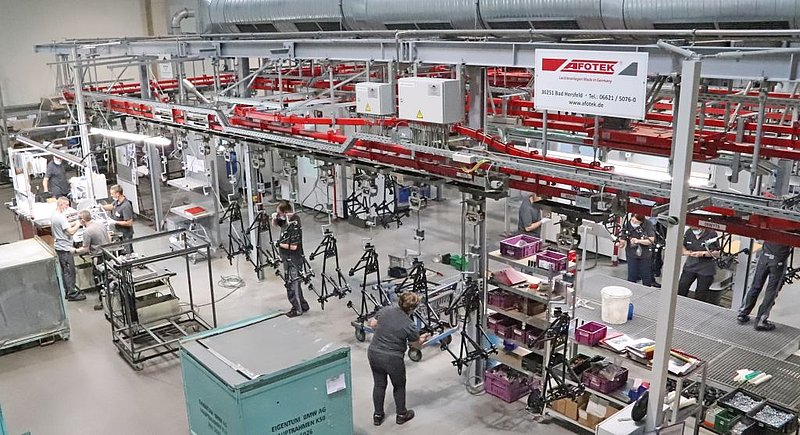
The coating hall is exceptionally clean, not a breath of powder dust covers the floor. In the front area, motorcycle frames are unloaded from the transport containers and hung up. Right next to it, when the finished coated frames are hung up, they are checked and, for example, holes are reworked if necessary. At another workstation, nimble and skilled hands mask the areas of the frames and components that should not be coated.
High flexibility despite automation
A large part of the hall is taken up by the support structure of the Schierholz conveyor system with its densely packed red Power&Free rails. To save space, most of the plant components, such as fans and filter technology, were arranged above the conveyor level. "The whole thing may well seem a bit cluttered at first glance," explains Nuber. "But at the end of the day, we have to be able to approach different stations in different sequences, depending on the frame type. That's why we need flexibility in the sequence and a correspondingly extensive rail network. Afotek built the plant as general contractor and did a very good job." KTL and anodizing plant in-house
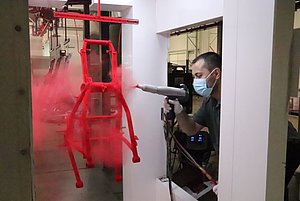
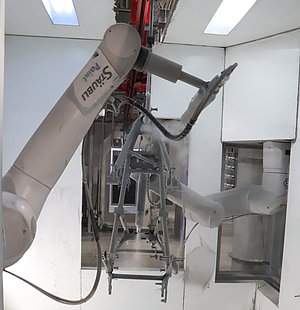
If the frames come directly from the KTL coating in the neighboring hall, further wet chemical pretreatment is usually not necessary, and they can be hung directly. Incidentally, the KTL coating used is particularly UV-resistant. There is also an automated anodizing plant in the neighboring hall. In principle, the powder hall also has a large throughput system for pre-treatment. Powder coating of the frames takes place either in one of the two very compact automatic booths, each equipped with two robots. These, as well as the powder management center, are from Nordson. Alternatively, for smaller batches or to increase throughput, three manual booths are also available, and these are also very compact. "These are custom-built. It was not at all easy to find someone who was able to comply with all the necessary technical and legal framework conditions despite the small footprint available," recounts Nuber. "In the end, the Börger company delivered a plausible approach and was awarded the contract."
In the automatic booths, two robots work diagonally across each other and coat the complex frame structure, including the internal geometries, down to the last angle, so that there is normally no need for manual recoating. During coating, it is noticeable that the powder cloud is very soft and tightly confined, and that there is a completely clear, powder mist-free view in the booth despite ongoing coating.
Both automatic and manual coating
"Even today, it takes a considerable amount of programming to teach the robot how to coat a frame like this - it may well take several months before all areas are optimally and consistently coated without defects," explains Nuber. "This requires a lot of know-how and is also only worthwhile above a certain quantity. That's why we also use manual booths. But the manual coater also needs high skills and self-confidence. After all, the economic responsibility of coating such a frame by hand should not be underestimated. Defects can often only be detected 20 to 30 barrels later after stoving, and then it becomes expensive. This is why dense phase technology is so important for us, because it gives us very constant coating parameters and, above all, interior geometries and recesses can be coated many times better than with conventional injector technology thanks to the soft cloud and the low air output. In addition, it is decisive that there is no drift of the powder output due to injector wear. In my professional life, I have turned out many injector sleeves that had no material at all at the crucial points. Even though such incidents are primarily a maintenance issue - I'm happy to do without this additional source of error."
Dense-phase powder conveying, and with it the promise of a softer cloud, more consistent powder delivery and thus a more homogeneous coating, first attempted to revolutionize the powder coating industry in the 1990s. However, the technology used at that time was not yet fully developed, showed numerous pitfalls in industrial application and soon disappeared again from most plants. But the basic idea was born: to realize a constant and wear-independent powder conveying with less air. Finally, the Nordson company came to the market with a completely new concept for dense phase powder conveying.
(Kopie 5)
This is how good dense phase conveying is in practice
"At first, however, people were rather skeptical and reluctant," Nuber recalls. "Confidence in dense phase technology first had to be rebuilt." The fact that dense phase powder conveying is gaining more and more approval is due to the fact that it offers some advantages over injector technology in terms of conveying consistency and the amount of air required for this. However, it is also more expensive to invest in. Coating problems in connection with powder coating are often caused by uneven powder conveying in injector systems. In the simplest case, these can be caused by incorrect regulation of conveying and metering air. But also the hose lengths, their routing and their diameter have an influence on a uniform and well adjustable powder conveying, as well as the powder output quantity.
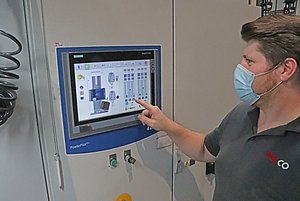
With automatic booths with several guns on each side, it is therefore not a matter of course that the powder output quantities of the guns are identical to each other, even if from the control all work with the same parameters. With a certain minimum of know-how and care, these aspects can be controlled without any doubt. Dense phase conveying technology, however, promises to eliminate such problems and to deliver the powder quantity, once set, to the gun day in, day out. At Welco, the opportunity has now arisen to check in practice, with a powder output measurement, how good and uniform the powder output really is, and how it can be controlled.
"At first, however, people were rather skeptical and reluctant," Nuber recalls. "Confidence in dense phase technology first had to be rebuilt." The fact that dense phase powder conveying is gaining more and more approval is due to the fact that it offers some advantages over injector technology in terms of conveying consistency and the amount of air required for this. However, it is also more expensive to invest in.
Coating problems in connection with powder coating are often caused by uneven powder conveying in injector systems. In the simplest case, these can be caused by incorrect regulation of conveying and metering air. But also the hose lengths, their routing and their diameter have an influence on a uniform and well adjustable powder conveying, as well as the powder output quantity. With automatic booths with several guns on each side, it is therefore not a matter of course that the powder output quantities of the guns are identical to each other, even if from the control all work with the same parameters. With a certain minimum of know-how and care, these aspects can be controlled without any doubt. Dense phase conveying technology, however, promises to eliminate such problems and to deliver the powder quantity, once set, to the gun day in, day out. At the Welco company, the opportunity is now offered to check in practice, with a powder output measurement, how good and uniform the powder output really is, and how it can be controlled.
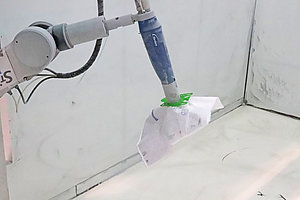
Checking the system with a vacuum cleaner bag
The measuring method itself seems a little unusual at first glance. For this purpose, a vacuum cleaner bag is placed on the gun head and the system is started for a defined period of time, for example one minute. The vacuum cleaner bag catches the powder coating coming out of the gun and hardly opposes the small air volume flow, so that a significant influence on the measurements is not to be assumed. The dust bag is weighed in the empty state before the measurement and afterwards - the difference gives the amount of powder collected. In this test, measurements were taken several times for one minute per robot, followed by an increase in the output quantity together with a new measurement. The results show that the fluctuation range is clearly below that of a conventional injector system. Measurements were carried out on both robot systems, and both the uniformity of the powder delivery and the effortless and precise variation of the output quantity were convincing. The reason for this lies in the map control of the HDLV pump technology, which independently calculates all parameters on the basis of the desired delivery rate. "It is true that an optimally designed, adjusted and maintained injector powder coating system can certainly also produce a nice soft powder cloud - but in my experience, the need for know-how and maintenance is considerably greater with an injector system in order to achieve and, above all, maintain such an ideal condition than with dense phase technology," Nuber concludes. "And especially when it comes to coating difficult internal geometries, dense phase technology is clearly superior to injector powder conveying.
Not just a contract coater - also a problem solver
Welco's success story is based on many correct decisions - these included building up additional coating expertise in the field of cathodic dip coating and anodizing. The ability and the will to rethink processes and, for example, to rely on dense phase technology, as well as the high quality standard strived for, were also important aspects. However, the basic philosophy of the current managing director, who took surface technology from a 150-square-meter powder corner into his own plant, certainly also played a decisive role: "It is not enough to simply coat parts and do a good job as a supplier," says Nuber, explaining his strategy. "It's crucial to succeed in becoming a problem solver for your clients."
Welco GmbH www.welco.eu