

Cold coating on the road to success
Eine neue Beschichtungsmethode, die sich für verschiedenste Materialkombinationen eignet.
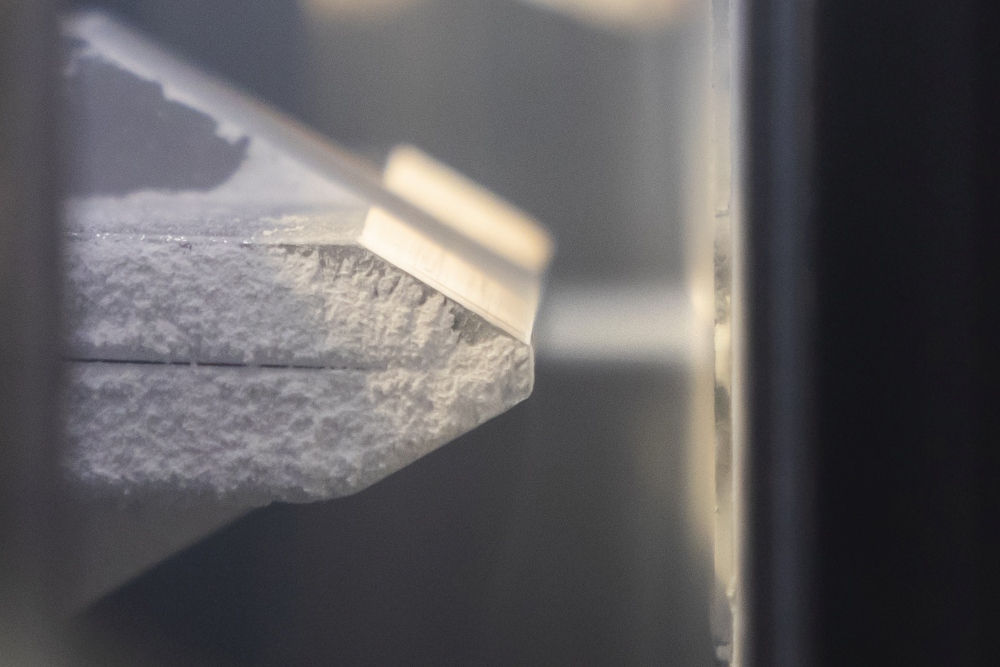
The aerosol deposition technique has hardly been used in industry so far - yet it gives the user great freedom in the selection of substrate and coating material. A wide variety of coating powders can be applied to the component in a rough vacuum at room temperature.
Aerosol Deposition, a coating method developed in Japan and pursued by Heraeus High Performance Coatings, is used primarily in Asia to coat components for plasma etch chambers used in semiconductor production.
Aerosol deposition is a so-called cold coating process. Neither the component to be coated nor the coating material are heated or experience a temperature increase.
Aerosol deposition has no fundamental limitations with regard to the material to be deposited or the substrates that can be used. This paves the way for completely new combinations of coating and substrate. For example, when it comes to coating high-temperature alloys whose service life was previously limited by corrosion, they can now be protected with a layer of α Al2O3 with the aid of aerosol deposition. Particles can no longer flake off and contaminate products during production.
Conventional processes such as thermal spraying, PVD or CVD are often limited in their application because the negative effects of heat exposure on many materials are too great. Another advantage of aerosol deposition is the excellent adhesion of the coating. The technology is particularly promising where conventional methods do not achieve the required quality or the desired coating cannot yet be realized at all.
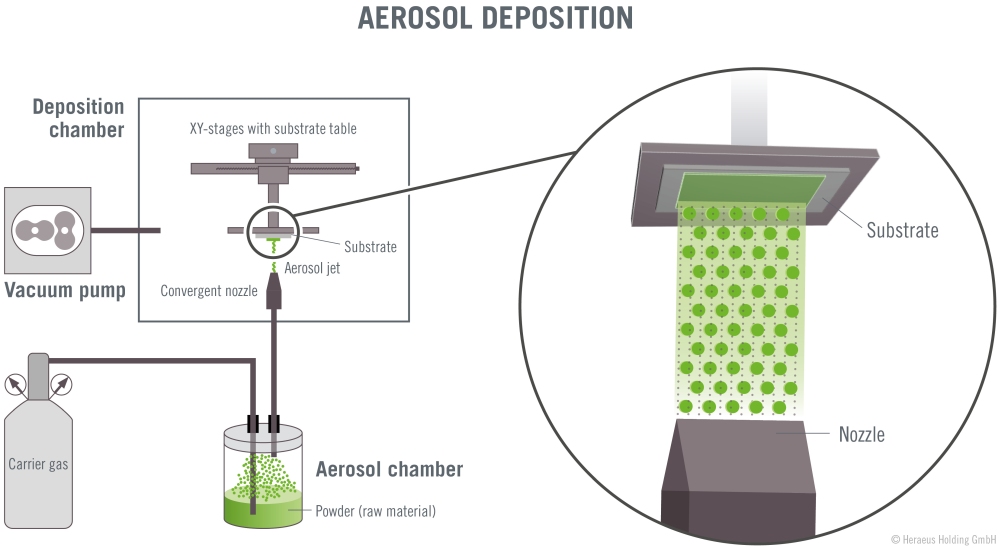
Aerosol deposition takes place in a closed chamber in which a rough vacuum of about one millibar prevails. This makes the process technically much less complicated and faster than conventional coating methods such as sputtering or evaporation. The coating material is supplied as a dry, binder-free powder in an aerosol-generating unit, which is also evacuated. Both process chambers are interconnected and are continuously evacuated throughout the process. The process starts by introducing a carrier gas, for example compressed air, into the coating powder, thus generating an aerosol of fine ceramic particles.
Acceleration to 600 meters per second
The powder aerosol is fed to the coating chamber through a specially designed slot nozzle. A pressure difference of several hundred millibars is created between the two chambers, which results in an acceleration of the ceramic particles in the carrier gas flow. These are transported into the coating chamber, where they reach speeds of between 100 and over 600 meters per second at the nozzle exit.
With this high kinetic energy, the ceramic particles hit the substrate surface. The powder used and the powder preparation are of decisive importance for successful layer formation. If the particles are too small (< 100 nanometers), they do not have sufficient energy to break up or overcome the dynamic pressure range in front of the substrate, and are accordingly not deposited. Very large particles (> 10 microns) do break up, but there is additional abrasive removal of the substrate or already formed layers. Only particles with an ideal particle size and morphology break up into nanometer-sized fragments on the component surface. This results in a large number of free, unsaturated surfaces, which form a so-called mechano-chemical bond with the component.
The resulting microstructure is nanocrystalline, non-porous, highly dense and exhibits very high adhesion strength due to the chemical bond between the coating and the substrate. The coating thicknesses in aerosol deposition are in the range of 1 µm to 70 µm and deposition rates of up to 25 micrometers per minute are achieved.
Neither material nor phase transformation occurs during deposition on the substrate. Thus, both high-purity coatings and material composites are possible. Since no chemical reactions or high temperatures are required for layer formation, any material mixtures can be provided as starting powders, which are then deposited as a composite layer on the component. For example, electrically conductive metal particles can be incorporated in a ceramic matrix on the component.
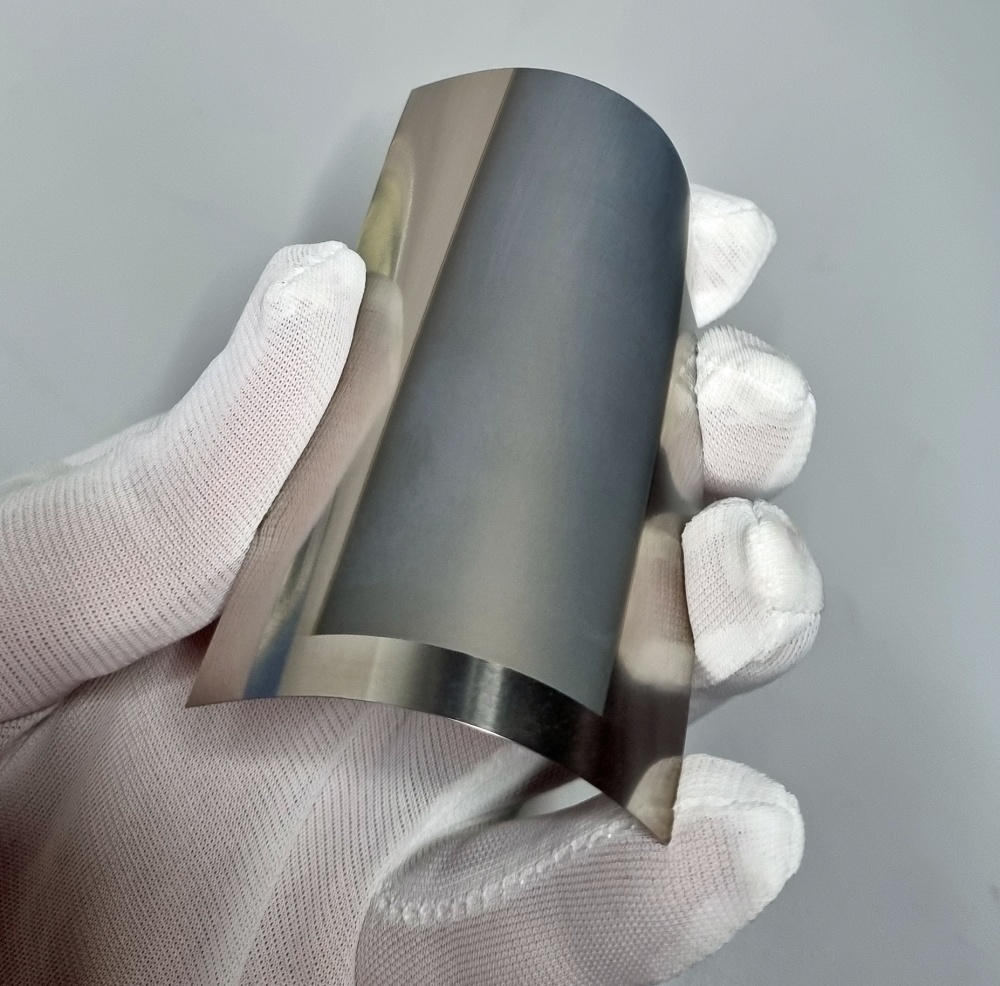
Depending on the material used, coatings applied by aerosol deposition can be used as electrical insulation layers, heat-conducting layers, corrosion and abrasion protection, adhesion promoters, surface finishing and even for the production of free-standing metal layers.
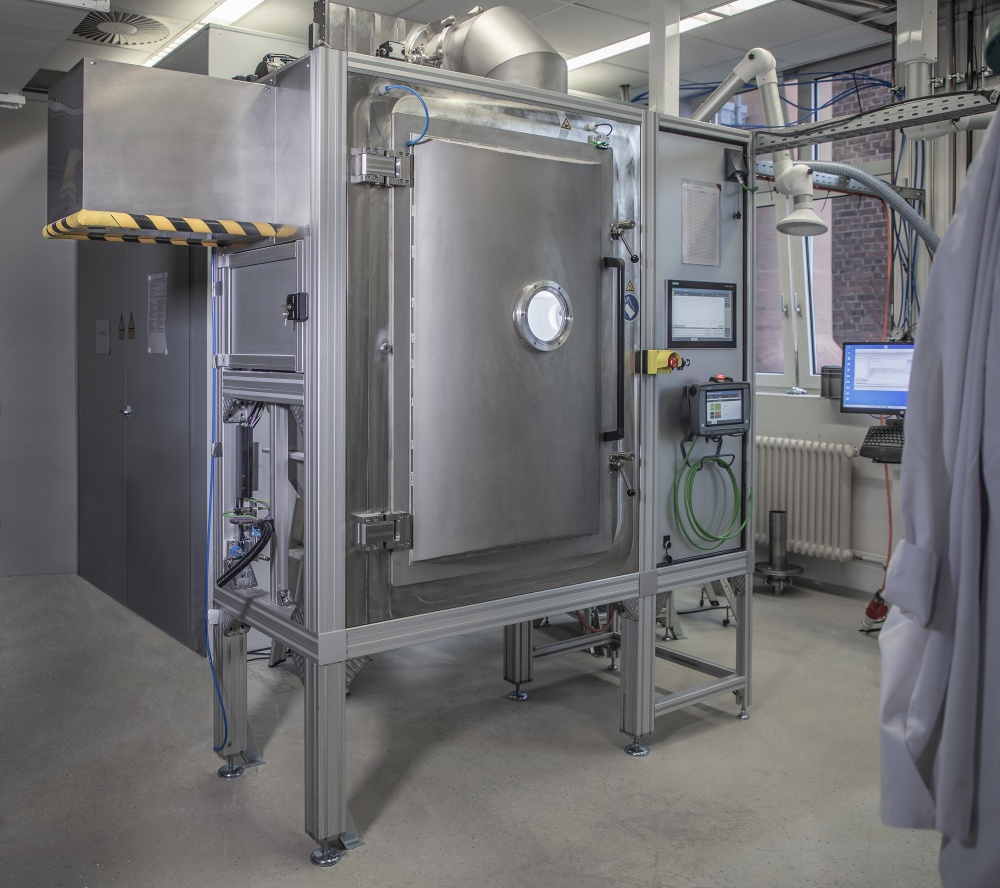
Research at the Universities of Bayreuth and Erlangen.
Feasibility studies by universities such as the University of Bayreuth and the Friedrich-Alexander University of Erlangen-Nuremberg have already confirmed the potential of aerosol deposition. Here, among other things, basic research has been successfully carried out in the fields of battery technology, sensor technology and lead-free piezoelectrics based on aerosol deposition. In recent years, Heraeus has worked intensively on optimizing processes and machines for industrial-scale production, accompanying customers from the initial feasibility study to the introduction of this new process into series production.
Heraeus has already successfully tested a wide range of substrate materials, including steel, ceramics, glass, plastics, silicon and indium phosphide wafers. For example, metals and ceramics such as Al2O3, AlN, SiC or Si3N4 can be deposited on these substrates.
One application example is ceramic protective layers on high-temperature sensors. Platinum resistance sensors are often used here. To protect the fine Pt structures, protective layers of aluminum oxide are usually applied. With conventional coating processes, it is not possible to produce phase-pure α-Al2O3 coatings. Therefore, when the sensor is first heated, phase transformations occur in the aluminum oxide, which are accompanied by a change in the volume of the coating. This results in cracks and defects. With the aid of aerosol deposition, Heraeus has succeeded in directly applying α-Al2O3 protective layers and thus producing crack-free cover layers. This not only makes it possible to reduce process steps in order to cover the cracks that would otherwise occur again, but also to increase the maximum operating temperature of the Pt sensors to over 950 degrees Celsius.
Successful studies have also been carried out in the field of gas sensor technology, for example in the manufacturing process for oxygen or hydrogen sensors. Functional layers produced by aerosol deposition exhibited significantly faster response times.
Cleanly coat semiconductors with ever smaller structures
Cleanly coating semiconductors with ever smaller structures
Great potential is also seen in semiconductor applications where process chambers of the latest semiconductor generation are lined with novel coatings. Due to ever smaller structure sizes, the requirement for stability and cleanliness of the process chambers is increasing. Materials and coatings currently in use are reaching their limits here, and aerosol deposition is opening up a significantly larger portfolio of coating material classes.
However, current battery trends, such as new Li- or solid-state batteries, are also starting to establish aerosol deposition as an important manufacturing step for functional and protective coatings. Particularly in the production of solid electrolyte layers in future solid-state batteries, aerosol deposition has major advantages over conventional methods. The coating takes place at room temperature, so that no energy-intensive sintering steps are necessary. In addition, aerosol deposition is a dry coating process and does not require any binders, so that the entire production of the cell can be carried out completely moisture-free.
First customer is EOS Biomaterials Incorporated
Aerosol deposition will be used in medical technology as early as this year. EOS Biomaterials Incorporated relies on an R&D system from Heraeus to develop coatings for the medical market. Aerosol deposition will enable the company to test and optimize new antiseptic and antibiotic coatings in even shorter cycles. In addition, Heraeus sees numerous other potential applications, such as in e-mobility or electronics.
Heraeus High Performance Coatings
www.heraeus.com