

Improved durability
Plasmabeschichtung von Innengeometrien
Plasma coatings are successfully used in various industries. However, the use for coating internal geometries is often not possible at all or only with considerable restrictions. One company offers a solution for this - and achieves high coating speeds in the process.
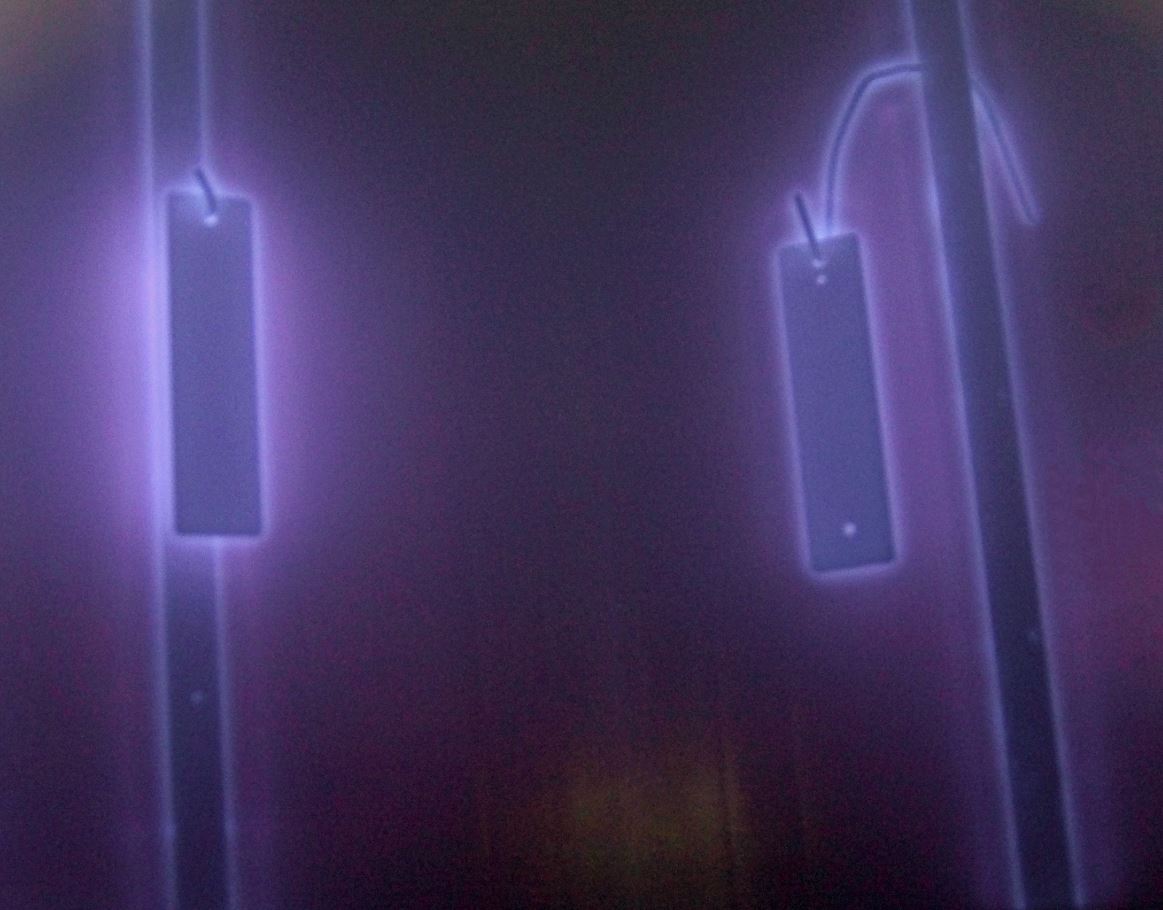
The process used by C4E is a plasma-assisted, chemical vapor deposition. Using the hollow cathode effect, a high-density plasma is ignited in the interior of the workpiece to be coated and the solid component is deposited on the inner surface. This particular process can be used to produce the same coatings as other CVD processes at a much higher coating rate.
Coatings that can be produced by the process include wear-resistant and low-friction amorphous diamond-like carbon coatings, also known as diamond-like carbon (DLC). In addition to minimizing friction and adhesion, the surface functions of the DLC layer include protection against wear, corrosion and erosion, and chemical resistance. DLC can be deposited with layer thicknesses between 1 and 50 µm on most materials. The DLC properties are modified by the company for specific applications and adapted to individual customer requirements. Complex multilayers made up of different layers are also possible.
If required, the outer surfaces of both complex parts and pairs of parts can also be coated with the same or a different layer. In addition, C4E coating processes are environmentally compatible. Unlike commonly used electroplating processes such as hard chrome plating, there are no toxic byproducts. The DLC coatings produced are bio-compatible and thus also suitable for use in the food industry and medical technology.
Tribological coatings for engine parts
Reducing friction power is one measure for increasing the efficiency of internal combustion engines. The friction component of the cylinder-piston ring/piston pairing in an average internal combustion engine is around 50 percent. The company's coating process allows friction-reducing coating of the running surfaces in cylinder liners and engine blocks, which can also significantly reduce wear on the running surfaces. Just a few microns thick of DLC coating provides durability of these treads for a truck's mileage of over 500,000 kilometers.
The DLC coating can be applied as the final process step in cylinder production, making it easy to integrate into existing engine and liner manufacturing processes - no post-processing is required. The coating follows the cylinder surface exactly, and honing grooves are preserved. A process for mass production is already available for components such as cylinders. Depending on the cylinder size, the current generation of machines can coat over 30 cylinders per hour
Protective coatings for applications in the oil and gas industry
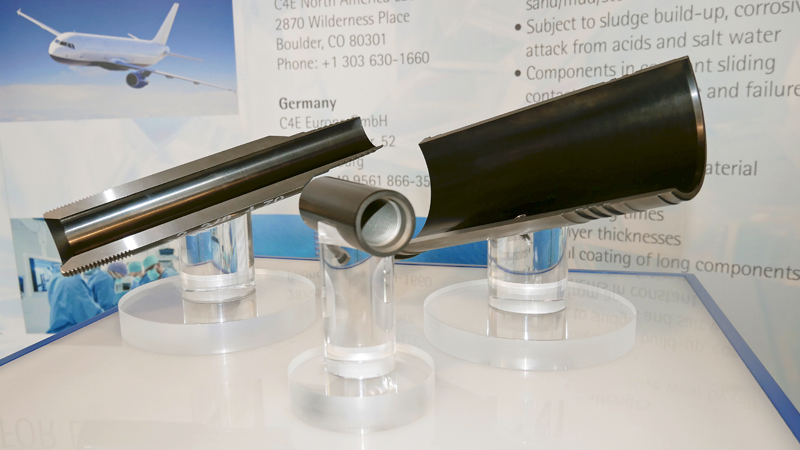
High corrosion protection as well as very good resistance to erosion and wear extend the service life of components under extreme conditions and continuous stress, as is typical in the oil and gas industry. When expensive precision components are used, when they have to be replaced at great expense, or to avoid costly downtime, the DLC protective coating adds significant value. Components coated with DLC extensively withstand abrasive slurries, aggressive chemicals and gases, as well as high pressures and temperatures encountered especially in the production of unconventional deposits. At the same time, the smooth DLC surface reduces mineral deposits, increases flow rate and thus pumping efficiency. Application examples include: Pump barrels, housings and linkages, valve components, nozzles, ball bearings, crossovers, couplings, and fasteners such as nuts and bolts.
Restrictions still exist with regard to part size. Currently, coating of the following dimensions is possible: for external coating, a maximum outer diameter of 500 mm and a maximum length of 1,470 mm; for internal coating, a maximum outer diameter of 280 mm and a maximum length of 840 mm. The maximum aspect ratio is 7:1. In the future, however, entire pipes with lengths of over 12 m are to be coated.
Non-stick coatings for molds
Mold wear and part sticking can significantly reduce mold life and machine availability. The properties of the DLC layer can be varied by the inclusion of dopants according to the requirements. Thus, for different molding compounds, a suitable compromise can be found between the surface energy affecting adhesion, hardness, fracture toughness and crack toughness. Furthermore, the high corrosion protection as well as the high thermal conductivity, which is 250 times higher than thick tool steel, are advantageous. The DLC coating can be applied to holes, the mold housing and the ejector pin. Since even a very thin layer of 3 to 6 µm is sufficient, the coating can usually be used on molds for which no coating was originally planned.
For applications where friction and anti-stick properties are not required and higher hardness, improved heat resistance as well as corrosion protection are in the foreground, C4E Technology offers silicon carbide SiC and boron carbide B4C as an alternative in addition to the DLC coating.
► C4E Technology GmbH
► www.c4etechnology.com