


VOC reduction also for existing plants
Lackieranlagen fit machen für die Herausforderung
The emission limits for volatile organic compounds were tightened throughout the EU at the end of last year. This has consequences above all for existing paint shops. Dürr is working with operators to develop action plans for VOC reduction.
Wherever paint is applied and solvents are introduced into a process, pollutants are produced. That is why the new emission reduction limits apply to all industries that paint and coat. A four-year transition period began last December, which may be shortened depending on how long it takes to transpose the EU requirement into national law. The member states are allowed to move within bandwidths, for example between 8 and 30 grams per square meter for existing equipment in the passenger car sector. Some of these currently achieve emission values of up to 65 grams. Depending on whether a country tends toward the upper or lower limit, plant operators will have to react more or less strongly.For new plants with state-of-the-art technology, stricter VOC limits are not a problem. The situation is quite different for existing plants, of which an estimated 60 percent worldwide are more than 20 years old. In Europe, the average age is around 22 years.
From assessment to implementation
Four characteristics provide initial indications of the extent of the need for adaptation: the type of coating, the degree of automation, the separation system and the exhaust air purification. Even in modern plants, solvent-based coatings and rinsing solvents are used almost exclusively in the clear coat booth worldwide. A decisive VOC reduction is achieved by the latest systems for rinsing and color change processes. Operators therefore need an individual action plan that they can pull out of the drawer to get started. Drawing up an up-to-date emissions balance sheet is the first step towards a tailor-made concept, also in order to find the best economic solution. To this end, Dürr's experts bring with them the know-how from application, plant and exhaust air cleaning technology, but also the experience gained from more than 100 automotive paint shops installed in Europe alone.
Dürr carries out complete assessments of paint shops. The experts examine which processes are used, which products are involved, and where air pollutants are emitted in the booth or in the dryers. For an overall calculation of all solvent emissions, they supplement the actual measured values with a large number of system-related key figures such as rinsing processes or volume flows. This is supplemented by information from the customer, such as the first-run rate, and a large number of other assumptions, for example on coating details. This data is used to identify concrete technical action options for scenarios with different limit values. For each individual measure, an evaluation is made of how many grams of VOC the customer can thus save, what this investment costs and what return on investment it achieves through material savings. Dürr's team then prioritizes all the solutions into an implementation plan and completes it with shutdown planning. It contains the possible time windows in which conversions are even possible without affecting ongoing production.
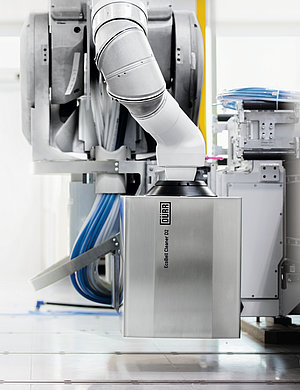
Innovative application technologies enable operators to reduce VOC emissions already in the paint booth by introducing less paint and solvent from the outset. The cost of these retrofits is comparatively low and achieves a return on investment. For example, replacing an existing EcoGun air atomizer with the EcoBell3 Ci high-rotation atomizer in the basecoat interior paint shop reduces the VOC load by 65 milliliters per unit. Running costs are reduced because 540 milliliters less paint is used per car body. Another example is the use of a linear color changer, which reduces paint loss from the 45 to 120 milliliters that were previously common to just 10 to 15 milliliters per color change.
Many paths - one goal
Other effective ways of avoiding VOCs include automatic atomizer cleaning equipment and new rinsing technologies, as well as switching to the VOC-free EcoFlush Zero rinsing medium, which cleans very well and is economical to use. In plant engineering, VOC reduction is best achieved with dry separation systems. With this process, a high proportion of the process air can be reused in a recirculation system, thus reducing the volume of exhaust air. The exhaust air can then be concentrated and optimally cleaned. The fully automatic EcoDryScrubber filter system, which also meets very strict dust emission limits, is particularly environmentally friendly. Like the semi-automatic EcoDry X dry separation system, it has a low exhaust air flow rate. It can be reduced to such an extent that the entire booth exhaust air can be economically concentrated and cleaned. At the end of the process chain is the exhaust air purification system, which cleans the exhaust air of solvents by means of concentration by adsorption or by recuperative or CO2-neutral regenerative thermal oxidation. If all the solvents produced in a paint shop and all reduction measures are included, it is technically possible to reduce pollutants and VOC content by an average of 95 percent.
No two paint shops are the same, so there is no such thing as an off-the-shelf solution. Instead, operators need a perfectly tailored tailor-made suit that fits their individual processes and the paints they use. Dürr can tailor this custom suit for its customers because the company combines all the necessary expertise in application, plant and exhaust air cleaning in a single source. With this know-how, the expert teams develop tailor-made solutions with which operators are ideally prepared to be able to operate their existing plants economically and safely in the future - and to comply with both statutory VOC limits and achieve their individual environmental targets.
Dürr Systems AG
www.durr.com