
UV coating: increase productivity, reduce emissions
UV-Lacksysteme härten besonders schnell aus und bieten beste mechanische Eigenschaften
(Feb. 2020/OM) - Coatings protect surfaces, give them new functions and enhance them with special colors and haptics. UV coatings, which score points for their environmentally friendly properties, are increasingly in demand: Since almost all of their components react with each other through UV curing, virtually no VOC emissions are produced during their processing.
This makes UV coatings particularly interesting as an alternative to solvent-based coating systems, as the pressure from legislation continues to grow here.
UV coatings are applied by rolling or spraying. They are dried using radiation sources that emit ultraviolet light and do not require much heat: The photoinitiators contained in the coating absorb the light energy and decompose, triggering a chain reaction - after a short, high-energy irradiation, UV coating systems are cured. The advantage is that the coated substrates can be processed, packaged and stacked immediately. This ensures correspondingly high productivity in the processing plants.
Minimal abrasion
"UV systems are mainly used on flat surfaces," says Beate Brehmer Dipl.-Ing. (FH) at FreiLacke. "But the development of 3D curing mechanisms is advancing in leaps and bounds, so they can also be used on less flat surfaces. Accordingly, hydro-UV coatings are increasingly being used here." The latter are mostly applied as UV spray coatings to minimize solvent emissions in production. On flat surfaces, completely solvent-free UV coatings can be applied with rollers.
Coatings expert Frei offers a wide range of UV systems that are characterized by particularly short curing times and very good mechanical resistance. The ES1910, ES1952 or ES1913 UV coatings, for example, have a surface hardness of more than 100 oscillations according to the pendulum cure method immediately after curing. "This is also shown in the abrasion test according to TaberAbrasor CS10 2 x 500 grams at 500 revolutions. For FreiLacke's ES1901 and ES1952 products, the abrasion is less than five milligrams," explains Brehmer. By comparison, this is around ten to 15 milligrams for conventional UV coatings.
High scratch resistance, good elasticity
Due to the integrated nanoparticles, ES1952H in particular is characterized by very high scratch resistance with simultaneous good elasticity and good chemical resistance, which has been tested according to DIN 68861, according to the coatings expert. The ES1910 and ES1913G systems also meet the highest chemical and disinfectant resistance standards, which customers often demand for interior applications.
In recent decades, UV coatings were mainly used for wood surfaces. This has changed in the meantime: They have long since also been used for substrates such as metals or plastics. But FreiLacke's UV clear coatings are not only used to protect surfaces: systems such as the ES1975HF or the ES1970 are also ideally suited as adhesion primers on difficult substrates prior to printing to enable digital printing inks to adhere.
Practical example and background information
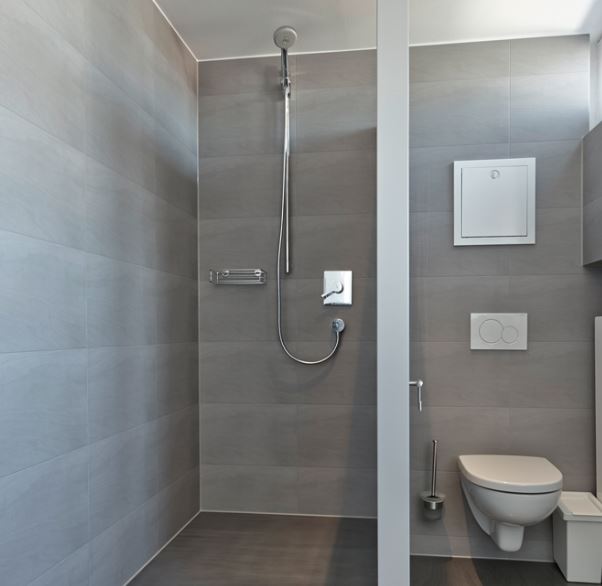
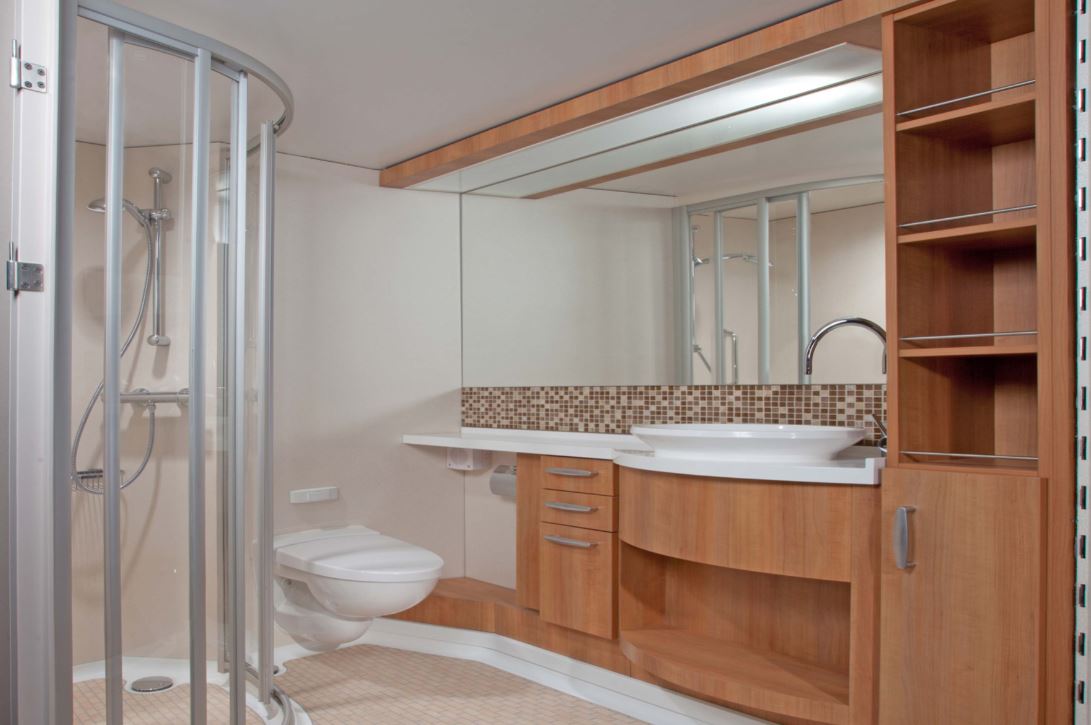
Auch die Nachfrage nach digital bedruckten Oberflächen mit UV-Materialien steigt – wie zum Beispiel für Kunststoffuntergründe im Baubereich, Wandbauelemente im Bauinnenbereich und für sanitäre Einrichtungen sowie für bedruckte Industrieflächen im Außeneinsatz. So auch bei der Stengel GmbH aus Ellwangen: Das Unternehmen hat sich auf die Fertigung von Metallfliesen für den Schiffsbau und hier im Besonderen für die Nasszellen spezialisiert. Bereits seit 2013 setzt man bei Stengel auf die UV-Systeme von FreiLacke. „Zunächst grundieren wir unsere Metallfliesen mit einem weißen UV-Grundlack durch Spritzappliaktion. Nach der Angelierung werden die Fliesen in große Fachbrettdrucker gelegt, wo der Auftrag des UV-Dekolackes erfolgt“, erklärt Produktionsleiter Uwe Sendner. Beide Schichten werden mit speziellen UV-Lampen getrocknet, um abschließend durch Spritzapplikation mit einem schützenden Klarlack überlackiert zu werden. Ein anderes Verfahren käme in ihrer Produktion nicht in Frage, sagt Sendner, denn die Qualität stimme uneingeschränkt und der Workflow sei ausgereift. Derzeit forschen Stengel und FreiLacke gemeinsam an einem Antirutschlack für den Schiffsbereich.
UV-härtende Lacksysteme bestehen hauptsächlich aus Oligomeren (Bindemittel) und Monomeren, sogenannten Reaktivverdünnern. Sie sind überwiegend für die Filmbildung verantwortlich und geben dem Lacksystem seine grundlegenden Eigenschaften. Eine zusätzliche Aufgabe der Monomere ist die Reduktion der Viskosität. Zur Initiierung der Radikalpolymerisation sind Fotoinitiatoren in der Formulierung zwingend erforderlich. Zur Farbgebung, Mattierung und zur Preisreduktion lassen sich Füllstoffe und Pigmente einsetzen. Klassische Additive verbessern die Entschäumung, den Verlauf, die Benetzung und den Lichtschutz.
Die Schichtdicken der UV-Systeme des Schwarzwälder Herstellers variieren je nach Auftragsverfahren von 10 bis über 80 Mikrometer. Sie erfüllen eine große Bandbreite an Glanzgraden von hochglänzend (Winkel < 20°:70-90GE) bis matt (<60°: 15GE). Die Produkte ES1901, ES1970 und ES1952 weisen nach 1000-stündiger WOM-Bewitterung einen Restglanz von >90 Prozent bei einem dE-Wert von <1,5 auf. Zudem hat FreiLacke in den letzten Jahren einige stark mattierte Systeme entwickelt, die die Kunden gut annehmen.
FreeVarnishes
www.freilacke.de