
More productivity for hydraulic cylinders
Effizientere Nasslackbeschichtung mit Elektrostatik
(Kopie 2)
At KMF-Maschinenfabrik, hydraulic cylinders for agricultural and construction machinery were previously coated exclusively by hand. Extensive modernization has now led to significant improvements in quality and productivity.
KMF Maschinenfabrik is a medium-sized mechanical engineering company in Kempten in the Allgäu region of Germany. With around 200 employees, KMF has been producing high-quality hydraulic cylinders for the agricultural and construction machinery industry since 2002, as well as quick-change plates for wheel loaders and telescopic handlers and customized hydraulic assemblies. After its founding in 1954, KMF began as a supplier and component plant for the Fendt company. The core business is the production of front and rear power lifts for commercial vehicles in the agricultural sector.
There is a high level of vertical integration at the Kempten site - among other things, surface coating, which is crucial for robust corrosion protection of the cylinders, also takes place here. In this respect, KMF has correspondingly high demands on the coating. What is required are closed and smooth surfaces, uniform coating thicknesses and a high gloss level. Until now, the workpieces there have been coated by hand. Bernhard Wirnharter, a member of the project team at KMF, looks back: "The old coating line was still from the 1960s and the process was simply no longer economical enough. To make production more efficient, we therefore automated parts of the coating process."
In March 2020, the company invested around 4 million euros in the construction of a new, 800-square-meter production hall, including a modern wet paint shop with application, metering and mixing technology from Wagner. Powder coating was under discussion, but was out of the question because the parts already installed, including seals, would not withstand the high temperatures when the paint cured. KMF's goal was to make the best possible use of resources. In addition, the coating technology should allow a wide variety of colors, as the components are often coated in the brand color of the respective customer.
(Kopie 3)
Sustainable with high-solids coatings
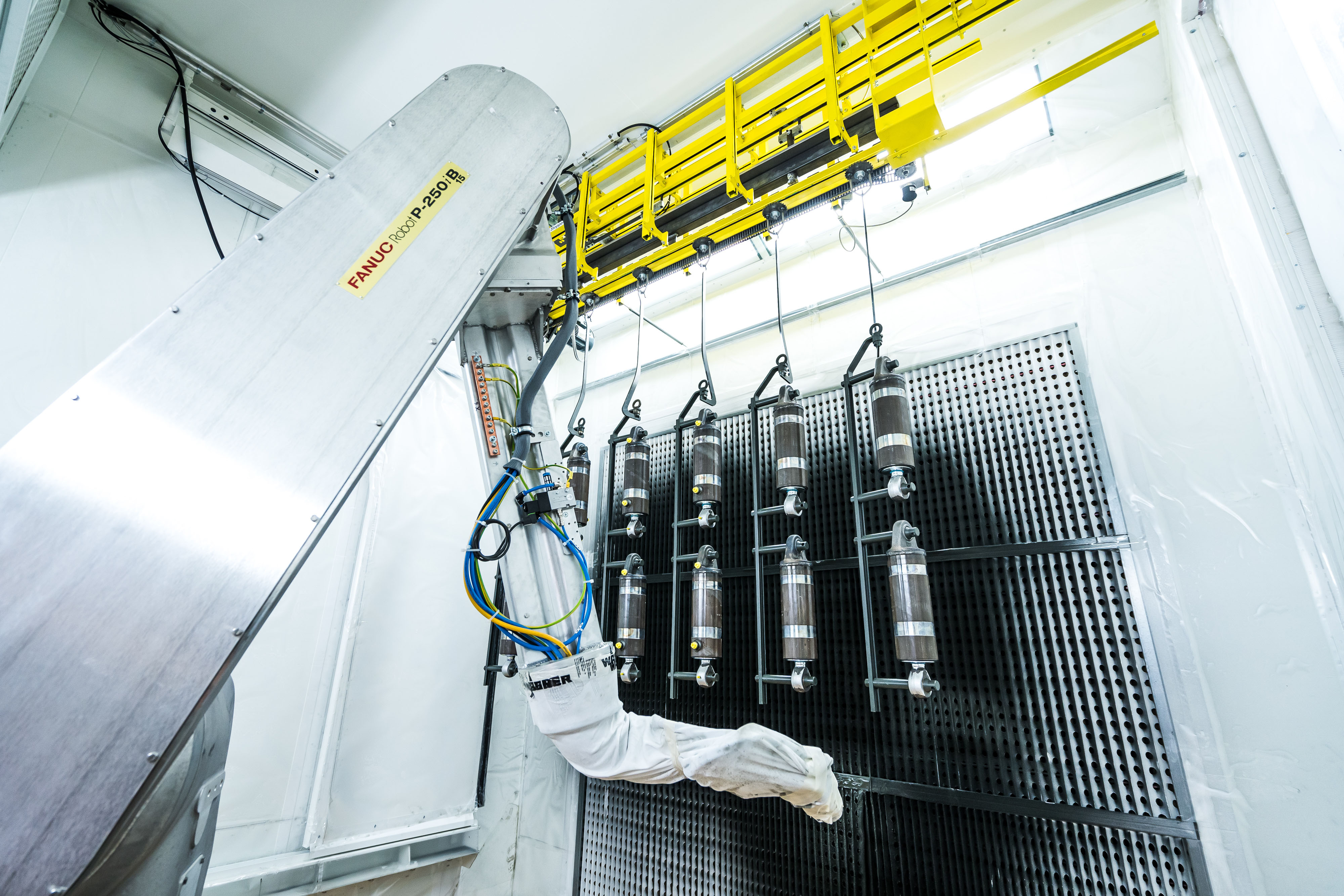
In the new plant, the workpieces on the suspension travel at a cycle time of 7.5 minutes after the washing system through an adhesive water dryer and then into the first paint booth, where the primer is applied fully automatically. In order to reduce VOC emissions, water-based paint was originally to be used, but this would have required elaborate conditioning of the booth supply air in order to be able to process the water-based paint reliably. This would have been an immense cost factor. KMF therefore opted for solvent-based paint because it was easier to handle. In order to save solvents nevertheless, high-solids coatings with a high solids content are used. Since these coatings are more economical than those with a lower solids content, the consumption of primer and topcoat is also lower, which reduces costs.
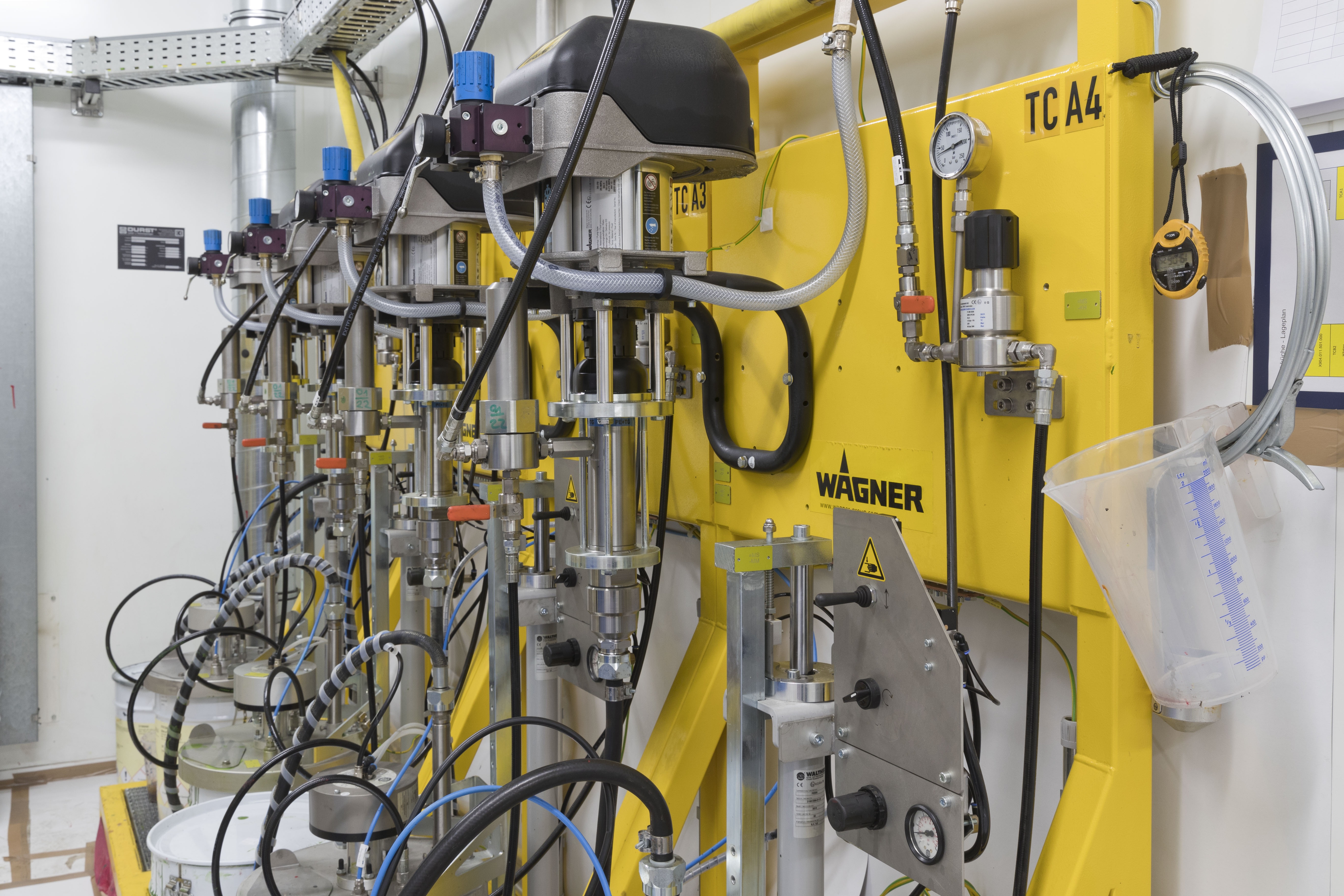
The primer is prepared with the intuitive 2K Smart electronic mixing and metering system. Accurate measurement of the material flows via gearwheel measuring cells and precise metering ensure constant and reproducible mixing ratios.
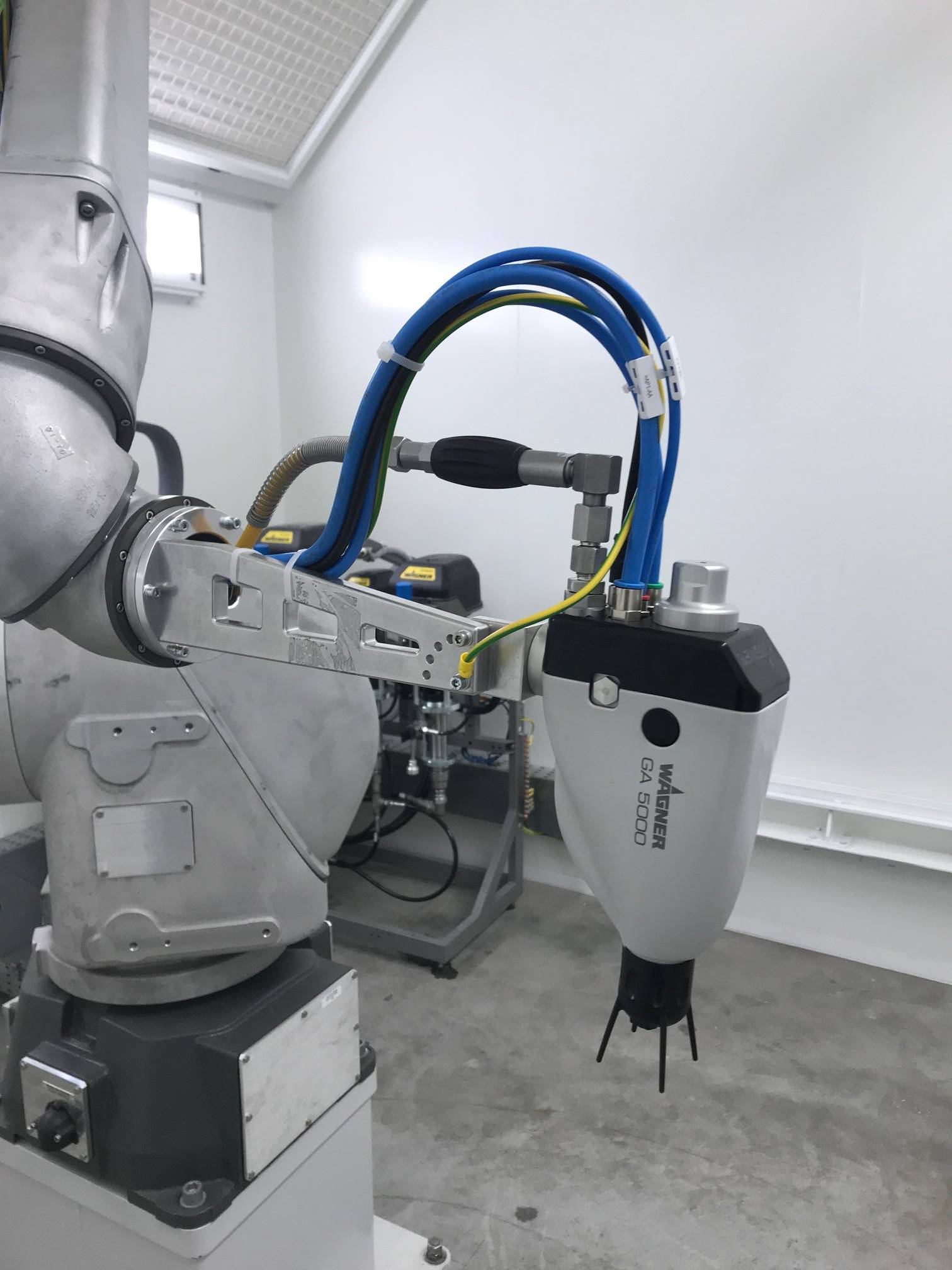
The robot-mounted AirCoat gun GA 5000 EAC with the control unit VM 5000 is used for priming. Thanks to electrostatics and homogeneous atomization, a very high application efficiency with little overspray is achieved for the large-area hydraulic components. The soft spray jet also coats curves and hard-to-reach areas very reliably. AirCoat technology thus helps to ensure that the solvent-based paint is used sparingly, which reduces both VOC emissions and material costs. "Automatic coating naturally also reduces the workload of the painters: where previously an employee had to stand in the priming booth all day with protective equipment, the robot now takes over the work," Wirnharter is convinced of the concept.
The top coat is applied manually in a second booth. Since only 50 percent of the primed workpieces require a top coat, KMF had decided to automate only the priming process for the time being for economic reasons. The GM 5000 EAC electrostatic AirCoat gun - the counterpart to the automatic version - also brings significant advantages in manual application, enabling very efficient work and high-quality coating results. The 2K Comfort mixing and metering system enables fast automatic color changes. This is a major advantage for KMF, as a total of six different colors are regularly in use. In 2023, an expansion of the mixing room to ten color stations is planned so that special colors can also be processed easily and efficiently. For a reliable ink supply, several Wagner high-pressure piston pumps are installed to ensure a constant material flow with low pulsation.
(Kopie 5)
Efficiency and productivity increased
The automatic color change for the top coat application contributes significantly to this productivity gain: While it took 30 minutes to rinse, manually change and mix the color on the old system, the setup time with the new 2K Comfort is now only about five minutes. The faster color change process with the automatic control system not only gives KMF a high degree of flexibility and color variety, but also saves around 10 working hours per week. Savings are also evident in the use of solvents: thanks to the more efficient color change and shorter pipe runs that have to be flushed, 1,500 kilograms of solvent were saved in 2021 compared with the previous year. The high application efficiency of the electrostatic guns also results in lower material consumption.
The new system significantly increased efficiency, as Wirnharter explains: "We used to paint around 1,500 cylinders a day in 3-shift operation, including Saturday work. Today, we can cover the same volume from Monday to Friday in 2-shift operation." The modernization thus resulted in a very significant gain in productivity and savings in resources, not to mention the reduction in the workload of the employees, which is an enormous advantage in times of scarce skilled labor.
(Kopie 7)
Wagner Group
www.wagner-group.com