

Color change in the automotive industry
Farbmengen einsparen und Verschleiß reduzieren
Color changes in the production lines of car manufacturers are increasing. Thousands of liters of paint are lost in this way, resulting in high costs. With the right technology, however, this can be avoided.
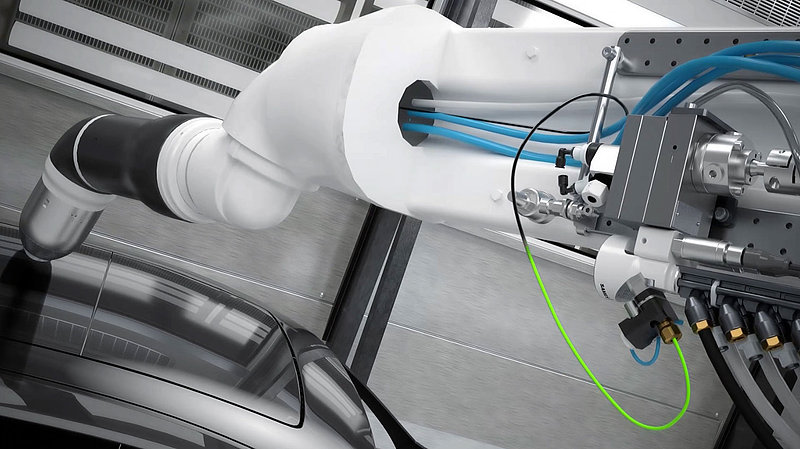
Automobile manufacturers produce to order in order to be able to deliver quickly and keep their inventories small. It would be much more ideal if they proceeded in color batches and produced a different color every day. Color changes would then be very rare and the associated unit costs negligible. The cost of a color change is 40 cm3 of paint, or in other words 48 euro cents, assuming a paint price of 12 euros per liter. But running only one color every day is not feasible in practice. Therefore, an average of twenty to thirty thousand euros in lost paint per year and per robot applicator adds up. Depending on production, the color shades of the individual models are changed on every second to fifth vehicle. A simple calculation shows how costly this can be: if a line producing 16,800 vehicles a month changes color after every five vehicles, paint costing 19,350 euros would have to be disposed of unused every year. - or even 32,200 euros if the color changes take place after every third vehicle.
Limitations of conventional systems
The general market trend in the automotive industry is towards more and more different color shades and individualization. This means that even more color changes are required. In short, the standard vehicle in that sense no longer exists.
In order to minimize the costs and environmental impact of the resulting paint loss, experts are continuously working on ways to prevent paint loss. Over the past 20 years, manufacturers have succeeded in reducing this to 40 cubic centimeters without any far-reaching technical changes. In the so-called push-out process, the paint is pushed toward the end of the painting process with solvent. Due to fluid mechanics, the solvent flows faster in the middle of the hose than at its edges and exerts a strong pressure. With this simple system, it was possible to further minimize color change losses.
At the same time as the push-out, pigging systems came onto the market. Here, a cylindrical plastic part, the pig, is pushed through the hose with the aid of compressed air. With its seals, the pig removes the coating from the hose almost without residue and transports it to the applicator. This system is extremely efficient: the total paint loss is less than ten cubic centimeters. Despite these advantages, pigging systems have not made it onto the process arms of robots across the board. Only five percent of all automotive plants worldwide use them, because they are not only expensive but also complex to install and maintain.
Contactless shuttle
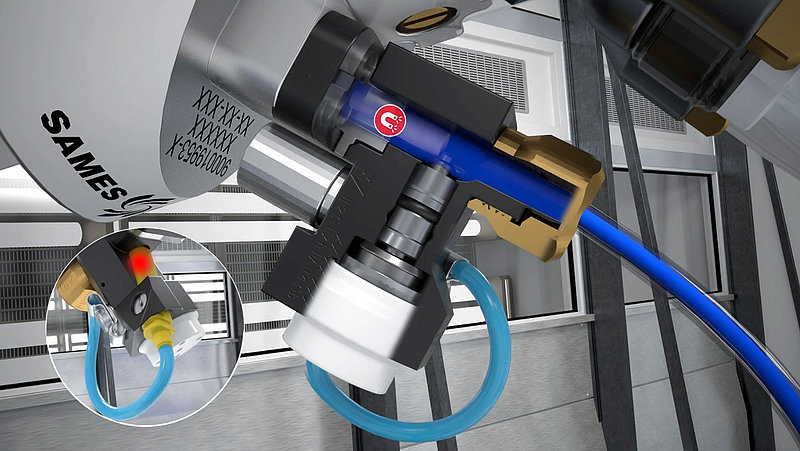
The main disadvantage is that the pig wears out quickly due to friction on the inner wall of the hose and also wears out the hose. This happens during transport in the direction of the atomizer as well as during return transport to the starting point. During both processes, particles of material can come loose and contaminate the paint. In addition, the pig is so tightly fitted to the diameter of the hose that it can get stuck. While the pig is located and retrieved, the robot and the paint line are at a standstill. Now a new system has come on the market that elegantly circumvents the disadvantages of the two techniques described above. Sames Kremlin has replaced the pig in its PaintSave system with a cylindrical shuttle. This has a slightly smaller diameter at 3.85 millimeters instead of 4 millimeters.
Exceptionally durable
Because of the smaller diameter, the shuttle does not directly contact the inner wall of the hose, which prevents friction and blockages. As a consequence, logically, less ink is recovered than would be the case in a pigging system: A total of 18 instead of ten cubic centimeters of ink is lost. However, a loss of 18 cubic centimeters compared to 40 cubic centimeters still means a saving of 55 percent. In addition, the novel shuttle impresses with its exceptional service life. In Sames Kremlin's laboratory, it has survived 600,000 color change cycles. This corresponds to a color change cycle of seven to twelve years in production. Another plus point with this solution is that the shuttle is not pushed by compressed air but by solvent. The solvent cleans the ink hose while simultaneously pushing the shuttle into the applicator.
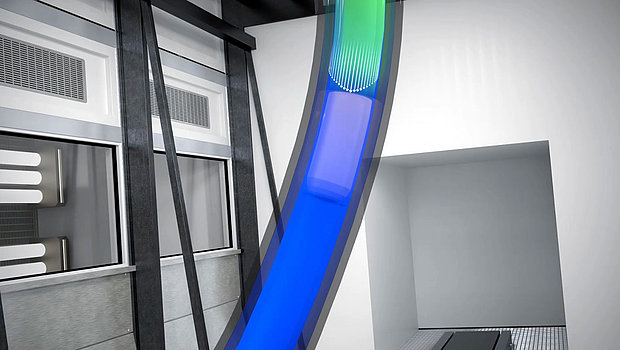
It is also important that the solvent cannot flow past the sides of the shuttle and contaminate the paint. Because of the laminar flow, the flow speed of the solvent is highest in the middle of the hose. The solvent therefore transports the shuttle forward faster than it could mix with the paint at the sides. Once at the receiving station, the shuttle stops the applicator. The color change begins as the shuttle is transported back to the start station by alternately flushing it with compressed air and solvent. The entire cycle takes ten seconds, compared to fifteen seconds for a color change using a pigging system. A magnet is integrated inside the shuttle, which is used to detect the shuttle at the start station. A counter magnet then pushes the shuttle back into the ink flow to the applicator. This technology is extremely advantageous because there are no moving parts in the system, which reduces wear and tear and minimizes the risk of failure. PaintSave is also light and compact enough not to slow down or strain the robotic arm. In addition, the system is very reliable even at high production speeds. The most important advantage, however, is that the new process cuts the cost of ink loss by more than half. This means that annual savings of 10,000 to 16,000 euros per robot applicator are possible, based on a calculation using the above examples. The investment in the system pays for itself within six to twelve months. An American automotive production facility has been using the system on a daily basis since December 2020 and has already decided to install several more PaintSave systems at sites in India.
Sames Kremlin Ltd.
www.sames-kremlin.com