
Deburring and finishing surfaces for automotive applications
Producing surfaces that meet requirements efficiently, sustainably and flexibly

Application-specific machined surfaces are essential for product quality in vehicles. Friction losses, fuel consumption and emissions can be minimized with the help of individually selected vibratory finishing, blasting and 3D post-processing solutions.
The changes in the automotive and supplier industry are also having an impact on surface technology. Not only because alternative drive systems and the trend towards autonomous driving mean that other components and systems are being used. Higher requirements also apply to the components of classic combustion engines. Optimal surfaces help to minimize friction losses, fuel consumption and emissions, as well as wear and vibrations on mechanically highly stressed components. Lightweight construction - actually already anchored in the automotive industry for many years - is playing an increasingly important role regardless of the type of drive, so that the relevance of surface processing in line with requirements is increasing further. In addition, individualization and personalization are giving rise to new demands on the look and feel of surfaces. Process automation in conjunction with digitization solutions is now also taking on a high priority in surface technology - driven by the need to design manufacturing processes flexibly and reduce personnel deployment. Rösler Oberflächentechnik GmbH is a long-standing and experienced partner of the automotive and supplier industry and is intensively involved with these requirements. Both in vibratory finishing and shot blasting technology as well as for the post-processing of additively manufactured components, Rösler supplies suitable solutions for surface finishing that support various production processes in a resource-saving and sustainable manner.
Deburring in the production cycle
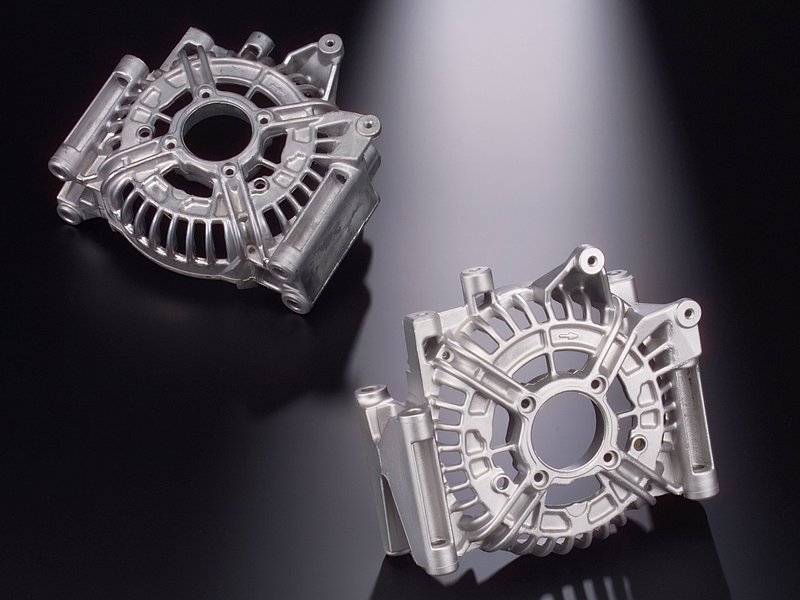
The aim of increasing the range of electric vehicles and reducing the consumption and thus the emissions of vehicles with internal combustion engines is leading to increased use of light metals such as aluminum and magnesium. Among other things, stator carriers, housings and components for drive technology, axle and wheel mounts are made from these materials by sand, pressure and injection molding. The parts must then be finely desanded, deburred and their surfaces homogenized. For these tasks, Rösler has developed compact reversing chamber shot blast machines with automated parts handling, which can be integrated into compact production lines in a space-saving manner and enable parts to be processed in the production cycle.
While additive manufacturing in the automotive industry used to play a role primarily in rapid prototyping and pre-series development, there is now a clear trend toward the production of series parts. In a report, SmarTech Analysis assumes that the production of additively manufactured series parts in the automotive industry will generate sales of $9 billion by 2029, compared with $1.39 billion in 2019. On the one hand, this is attributable to the further development of printers and printing processes as well as the available materials. On the other hand, 3D printing offers a wide range of possibilities for producing functionally integrated and thus lighter components with complex geometries. In addition, for exterior and interior parts, there are aspects such as individualization and personalization as well as the achievement of differentiation features.
However, the use of modern printing processes for series applications depends not only on reproducible printing processes and further reductions in unit costs, but is also largely determined by whether there is an economical and reproducible solution for parts post-processing. Developments of the Rösler brand "AM Solutions - 3D post processing technology" ensure that these industry requirements are met. The business unit of the Rösler Group, which specializes in automated, series-ready solutions for the post-processing of additively manufactured parts, already has experience in a wide variety of application areas.

Individual automation
Tailored to the specific requirements and circumstances, the automation of parts handling and parts logistics as well as the integration and interlinking in new or existing production lines is realized by our own team of specialists. If required, this also includes monitoring by means of data matrix codes or visual systems. With Rösler Smart Solutions, the company also offers software and hardware solutions for the digitalization of processes in vibratory finishing and shot blasting systems. While in shot blast machines the focus is on the operating parameters of the machine, which are responsible for part quality and maintenance, in vibratory finishing processes the focus is often on the maintenance and monitoring of the process water circuit.
Rösler GmbH de www.roesler.com