
Clean blasted surfaces for cranes
Zwei neue Strahlanlagen sorgen bei dem Kranhersteller Abus für hochwertige Strahlergebnisse

When it comes to highly stressed crane systems and lifting equipment, the surface must be right not only for visual reasons. The strength and durability of the weld seams depend on the correct pretreatment. For this reason, the crane manufacturer invested in two new blasting systems specially adapted to the task.
When crane systems and hoists with a load capacity of 80 kilograms to 120 tons are built, the surface must also be right. Abus, one of the major European manufacturers of indoor cranes, has built a completely new plant in Gummersbach and has been working there with Agtos wheel blast machines since 2019. These have been equipped with special functions and adapted to the high requirements regarding ergonomics and safety. Michael Wirths, plant manager for components at Abus, on how the cooperation with Agtos came about: "We had been in contact with Agtos since the early 2000s in connection with spare parts for our Schlick shot blast machines at the time. Even then, the cooperation was good, Agtos has fast response times and good service. Therefore, it was clear to us that we would also approach Agtos for new investments. And so the cooperation in the project, starting with the definition of the requirements, the preparation of the specifications up to the quotation, then continuing with explanations and the consideration of change requests, went quickly and in a spirit of partnership. Even constructive changes were implemented in the best possible way by the Agtos project managers Udo Wietkamp (design) and Christian Remmes (sales). We liked the project work very much."
Blast machines specially adapted to the application
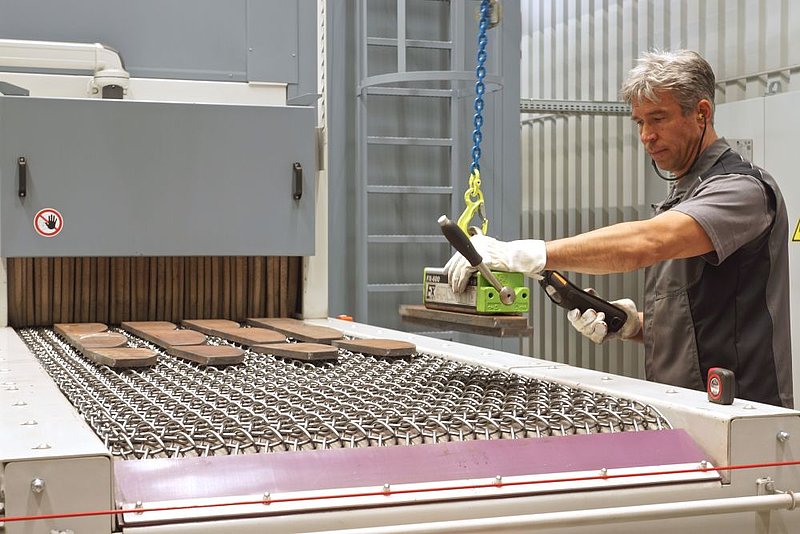
Both blast machines stand on vibration isolation mats, which reduce vibrations and noise. Also both machines are equipped with a large dimensioned touch panel type TP 1500 to enable the operators to operate the machines in an optimal way. Swivel arms allow flexible positioning and thus optimal operation of the machines. The batches are registered by barcode and the appropriate, previously defined, steel program is started in each case. The maintenance flaps and doors have been enlarged and thus adapted to the ergonomic requirements desired at Abus. In the event of a service call inside the blast cabinet, the extraction system that normally leads to the associated cartridge filter is switched over to the shop extraction system. The advantage is that additional mobile extraction units are not required. Nevertheless, the filter units are equipped with fire detection devices and extinguishing devices. The performance of the filter systems is designed for a degree of separation far below the legal requirements. On the wire belt blast machine supplied first, flame-cut blanks for the monorail trolleys are processed. The blasting task here is the optimum cleaning of the parts before welding. Rust and scale must be reliably blasted off to achieve a high weld quality. After the welding process, coating is carried out with water-based or also 2-component paints, depending on the requirements and wishes of the customer.

Application range of wire belt shot blast machine
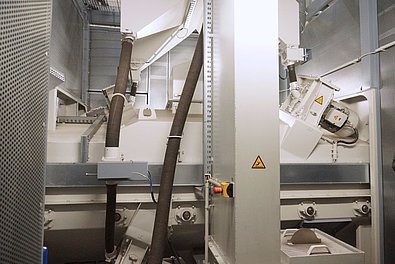
Basically, wire belt shot blast machines can be used very flexibly. The fact that the workpieces can be blasted from above and below at the same time considerably extends the range of workpieces that can be processed. The machines are used for deburring, descaling and cleaning of castings and laser-cut parts. The automatic workpiece recognition system located upstream of the infeed airlock starts the on-demand supply of abrasive to the four running Agtos high-performance turbines. In the case of Abus, these are equipped with 11.0 kW motors. This enables a blasting speed of up to 2.0 m/min. to be achieved. Workpiece detection ensures that blasting only takes place when workpieces are in the blasting area. This protects the wear parts in the machine and saves energy. The infeed sluice is equipped with wear-resistant rubber curtains for sealing. After passing through the blast zone, the workpieces reach the blow-off device. The abrasive remaining on the workpiece surfaces is removed here and returned to the abrasive circuit. The abrasive is kept in circulation and cleaned for continuous use. Cleaning takes place in a special air classifier. Here it flows in cascade over an edge, and at the same time a finely adjustable air stream is passed through it, which is generated by the fan of the cartridge filter system. This causes the fines to flow to the impact separator, which separates the coarser particles, and on to the cartridge filter system, which eliminates undersize particles and dust. Via the abrasive metering system, the cleaned abrasive passes from the abrasive hopper to the high-performance turbines. hristopher Fritz Dietrich, Project Engineer Plant Planning and Organization, emphasizes the compact design of the machine, which was not available from other manufacturers in this way. There were some special features to which Abus attached particular importance. For example, a safety screen made of Plexiglas had to be installed on the working platform to protect a worker located there from a crane passing close by. This way, the worker not only hears the sound of the approaching crane, but also sees it. "The blasting result has exceeded our requirements demanded in the specifications, so that the product range could be expanded," says Dietrich. The most recently delivered Agtos system, a roller conveyor shot blast machine, processes undercarriage beams for overhead travelling cranes. Modifications and improvements that Abus had emphasized in the first project were implemented here from the outset.

Operating sequence of the roller conveyor shot blast machine
Roller conveyor shot blast machines are used for descaling and derusting profiles and sheet metal. Rollers guide the loaded workpieces through the blast chamber and the downstream brush blow-off device. The machines can be integrated into production lines with the stations sawing, drilling, blasting and preservation. The workpieces actuate the switching threshold located upstream of the infeed sluice for automatic blast media feed from the running high-power turbines. This also ensures with this machine that blasting only takes place when workpieces are in the blasting area. At Abus, the machine has four high-performance turbines, each with a drive power of 15.0 kW. This means that a high blasting speed is also possible with this machine. The inlet sluice is equipped with wear-resistant rubber curtains and other sealing elements for sealing. After passing through the blast zone, the workpieces reach the combined brush-blow-off device. The abrasive remaining on the workpiece surfaces is returned here to the abrasive circuit. The abrasive is also cleaned in this machine by means of air classification. The special feature of this machine is the brushing station. Since workpieces of different heights are transported on this blast machine, the cleaning brush is also equipped with bristles of different lengths according to the track of the workpieces. This ensures that the bristles are not pressed on too deeply when lowering higher parts, as this would cause faster wear. In addition, the efficiency of the process is ensured with this measure. In addition, the workpieces are cleaned by means of a blow-off device. Another detail is the maintenance platform, which has been specially adapted to customer requirements. It further improves accessibility for servicing. On both machines, the quality of the blasting process is ensured by means of abrasive analyses performed by Agtos. Initially, there are tighter cycles, which are lengthened as the machines gain experience and are run in. The operating mixture is analyzed and compared with the previous values. In this context, it is important to check whether there are too many fines. This is because these significantly cause wear within the machine. On the other hand, constant proportions of coarse grit are necessary for blasting performance and constant proportions of fine grit for blasting overlap. A constant operating mixture results in the desired, consistent blasting performance and an economical process. Maintenance is carried out with the support of a plan drawn up by Abus, which simply and clearly shows the steps to be taken with confirmation by the workers. With the good cooperation and a coherent service concept, the outlook is for continued successful cooperation between Abus Kransysteme and Agtos.
mer, the heart of the wire belt shot blast machine; one of the turbines can be seen on the right (Photo: Agtos)