


Eye-catcher with depth
Properly pretreat hot-dip galvanized surfaces before painting

Pretreatment of the steel surface is of decisive importance not only before galvanizing, but also before further refinement into a duplex-coated product. Processes such as sweep blasting or the combination of alkaline degreasing and pickling removal are used.
The combination of hot-dip galvanizing and coating results in a protection period that is significantly longer than the sum of the protection period of galvanizing and painting. In addition, the coating can be colored - making it an attractive eye-catcher, for example in architectural applications or as a distinctive trademark for a company supplying hot-dip galvanized products.
Duplex extends service life and sets visual accents
So-called duplex-coated products benefit from the mutual protection of the zinc layer and the paint layer. The paint layer covers the zinc and protects it from atmospheric and chemical influences. If the paint layer is damaged, the anodic protection mechanism of the zinc layer against the steel comes into play: the less noble zinc dissolves as a sacrificial anode and protects the steel effectively and for a long time against red rust formation. An essential factor for the function and service life of the coating is perfect and long-lasting adhesion to the zinc surface. It is therefore best to select coatings that have proven their worth and passed appropriate suitability tests. More details on surface preparation and coating materials can be found in DIN EN ISO 12944-5 (wet coatings) and DIN 55633 (powder coatings) and in Worksheets Hot-dip galvanizing G.1, G.2 and G.3. Sweep blasting (DIN EN ISO 1299-4) or wet chemical pretreatment is used as mechanical surface preparation for both wet coating and powder systems. Sweeping as a mechanical pretreatment is also suitable for large constructions that cannot be treated by wet chemical means.
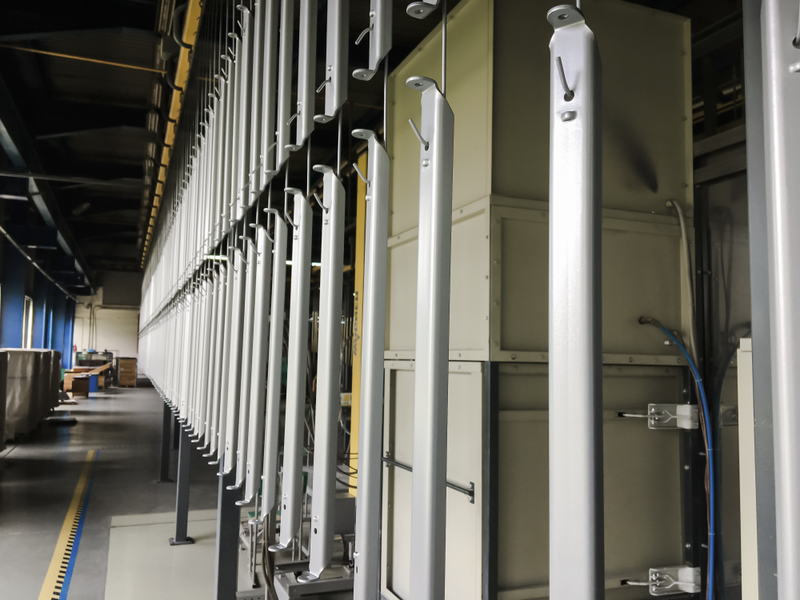
Basic pretreatment considerations
Chemical pretreatment is particularly useful when a high surface throughput density is required, or when different metal substrates - steel and aluminum in addition to hot-dip galvanized surfaces - are to be treated in a multi-metal pretreatment process. The most widespread application is in spraying. Historically, yellow chromating has been well established as a conversion treatment, but it must be replaced by chromium(III) processes or entirely chromium-free processes for occupational health and safety and environmental protection reasons, as well as because of the pending ban on its use. Pretreatment and coating take place either shortly after galvanizing or only after longer intermediate storage. In this case, the zinc surface changes depending on the storage conditions, which must be taken into account by adjusting the chemical pretreatment process accordingly. The original zinc surfaces can also have different surface compositions depending on the composition of the galvanizing bath, which the chemical pretreatment must take into account.

Extremely important: the pickling removal
The most efficient and flexible pretreatment strategy for hot-dip galvanized surfaces is the combination of an alkaline degreasing with an acid pickling or decapping and a conversion treatment. The advantage here is that the alkaline cleaner removes organic contaminants somewhat more effectively than acid cleaning. Shorter processes, on the other hand, consist of an acid pickling degreasing and a conversion treatment. Of greatest importance is the pickling removal that should and must be achieved by the wet chemical treatment. In this process, oxides, residual impurities and other substances adhering to the zinc surface are removed; however, the zinc layer is also attacked. Particularly in the case of non-uniform zinc coatings, for example with a larger proportion of iron on the surface, this can lead to stains and other surface defects ("overpickling"). Furthermore, the excessively removed zinc accumulates more quickly in the pickle, which thus loses its effectiveness and has to be discarded and reapplied more often. Today, both chromium (III)-containing processes and completely chromium-free processes based on transition metals are used to produce the conversion layer. These processes are either based on purely inorganic formulations or are modified with polymer components. Polymers here can be based on both hydrocarbons and silicon and serve as layer thickeners and crosslinkers. However, in the case of systems containing polymers, it is essential to test the compatibility of the coating and, in particular, the adhesion of the coating layer, for example in cross-cutting.
Preparing for powder coating
The process can be illustrated using the practical example of spray-galvanized surfaces prior to powder coating. After acid pickling cleaning with pickling acid (Decorrdal AL 20-16-1) and pickling booster (Toner AL 20-16) as well as surfactant for cleaning support (wetting agent), double rinsing with process water takes place. The conversion treatment is then carried out, using Decorrdal ZN 420 as conversion coating former and Toner 675 as coating adhesion promoter. Finally, rinsing is repeated with osmosis water. A still widely used performance criterion is the test for paint infiltration and corrosion in the neutral salt spray test, although this test is questionable for galvanized surfaces. In addition, the boil test has become established, which quickly and easily yields at least comparative results in paint adhesion. The pretreatment processes become more complex in the case of multi-metal pretreatment, i.e. when steel materials, galvanized surfaces and aluminum parts are to be treated simultaneously. If a high level of quality is to be achieved, it is advisable to split the process as shown in the table below. Aluminum pickling should be carried out separately from zinc pickling in a separate tank. If technically possible, the first rinse should also be separate. Passivation can be used for all substrates together. For many users, wet paint adhesion on hot-dip galvanized surfaces has been and still is a challenge. In summary, the reliable determination and adherence of the pickle removal on the substrate and a compatibility test prior to chemical pretreatment and painting significantly leads to a stable process and resilient coating results.
Kluthe GmbH Chemical Works www.kluthe.com