

Pioneering coating for more robust rolling bearing rings
(Nov. 2019/OM) - Using novel electroplated coatings, researchers want to make rolling bearings so robust against corrosion that housings and lubricants become superfluous. This could increase the energy efficiency of wind turbines by up to 30 percent.
Rolling bearings located in wind turbine rotors are exposed to enormous frictional forces. The moisture and salt content of the air is particularly high in offshore wind farms and at locations close to the coast. This additionally increases corrosion of the steel from which the components are made. Up to now, wear has been kept low with oil and other lubricants. Sealed housings offer good protection when used in aggressive media such as seawater, acids or even alkalis. But enclosures reduce the energy efficiency of the entire plant by up to 30 percent due to friction losses.
In the Poseidon II research project, science and industry are therefore working together to find rolling bearing materials, coatings and surface treatment processes that enable a long service life for rolling bearings even without lubricants and housings. This is the only way to avoid time-consuming and expensive maintenance work. Researchers at the Fraunhofer IPA's Electroplating department are pursuing one solution with the development of ultra-thin electroplated layers made of nickel and other chemical elements.
Nickel tungsten performs best
An alloy of nickel and tungsten, with which conventional rolling bearing steel is coated, has proved to be the least susceptible to wear and corrosion in pin-on-disc tests to date. So this alloy could be suitable for use in offshore wind farms and tidal power plants. "But we are also testing compounds such as nickel-cobalt, nickel-tin, nickel-molybdenum or nickel-phosphorus. After all, extreme operating conditions and high energy losses due to friction also exist far from the coast, and they affect gas pipelines, pumps, compressors or even the drive systems of electric vehicles," says Katja Feige, who heads the Galvanic Processes and Materials Group at Fraunhofer IPA.
Electroplating without fixed support point
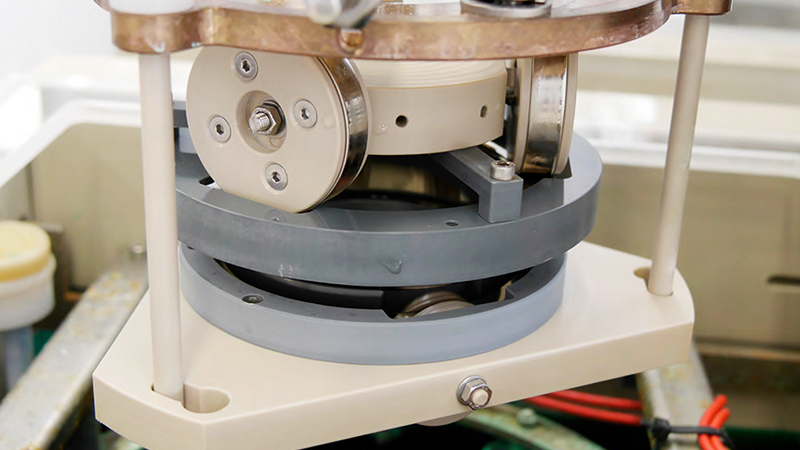
But it is not only the search for the best electroplated layers in each case that is occupying the researchers at Fraunhofer IPA, but also the search for a new process with which the electroplated metal layer is deposited on the rolling bearing. Conventional electroplated racks, in fact, have a decisive disadvantage: "At the points for electrical contact with the bearing ring, the applied metal layer is disturbed," warns Feige. "That's exactly where corrosion can then set in." The scientists have therefore developed a system for full-surface bearing ring coating. A special system of drive and contact rollers enables coating without contact points.
In the future, if rolling bearings need neither housings nor lubricants to run under extreme operating conditions, this will not only save resources and increase the energy efficiency of the plant. It also means that lubricating oil can no longer leak out, lead to contamination and thus harm the environment. Long-life bearing rings used under aggressive conditions - such as in or near seawater - can thus also contribute to the energy transition.
Fraunhofer Institute for Manufacturing Engineering and Automation IPA
www.ipa.fraunhofer.de