

Great savings potential with rectifiers from Munk
Efficiency improvement and government funding enable short ROIs
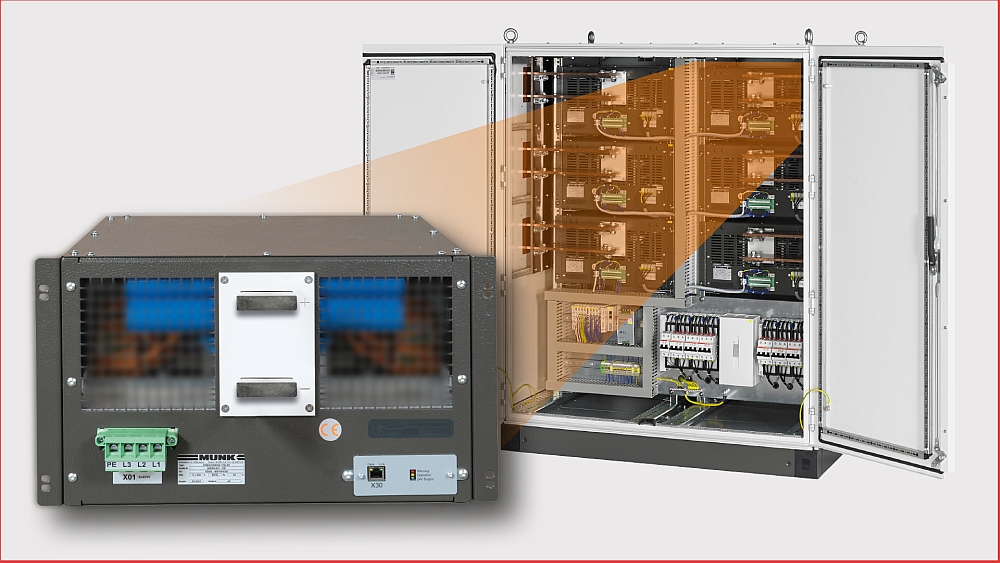
High energy prices make it necessary to prevent unnecessary energy consumption. New, more efficient rectifiers and the use of state subsidies from BAFA offer great potential and short payback periods in this respect.
In surface technology, many factors influence the efficiency of a coating process. Electrochemical processes such as electroplating are often energy-intensive processes. Particularly in times of skyrocketing electricity and gas prices, plant optimizations are important in this area to maintain a company's economic viability in a difficult environment.
In the deposition of electroplated coatings, rectifiers are among the units that offer very large potential savings - after all, they are the energy sources for the electrochemical process and must convert the high voltage from the power grid into voltage and current levels suitable for the process. Since considerable amounts of energy flow through here in an electroplating operation, the power dissipation generated by a rectifier is a significant cost factor. Rectifiers, by the way, tend to decrease in efficiency with age. Statistical surveys show that around one third of the energy required by a galvanic operation is attributable to electrical process energy.
So anyone who has not dealt with the rectifiers in their own plant for some time, and who may not even have any reliable information about their current efficiency, should take the current energy price developments as an opportunity to address the issue. In particular, because for some years now the BAFA (Federal Office of Economics and Export Control) has been promoting the investment of highly efficient rectifiers in the Federal Republic of Germany. Under the heading of energy efficiency, there are five funding modules that are used for federal funding of projects for measures in the field of energy and resource efficiency.
Funding for rectifiers falls under Module 4: Energy- and resource-related optimization of plants and processes. In principle, this involves the optimization of industrial and commercial facilities that help reduce energy consumption and avoid carbon dioxide (CO2) emissions. In order to apply to BAFA for a subsidy, it is necessary to prepare a savings concept, which is therefore the basic application document.
BAFA subsidy of up to 40 percent
Existing installations are those that include rectifiers that have been in operation for at least ten years. By definition, an existing installation has rectifier devices that have already had a service life of more than 25 years. Experience shows that the savings potential for old installations is many times higher, as rectifier technology has advanced enormously in recent decades.
New rectifier generation
Munk GmbH used the time before and during Corona in particular to launch a new rectifier innovation, the gamma L3+ rectifier module. The gamma L3+ impresses with an efficiency increase of 4 percent compared to current market standards. In addition, the output current was increased to 1,800 amps per module, although weight and design remained the same. The latter was a basic requirement for the engineers in order to ensure that existing systems could be retrofitted without any problems. Furthermore, the increase in efficiency leads to energy cost savings of at least 4 percent, resulting in savings of up to 1.2 kW per hour at an output power of 24 kW, 16 V and 1500 A.
Major savings for existing and old plants
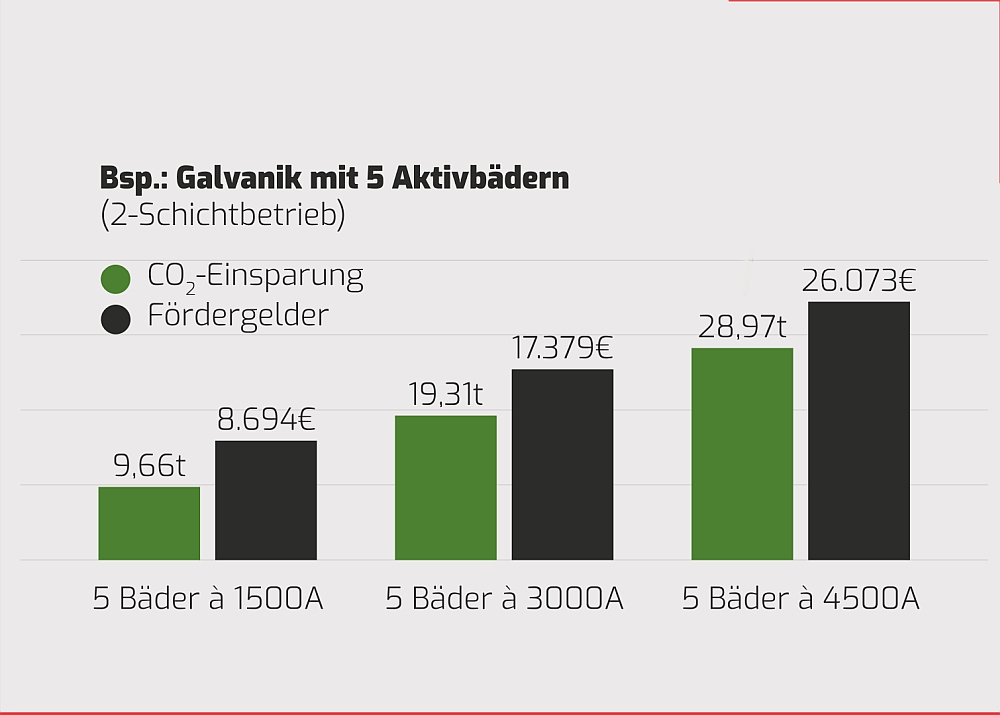
In the course of an efficiency measure, i.e. a BAFA-supported project, a surface coater was able to achieve an efficiency increase of five percent. A total of nine rectifiers with different performance data were replaced. Most of these were devices for a zinc rack line, on which 6,000 hours per year were produced in 3-shift operation. The target/actual comparison shows an actual energy saving of around 162,000 kWh per year for the running times. Despite the increase in efficiency, which is not very large at first glance, the savings due to the long operating times are immense.
With regard to the subsidy, the amount of CO2 saved is decisive. If the 162,000 kWh are converted, this example results in a CO2 equivalent of over 118 tons. As an SME, the company is entitled to a subsidy of 900 euros per ton, but the legislator has defined a so-called CO2 cap at 40 percent of the total investment sum. Of the actual investment sum of 240,000 euros including ancillary costs, 96,000 euros in subsidies could therefore be accessed. With an energy price of 32 cents for a kilowatt hour, the price the customer has had to pay since mid-2022, additional energy cost savings of just under 57,000 euros per year are secured. Taking into account the energy cost savings, the subsidy project achieves a payback period of less than 36 months.
Another good illustrative example is a small medium-sized company that runs its coating plant in 2-shift operation. In this modernization project, some of the equipment was over 40 years old - so it was clearly an old plant. As the inventory showed, some of the rectifiers only achieved efficiencies of 60 to 70 percent due to age-related degradation. The savings potential for such old systems is correspondingly high. In the case of the automatic system, a total of seven active baths of a drum system were refitted. The new, more efficient rectifiers required an investment of around 140,000 euros, including the dismantling of the old equipment and adaptation work in the low-voltage distribution system. The 133,000 kWh of energy saved is equivalent to more than 97 tons of CO2. Again, the CO2 cap had to be taken into account.
In the course of the project, the ongoing conflict in Ukraine caused the price of electricity to double to 0.35 euros per kilowatt hour, so that with annual energy cost savings of 45,000 euros, the investment sum remaining after deduction of the subsidy will already have paid for itself within 24 months. Regardless of the project size, the payback period of subsidized projects is often between one and three years.
With support for BAFA funding
The advantages of a subsidy are therefore obvious. It is a one-time grant without the commitment to further liabilities. Beforehand, however, the energy consultant should check whether the customer side has already taken advantage of subsidies elsewhere. Due to the de minimis limit, a company may collect a maximum of 200,000 euros in subsidies within the current and the last two years.
Between application and approval should normally be between six and eight weeks, but the large number of applications in the last two years have now extended this period to at least six months. If time is pressing, it is possible to apply for an early start of action. As soon as this is granted, orders may be placed, but it is not yet certain that the measure will then actually be approved by BAFA - the applicant must take this risk into account.
Partial implementation, for example the replacement of only four instead of eight rectifiers, of an efficiency measure is also possible - an effective means for companies with little financial leeway. Once the subsidy has been approved, the company has two years to implement it, otherwise a new savings concept must be drawn up.
In total, Munk GmbH, in cooperation with the energy consultants, has achieved a total subsidy amount of more than 500,000 euros for its customers in 2022. In order to be able to offer the most objective and technically sound advice possible, Munk uses the competence and expertise of the Öko-Zentrum NRW from Hamm for its energy consulting. This employs certified energy consultants as an independent company. These consultants not only provide technical advice, but also help with the bureaucratic process of applying for subsidies. In particular, the effort involved in compiling all the necessary data is high.
This makes the highly efficient rectifiers from Munk, as well as the technical consulting services, an effective instrument for improving the profitability and sustainability of electroplating companies.
Munk GmbH www.munk.de