


Evaporator under the microscope
Advantages and disadvantages of the different evaporator methods for wastewater treatment
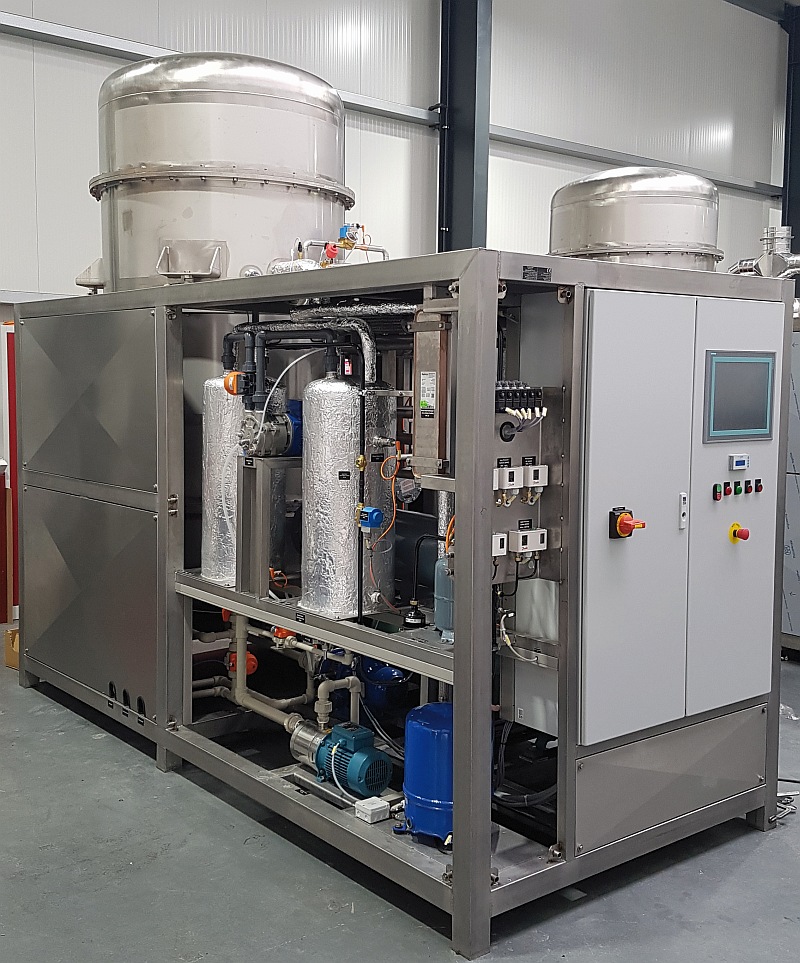
Vapor recompressors and vacuum evaporators are used in recycling technology and wastewater treatment; both are based on the evaporation of the medium to be treated or a refrigerant, respectively. They differ in terms of applied pressure, temperature, energy and maintenance requirements.
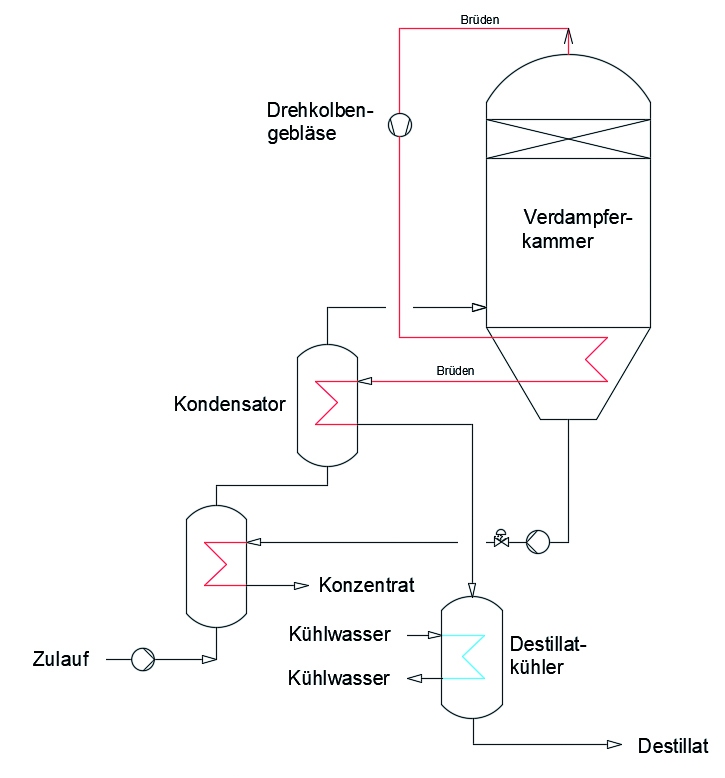
Evaporators with different modes of operation are used in the treatment of industrial wastewater: In evaporators with vapor recompression, the steam generated in the boiler is compressed by a rotary blower. The compressed steam is then used to heat the boiler. In a vacuum evaporator with heat pump, on the other hand, a refrigerant is compressed. Both processes require pretreatment of the wastewater. And in both processes, the evaporator chamber must be adapted to the medium to be evaporated. However, the systems react differently to the constituents of the wastewater: the vapor recompressor tends to be more sensitive to certain constituents, since the rotary blower is in direct contact with the evaporated medium. Accordingly, the construction material of the blower must be adapted to the vapor and the aerosols generated. With corrosive media such as acids or chlorides in the medium, this can be very expensive. "The use of rotary blowers to compress steam is a technical misunderstanding," a specialist in rotary blowers boldly states.
With the vacuum evaporator, resistance of the material is easier to achieve due to the lower temperatures. Overall, the vapor compressors are more susceptible and require more maintenance due to the high temperatures. For example, the blower requires annual maintenance. Experience shows that an oil change must be performed on the rotary blower every 500 to 2,000 hours. After a few thousand operating hours, the rotary blower must be completely overhauled at the manufacturer's plant. Due to this maintenance work, the evaporator plant with vapor recompressor is not continuously available.
Low maintenance effort
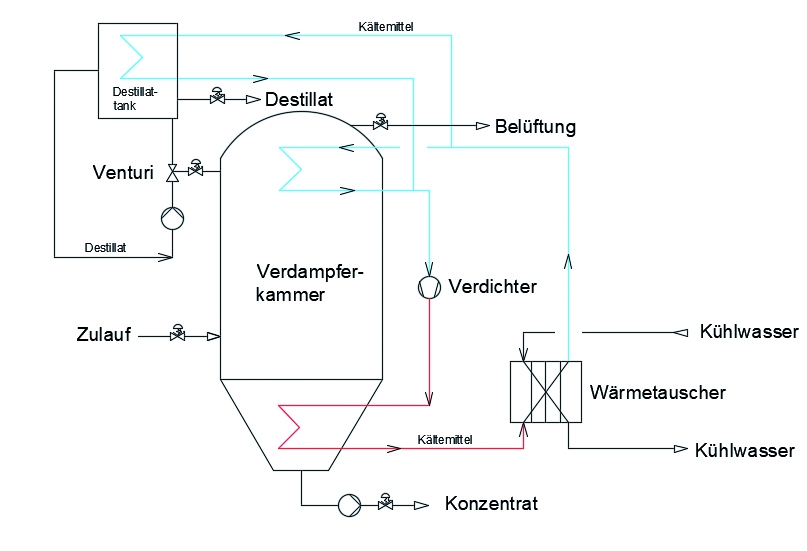
Since a refrigerant is compressed in the vacuum evaporator, the maintenance effort on the compressor is kept within limits. The service life is several years. But even here, the refrigerant circuit should be checked regularly, usually annually, by a trained refrigeration technician. Experience shows that the dryer in the refrigeration circuit must be replaced every one to two years. The legal regulations apply.
In both evaporator systems, there is a negative pressure in the evaporator chamber. This leads to a reduction in the evaporating temperature. In the vapor compressor, a relatively high operating pressure of around 600 millibars is used. Due to the negative pressure, the medium evaporates already at 86 degrees Celsius. Through compression, the vapor reaches temperatures of 130 to 150 degrees and thus heats the medium in the evaporator. At the condenser, the vapor still has 99 degrees. The distillate is cooled to 25 to 70 degrees with the feed to the evaporator. However, if the distillate is to be colder, it must be cooled further via an external cooling circuit. Depending on the outlet temperature, collecting vessels for distillate and concentrate must be made of temperature-resistant material - if necessary with contact protection.
The situation is different with vacuum evaporators. The operating pressure in the vessel is considerably lower here. It is about 60 millibar , which means that the operating temperature in the boiler at which evaporation takes place is only 30 to 35 degrees Celsius. Both the vapor before the condenser and the concentrate reach a maximum temperature of 30 to 35 degrees. The distillate is cooled to 20 to 30 degrees at the condenser. The collecting vessels for distillate and concentrate as well as the evaporator itself do not require any contact protection or elaborate insulation due to the lower temperatures.
Energiebedarfe im Vergleich
Unter energetischen Gesichtspunkten hat der Brüdenverdichter gleich einen doppelten Nachteil: Durch die vergleichsweise hohe Betriebstemperatur und zusätzlich durch den Energieverlust, der durch die externe Kühlung des Destillats entsteht, sieht die Energiebilanz dieser Technologie schlechter aus als die von Wärmepumpensystemen, denn diese behalten die Energie im Kreislauf. Hinzu kommt bei diesem Verfahren die geringere Arbeitstemperatur.
Geräuschlos arbeiten leider beide Verdampfersysteme nicht: Im Betrieb erzeugen sie mehr als 75 dB(A), was eine gewisse Lärmbelastung bedeutet. Vakuumverdampfer sind im Vergleich zu den Brüdenverdichtern die etwas leisere Alternative. Ein weiterer Punkt, der in die Betrachtung mit einbezogen werden muss, ist die Qualität des Destillats. Erfahrungsgemäß kann mit Vakuumverdampfern eine höhere Destillatqualität erzeugt werden. Die Gefahr des Übergangs von Entschäumer ins Destillat ist ebenfalls geringer. Dementsprechend sind die Chancen für eine Wieder- oder Weiterverwendung des Destillates besser. Auch die Möglichkeiten zur Aufkonzentrierung sind mit einem Vakuumverdampfer besser. Im Brüdenverdichter ist bei einer hohen Aufkonzentrierung der Reinigungsaufwand nach dem Entleeren des Verdampfers entsprechend hoch. Aufgrund der hohen Verdampfungstemperatur scheidet das Verfahren für temperaturempfindliche Medien aus.
Conclusion: Vacuum evaporators ahead of vapor recompressors
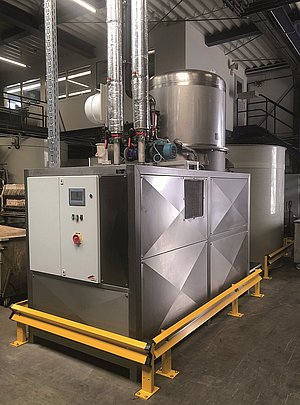
In this respect, it can be concluded that, depending on the application, vacuum evaporator systems with heat pumps can bring significant advantages over vapor recompressors in the concentration of wastewater, because they operate at lower temperatures, produce a purer distillate, and are usually less maintenance-intensive and prone to failure.
AGW Antech Gütling GmbH www.agw.de