
Drying process for helicopter gearboxes
Herausforderung: Sehr große Bauteile und eine erhebliche Wasserfracht nach dem Spülen
The complete drying of large-area helicopter gear parts presented a drying plant manufacturer with a completely new challenge. This was successfully solved with a combined blow-off/drying room variant.
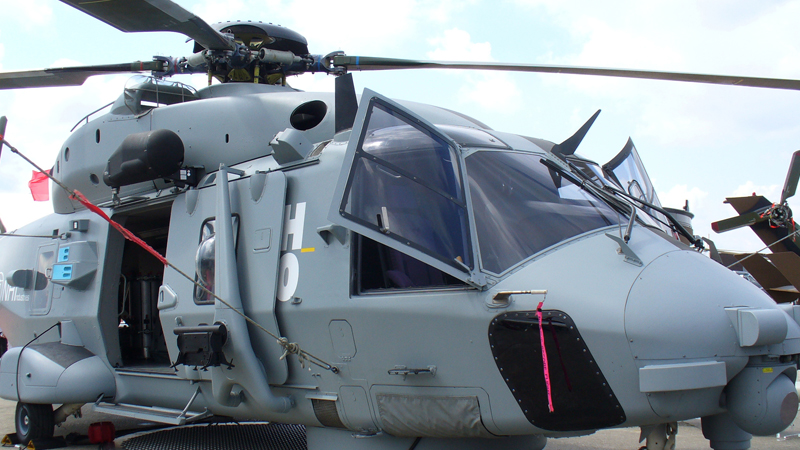
ZF Luftfahrttechnik GmbH (ZFL) in Calden develops and manufactures dynamic components for helicopters. Its plant in Hesse also services, overhauls and repairs the transmissions of many well-known helicopter manufacturers. With this comprehensive portfolio, ZFL is also one of the Bundeswehr's long-standing partners. In order to continue to meet the extremely high demands of its customers, it had become necessary to bring the drying process section up to date. Whether new production or maintenance - the gearboxes or their components are always surface-finished and subsequently require reliable and homogeneous drying. While searching for a suitable partner for this purpose, ZFL's attention was drawn during an Internet search to the drying plant manufacturer Harter from Stiefenhofen in the Allgäu region. Harter, in turn, has been confronted with many challenges in its more than 25 years of business activity and has already solved many drying problems with its heat pump condensation drying in a closed system. Harter was also asked to develop a suitable solution for ZF Luftfahrttechnik GmbH.
Large-scale test in the pilot plant
After a visit to the site and an inspection of the technical and local conditions, it was clear that for Harter this project would surpass anything previously implemented. The gearbox components are very large, some of them meters long and extremely voluminous. Their highly complex geometries had nothing to do with what the drying plant manufacturer had previously known, for example, with classic rack dryers or paint dryers. For the innovation-minded Allgäu specialists, it was clear that large-scale drying trials were inevitable. However, the standard dryers available to Harter in its in-house technical center were not sufficient for these large components. Therefore, Harter prepared a special test setup to be able to simulate the technical situation as realistically as possible. For the test series, Harter always takes the most difficult components for drying. If a good technical solution can be found for these, it will of course also be suitable for the simpler parts. A crane was used to immerse the gearboxes provided in a rinsing basin and, when they were moved out, they were tilted in such a way that a certain amount of water had already been emptied. Nevertheless, the remaining water load in the cavities was too high to start drying directly. For precisely such cases, the Allgäu dryer manufacturer developed a compressed air-free blow-off technology some time ago. This is used for geometrically particularly demanding products as a preliminary stage to the actual drying process. The results of the drying tests were promising, so that the planning of a corresponding plant could begin.
Extremely dry process air
Condensation drying in a closed system is a development from Harter. The basis for successful drying are two components. On the one hand, efficient air dehumidification by means of a heat pump and, on the other hand, the correct air flow. Harter uses a physically alternative approach for this. Extremely dry and thus unsaturated air is passed over or through the products to be dried, absorbing the moisture present. The stored moisture is then removed from the moisture-laden air using so-called Airgenex dehumidification technology. The moisture is condensed out and leaves the system as condensate. The cooled air is then reheated with the recovered energy and passed on. The cycle is thus closed. Drying takes place in a variable temperature range between 40° - 90 °C, depending on the application. It is now important to combine the air dehumidification with a targeted air flow. After all, the driest air is worth nothing if it does not reach the place where it is supposed to absorb the moisture. Designing the air ducting accordingly is part of Harter's wealth of experience.
Space and energy saving
For space reasons, both the dehumidification unit and the fan for blowing off at ZFL were installed on the second floor. The whole system is connected with insulated piping so that heat losses are reduced to a minimum. The high-pressure fan for the blow-off nozzles has a connected load of 5.5 kW, and the Airgenex unit 9.5 kW. Six special recirculation fans are installed in the drying room, which have a rated power of 0.7 kW. There is also an electric heating coil of 10 kW. This is only in operation at the beginning of the drying process to quickly bring the drying room to the required temperature. The rated power of the entire plant in production mode is 15 kW. "With this plant technology, we are ideally positioned for our so many different cases. All requirements in terms of technology, quality and energy were fully met," concludes ZFL.
► Harter GmbH
► www.harter-gmbh.de
► ZF Aviation Technology GmbH
► www.zf.com/luftfahrt