

Cleaning hardened components safely and thoroughly
Individually configured cleaning systems for hardening shops
In order to make steel and cast iron components more resistant to their subsequent use, they must be hardened. Depending on the hardening process, the production auxiliaries used and the intended end result, degreasing processes are used that are individually adapted to the size and weight of the components to be cleaned, the type of charging and the appropriate cleaning agent.
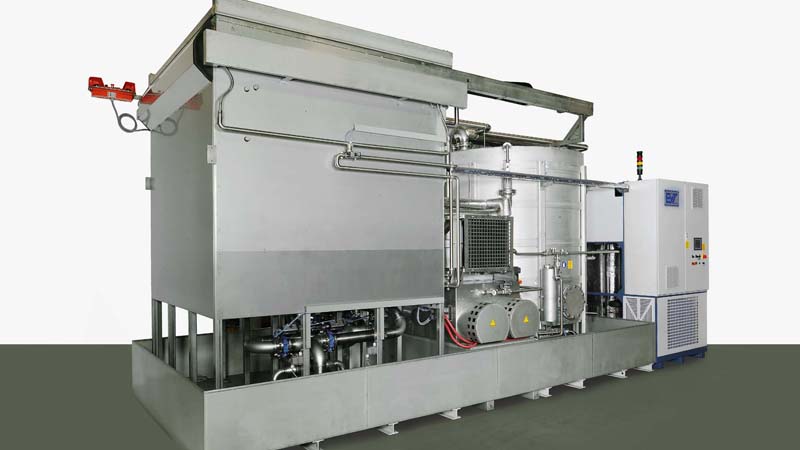
EVT Eiberger Verfahrenstechnik GmbH develops and manufactures custom-designed plants for the residue-free removal of production aids for hardening shops around the globe. The design of a cleaning system for a hardening shop is very demanding. It depends on many parameters, since on the one hand the spectrum of parts can range from the size of a screw to the size of a shaft for ship drives. Equally relevant are the process steps upstream and downstream of cleaning. For the cleaning system, there are also sometimes extreme ambient conditions, such as high temperatures or open barrage fires at the hardening furnaces. This means for component cleaning: Among other things, no combustible residues may remain on the parts or other interactions between cleaning media, deposits, gases, etc. and the furnaces may take place.
Michel Lubinsky, Sales Manager at EVT: "There is no such thing as an off-the-shelf machine for the requirements in hardening shops. The often cramped conditions in a hardening shop, the immediate vicinity of hardening furnaces, the special features of component geometries, the process steps before and after - our wide-ranging process expertise in the various industries, which is a prerequisite for the highest product quality in component cleaning, combined with decades of experience in mechanical engineering, helps us to optimally take into account all special parameters. The result is individually developed cleaning concepts that are perfectly tailored to the requirements of hardening shops."
Suitable cleaning medium
The selection of the right cleaning medium in hardening shops is a difficult matter. Here, EVT recommends the use of non-flammable solvents such as perchloroethylene (PER), which has the advantage over the use of modified alcohol or non-halogenated hydrocarbons that the risk of deflagration in the hardening furnace is excluded. Michel Lubinsky: "This can happen when components do not come out of the cleaning system one hundred percent dry, for example because they are heavily scooped. In this case, holes, recesses and other cavities hold the cleaning medium on the components. These then enter the hardening furnace, possibly directly. Flammable media pose a danger to life and limb here."
If non-flammable solvents, such as chlorinated hydrocarbons (CHCs), can be used, the immediate vicinity of hardening furnaces to the cleaning plant is harmless. This means that the available space in the work shop can be used optimally.
Michel Lubinsky: "During the entire development and design process, safety is our top priority. This means that depending on the cleaning medium and process, we equip the system with the appropriate EVT safety package. Examples are our air cleaning systems as well as the special explosion protection packages."
A good example is conversion hardening, where components are quenched in an oil bath. The challenge is that after the components come out of the hardening furnace or quenching bath, they must be cleaned of large amounts of oil. This poses a major challenge to the cleaning process to de-oil the components without leaving any residue. In EVT plants, which sometimes require a chamber volume of 9,000 liters of cleaning solution for hardening shops, special processes are used that can handle the high oil input and still have an ecologically and economically sensible consumption of solvent.
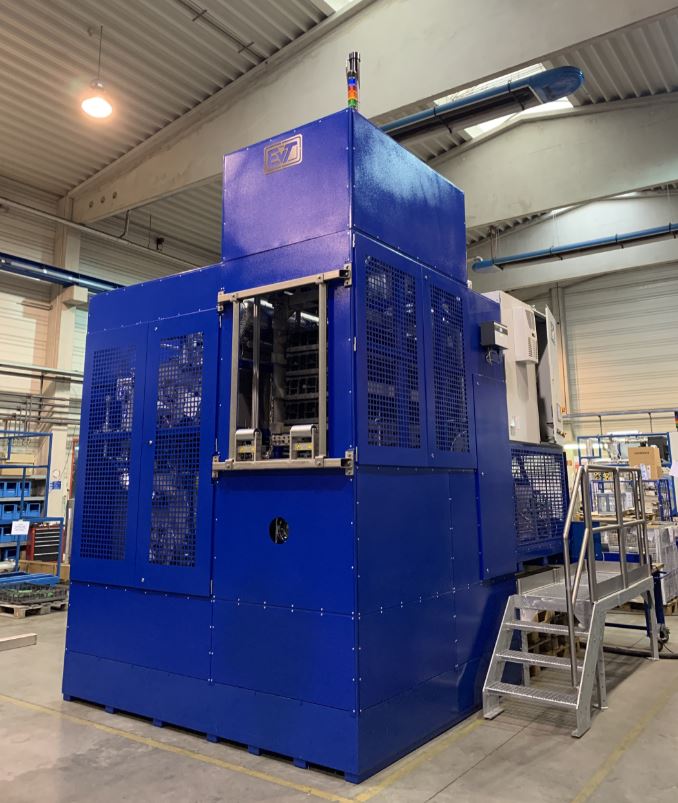
Spill-proof charging technology via front-top loader
In addition to the appropriate cleaning process, the loading of the automatic cleaning machine plays a special role for hardening shops, as degreasing systems are often integrated into hardening lines.
Typical front loaders harbor the latent risk of solvent escaping in liquid form or as vapor in the event of an unintentional opening of the chamber door. EVT developed the leak-proof front-top loader for lines where front loading is required from production processes. EVT front-top loaders combine convenient front loading of the system with the safety of a top-loading working chamber, whose maximum solvent level is below the loading door. In this way, solvent accidents, for example due to an accidental or incorrect opening of the door, due to a technical defect or because of an operator error, are excluded, according to EVT.
Michel Lubinsky: "We offer high-quality, specialized solutions for all sectors of industrial production and, as the example of hardening shops shows, develop individual plant configurations tailored to very specific customer requirements. This results in trend-setting, safe cleaning machines that work optimally in such demanding environments. As a result, our customers' production processes not only become safer, but also experience quality improvements in terms of the demands placed on their products."
► EVT Eiberger Verfahrenstechnik GmbH
► www.evt-gmbh.eu