Protected on good and bad roads
Successful poduction-use of waterbased zinkflake coating on automotive driving gear
The pressure on the automotive industry to become more sustainable, to minimize its own ecological footprint and, despite all this, to put a high-quality and durable product on the road is once again increasing sharply in the context of the structural shift toward e-mobility. In the chassis area, requirements are growing with regard to increasing the service life of individual components while at the same time saving weight. In addition, the use of new materials such as high-strength steels and new construction methods such as multi-layer structures is creating new challenges, especially for long-term corrosion protection. Some classic coating processes can now only partially meet these requirements. In terms of sustainability, increasing the service life of components used in automotive construction is a very relevant factor. Especially in the area of safety-relevant structural components made of metal, effective protection against environmental influences plays a significant role. Particularly in the chassis area and also on the underbody of the automobile, metal parts are exposed to aggressive weather conditions ranging from dirt to stone chips and moisture to considerable salt exposure in winter. At the same time, designers are being urged to minimize the weight of chassis components and thus also the previously generous safety allowances for corrosion damage. Long-lasting corrosion protection is therefore an important criterion for these components.
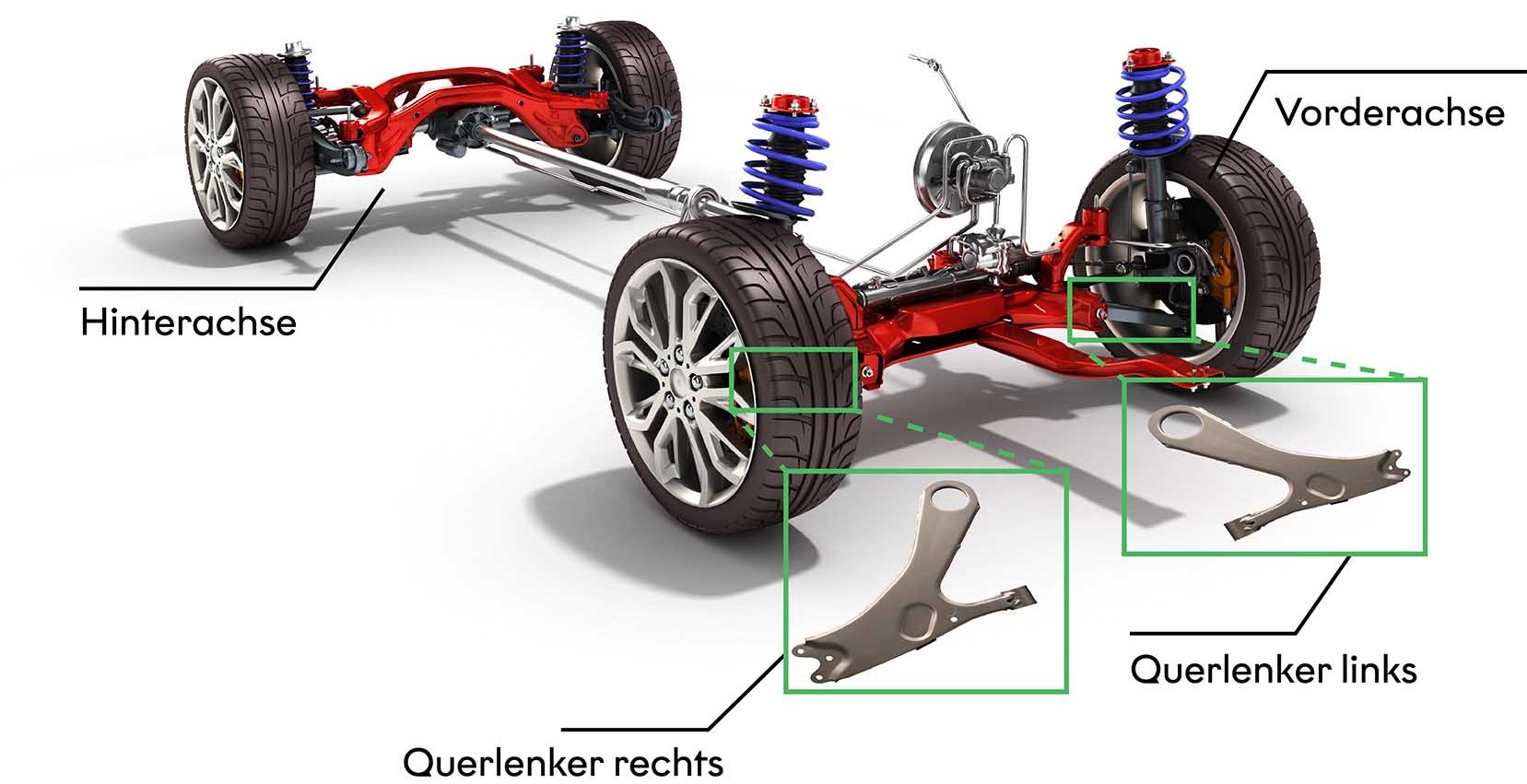
Chassis components - overview and requirements
Today's standard coating for such components is cathodic electrodeposition, usually in the thick-film range between 30 and 50 µm. This coating process is very effective as a barrier layer against corrosion, but shows clear weaknesses once the surface of the coating has been damaged - for example by stone chipping - and corrosive medium can thus penetrate to the substrate surface. In the chassis area, such damage can only be prevented by elaborate additional protective measures. In the worst case, the metal corrosion occurring in damaged areas can then lead to the complete failure of the respective component over time. The fact that even an optimally adhering cathodic dip coating in the underbody area of an automobile cannot prevent extensive corrosion in the long term usually becomes clear when looking under vehicles that are only a few years old. For this reason, the automotive industry is increasingly looking for alternatives to a classic paint coating in order to effectively extend the service life of the components used. There are various ways of increasing the protective effect of pure paint layers, such as combining electrocoat layers with other coatings, known as multi-layer systems. However, the application of various different layers causes additional work with significant costs, and these systems also quickly achieve total coating thicknesses in the range of over 100 µm.