

Nano coating for zinc die castings
"Green" alternative to galvanic processes offers good protection against abrasion and corrosion
A manufacturer of zinc die castings is using a new type of nanocoating to coat components for the automotive industry. Tests show that this also offers a very good protective effect in terms of abrasion and corrosion compared with electroplated coatings.
Föhlan is the name of a novel nanocoating in combination with thin-film passivation of zinc die castings, which represents an interesting alternative to galvanic processes. According to corresponding tests, it offers very good protection against abrasion and corrosion. The process, developed in-house at Adolf Föhl GmbH, was presented at GIFA. Föhl is already using the new coating both in its Chinese plant in Taicang and in its German production plant in Michelau to coat components for the automotive industry. Among other things, base plates for the antenna of the van model of a well-known German premium manufacturer are coated here.
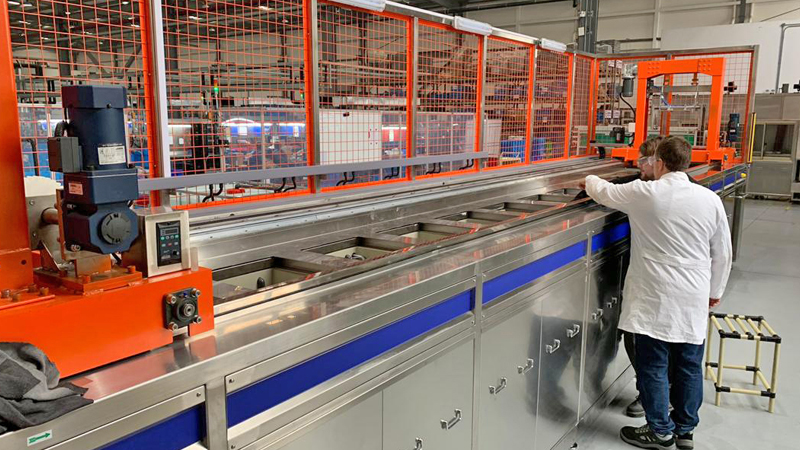
Prompted by the general Europe-wide ban on substances containing chromium VI, Föhlan was designed as an alternative to electroplating processes. According to the manufacturer, after several years of development, the new technology offers excellent corrosion protection and also economic and ecological advantages. For example, the new method impresses with a savings potential in the double-digit percentage range and high corrosion resistance with a layer thickness of only about 2 micrometers. In contrast to galvanic processes, both a uniform layer thickness distribution and protection in cavities are ensured. At the same time, the coating system conserves resources at several levels: With a reduced number of process steps and a coating time of only a few minutes, the passivation machines can be set up effectively and directly at the user's site. This reduces logistics costs while at the same time increasing the number of units, and also reduces transport-related damage.
Resource-saving process
As a green technology, Föhlan is not only more energy-efficient than many conventional coating processes for zinc parts. The chemical-physical process does not require pickling during pretreatment, thus avoiding wastewater problems and does not require any approval procedures, nor do any accident regulations apply. This is because alkaline liquids instead of acid are used as the basis for activation, passivation is chromium(III)-based, and the nanoparticles used consist of inorganic SiO2 and an organic polymer-like substance that is 100 percent biodegradable, non-flammable and non-corrosive. The passivation layer, which has a thickness of only 0.2 to 0.8 micrometers, acts as an adhesion promoter for the nanolayer. For sealing, the nanoparticles are aspirated by osmotic effects and deposited in capillaries. Nanocoating is possible with an application of only 0.5 to 1.0 micrometers. This results in total coating thicknesses of only 1 to 2 micrometers, while an electroplated chromium(III) coating is about 10 micrometers thick, thus affecting dimensional stability.
Corrosion protection at a high level
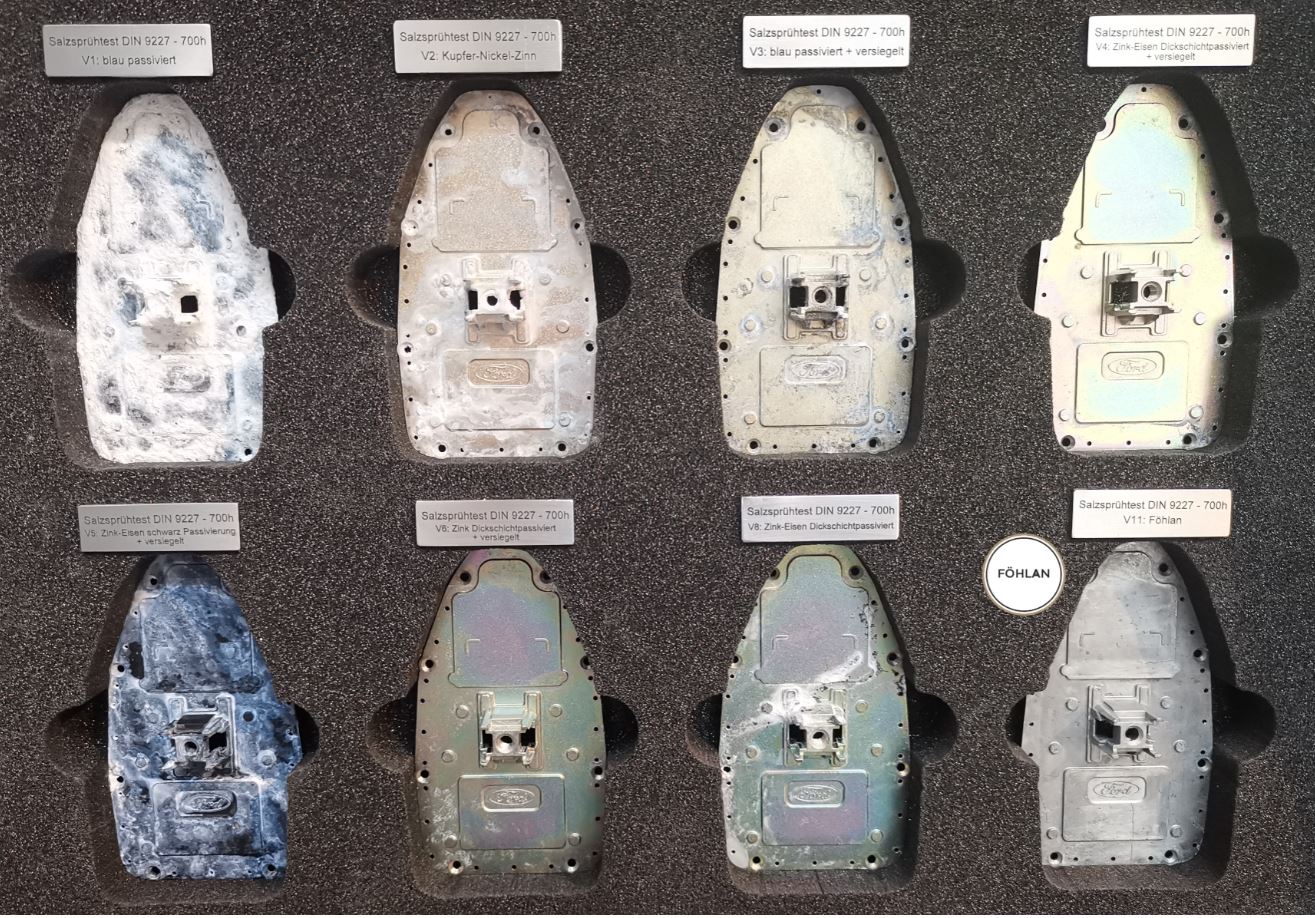
In addition to positive economic and ecological effects, this new surface treatment with nanoparticles is particularly convincing with its corrosion resistance and offers equally strong or even better corrosion protection compared to conventional processes. External laboratory tests in salt spray tests according to DIN EN ISO 9227-NSS prove a corrosion resistance of up to 640 hours and for the nanocoating the lowest attack, better tribological properties and better abrasion resistance than galvanic coatings. Specifically, the following samples were used for comparison: galvanized + blue chromated, galvanized + thick-film passivated, galvanized + thick-film sealed and Zn-Fe + thick-film sealed.
Macroscopically, the nano-coating shows the most stability with the least wear traces. The weight loss confirms this picture: for the nanocoating it was only 3.25 grams, whereas for the other coatings it was 11 to 15.25 grams. The friction coefficient curve of the nanocoating shows a stable level. Whereby two samples are between 0.3 and 0.4, the other two at 0.6. In contrast, the other coatings in the test show a stable friction level around 0.8 after a short running-in period. The fluctuation range as well as the friction value curve indicate an abrasive wear behavior. The wear track depth of the nanocoating is the lowest with a maximum of 48 micrometers. The other coatings tested showed depths of 65 micrometers to 147 micrometers.
Efficient process flow and high quality assurance
Not only the coating itself is efficient, but also the entire process flow. Compared to electroplating baths, Föhlan not only offers positive aspects in the area of environmental protection, but also in the entire workflow: work steps are greatly reduced and processes such as drying are simplified. Quality assurance of the new Föhlan systems is carried out via flow monitors to detect whether liquid is flowing around the parts, and PH and LF probes to control process bath and rinse water quality. In addition, internal and external analyses are used to check automatic metering. Finally, an external corrosion test is carried out for each batch by means of a salt spray test.
In summary, Föhlan offers an interesting serious alternative for the corrosion protection of zinc parts and has already proven itself in practice. In view of ever stricter environmental regulations, many advantages speak for themselves.
► Föhl GmbH
► www.foehl.de