
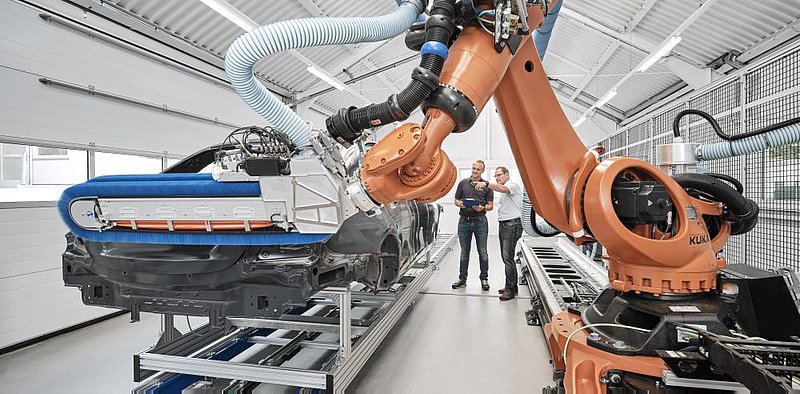
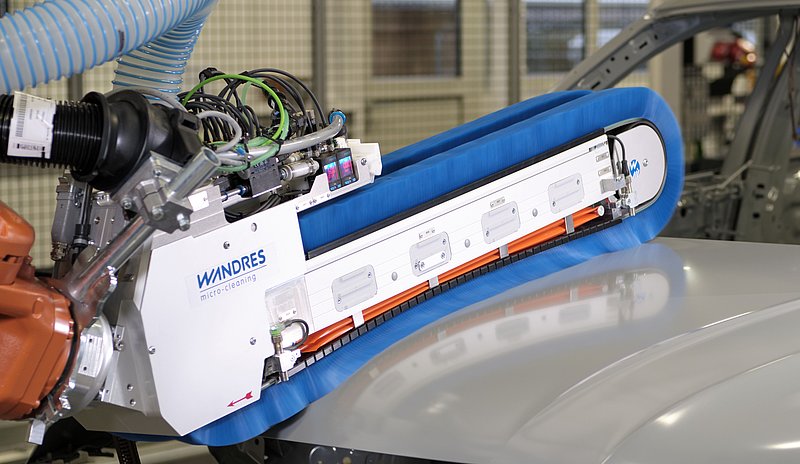
The Laura robotic sword brush cleans car body surfaces at renowned automotive manufacturers worldwide prior to painting using air and brush technology. The gel dryer can be dispensed with thanks to the non-contact cleaning of the weld seams, thus saving a considerable amount of energy.
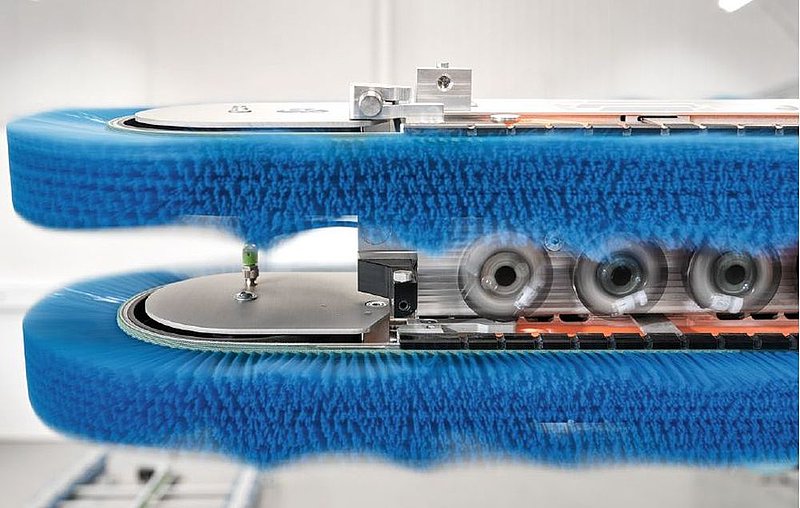
Even small amounts of dust and fibers from the environment or from previous production steps cause serious defects in the painting process. Particle inclusions remain visible under the top coat and have to be reworked at great expense. The Laura 160 robotic sword brush from Wandres, on the other hand, combines the advantages of air technology with the strengths of brush technology. This combination ensures optimum cleaning performance and surface quality, especially with short cycle times in modern paint lines. Robotic sword brushes clean car body surfaces very efficiently and avoid particle-related defects in the top coat. As a result, there are fewer returns and First Time Quality (FTQ) can be increased. Recesses such as roof seams or handle recesses are first air-wiped. This is followed by wiping for fine cleaning. The two parallel rotating linear brushes clean the car body surface using the Ingromat process, a wet wiping process patented by Wandres. The brush filaments are wetted with a fine spray film of the Ingromat cleaning and antistatic agent. This micro-moistening causes even the finest particles to adhere to the filaments, yet the surface remains dry. The adhering particles are transported by the filaments to the self-cleaning unit, where they are mechanically separated and fed to the exhaust system. The linear brushes permanently regenerate themselves through the self-cleaning function and are thus ready for continuous use in industrial production.
Cleaning technology for concave and convex surfaces
An internal direct drive drives the two parallel linear brushes. The working area of the two rotating linear brushes is mounted on a pneumatically controlled flex buffer. In the center of the flexible working area, the linear brushes can be deflected from -30 mm to +10 mm and thus adapt to both concave and convex surfaces. The linear brushes are manufactured in compliance with strict quality standards by sister company Wandres Brush-Hitec GmbH in the southern Black Forest and are durable even under harsh production conditions. The polyamide brush filaments are ground and rounded at the tips to protect sensitive surfaces. Eleven rotating Janus-type Tornado nozzles are arranged linearly between the two linear brushes. The diameters of the nozzle holes can be adjusted without tools, and the direction of the blast jet can be adjusted to achieve the optimum cleaning effect. Compressed air exits the tornado nozzles at several times the speed of sound. The compressed air removes particles and dust from recesses in the body surface without contact and with high performance.
No gel drying
After electrocoating in the dip tank, a paste-like sealing material is applied to the body-in-white at the weld seams and at folds as protection against corrosion, scuffing or stone chipping. The wet sealing material is sticky and is usually cured in a gelation dryer prior to the filler line. The gelation dryer is a long oven that heats the car bodies to around 120 to 130 degrees Celsius. A large amount of energy is required for this and a correspondingly large amount of greenhouse gases are emitted. In many cases, however, the gel dryer can be dispensed with by optimizing the cleaning process. This is made possible by the use of robotic sword brushes, since they traverse the body contour in a defined manner. The polyamide brush filaments do not come into contact with the freshly applied seam sealants. For this reason, the sticky sealant no longer needs to be dried before cleaning. It is sufficient if the sealing material is cured in the filler dryer later in the process. If robotic heavy-duty brushes for bodywork cleaning are planned from the outset in new projects, the space requirement of the filler line is considerably reduced by the elimination of the oven. The investment costs for the gel dryer can also be saved. Robotic Sword Brushes can also be easily integrated into existing lines. The flange of the robot sword brush can be adapted to existing robots and has a quick-change system. If the use of robotic sword brushes can eliminate the need to operate the gel dryer, not only is the painting process significantly simplified, but a lot of energy can be saved. Over the year, the energy cost savings can add up to a mid-six-figure sum.
Cleaning tests in the technical center
Before a cleaning system is installed in a paint shop, cleaning tests can be carried out in advance on an exemplary car body in the Wandres technical center. A modern six-axis robot with a seventh traversing axis cleans the car bodies or other test objects in a practical manner. In the technical center, customers can see first-hand how their own body-in-white is processed. As customer visits were only possible to a limited extent during the pandemic period, a cleaning test was filmed for the first time with several cameras in the technical center and broadcast live in September 2021. Behind the scenes, a three-person film team took care of the camera work so that viewers in front of the computer screen could easily see even the smallest particles and details. In front of the camera, sales specialist Daniel Rokoschoski guided the viewers through the demonstration. Live broadcasts from the technical center could also be an alternative to on-site appointments in the future.
Wandres GmbH micro-cleaning www.wandres.com