
Innovation in CO2 snow jet cleaning
Schneller, effizienter und effektiver durch pulsierenden Strahl
(Nov. 2020/OM) - Quattroclean snow blasting technology has established itself as an economical and reliable process for the full-surface and partial cleaning of a wide variety of components. A newly developed two-substance ring nozzle for a pulsating jet now makes it possible to realize further economic and technical advantages in CO2 cleaning.
Today, component cleaning is an essential part of quality-oriented manufacturing in all industrial sectors. The cleanliness specifications to be met vary depending on the product, the manufacturing phase and the next step in the production chain, for example coating, joining, assembling or packaging. Irrespective of this, the trend is increasingly towards dry cleaning processes, which, like the quattroClean snow blasting technology of acp systems AG, ensure process-safe cleaning results according to requirements and can be easily integrated into production lines and interlinked production environments.
The environmentally friendly alternative to wet chemical processes also offers advantages if only certain component areas such as adhesive, welding or sealing surfaces require a defined particulate and/or filmic degree of cleanliness or if cleaning is to be carried out on assembled components. Another area of application is the simultaneous deburring and cleaning of hard and brittle plastics such as PEEK and PPS.
Four effects for reproducibly clean surfaces
The process uses liquid, indefinitely stable and non-corrosive carbon dioxide as a cleaning medium. It is produced as a by-product of chemical processes and energy generation from biomass and is therefore environmentally neutral.
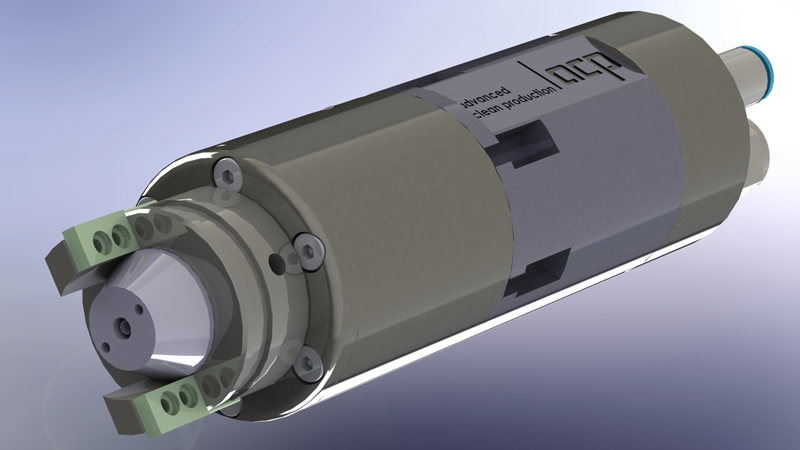
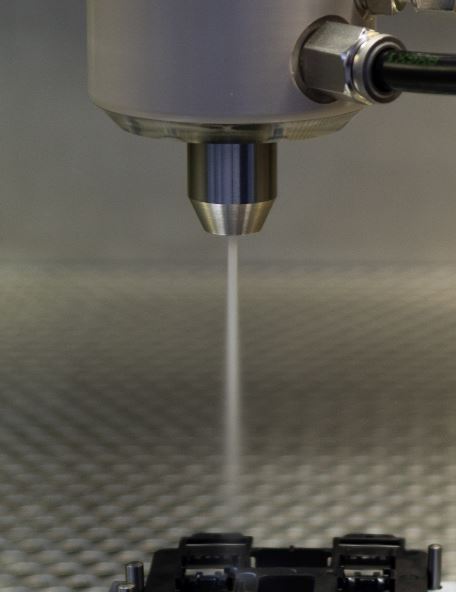
The essential element of the cleaning system is a wear-free two-substance ring nozzle through which the non-flammable and non-toxic carbon dioxide is fed. As it emerges from the nozzle, it expands to form fine CO2 snow, which is focused by a separate, annular compressed air jacket jet and accelerated to supersonic speed. When the easily focusable jet of compressed snow air strikes the surface to be cleaned, a combination of thermal, mechanical, sublimation and solvent effects takes place. The interaction of these four mechanisms of action removes particulate and filmic contamination in a reproducible manner. Detached contaminants are blown away by the aerodynamic force of the compressed air and removed by an integrated suction system. The CO2 sublimates under atmospheric pressure, the workpieces are dry after cleaning and can be further processed or packaged immediately.
Higher cleaning efficiency due to new nozzle technology
With the aim of further increasing cleaning efficiency and the range of applications, acp has further developed its nozzle technology. The result is a nozzle technology that generates a pulsating jet with a frequency of 25 to 30 hertz. Compared to the continuous jet, the pulsating snow jet has a higher kinetic energy resulting in an optimized cleaning effect: On the one hand, the micro-jet effect (mechanical action mechanism) is multiplied. It results from the transfer of momentum when the fine snow crystals strike the surface to be cleaned or deburred at high speed. On the other hand, the repeated micro-explosions that occur with each impact of the pulsating jet due to the approximately 600-fold increase in volume during the transition from the solid to the gaseous phase (sublimation effect) enable more effective removal of the contaminants.
Shorter treatment times and reduced costs
The already short treatment times can be further reduced in numerous applications due to the increased effectiveness of the jet. In deburring tasks, the effectiveness of the process is also increased by the enhanced pulse transmission, so that processing cycles can be shortened here as well.
This opens up new perspectives, particularly for the integration of the Quattroclean system into automated production steps with very short cycle times. The company is conducting tests on this in its own technical center. At the same time, the pulsating jet can reduce the consumption of carbon dioxide and compressed air. This in turn reduces the cleaning costs per part and thus contributes to increasing economic efficiency. Another advantage is that the use of snow jet cleaning with a pulsating nozzle can be implemented in a more weight- and space-saving manner.
Highly flexible - also in plant design
Adapted to the respective cleaning and cycle time requirements, acp systems realizes customized system concepts based on standard modules. They can be designed as stand-alone solutions or for integration into automated or interlinked production environments. The scalable Quattroclean process can be adapted efficiently and in a space-saving manner to different component geometries for full-surface or partial cleaning.
All process parameters such as volume flow rates for compressed air and carbon dioxide, blasting area and blasting time are determined by tests exactly for the respective application, the material properties and the contaminations to be removed. They can be stored as part-specific programs in the system control. Standardized interfaces allow easy integration into and control by higher-level host computers. For complete documentation and traceability, all process parameters are automatically recorded and transferred to the master computer.
acp systems AG
www.acp-systems.com