
Inline cleanliness for critical parts
Metallteile vor dem Beschichten oder Vermessen zuverlässig inline und trocken reinigen
Components that are coated or measured after machining require very clean surfaces. CO2 snow blasting can ensure these requirements as an integrated process even for very small workpieces such as valve components or indexable inserts.
The demand for precision, process reliability and high efficiency is leading many companies to put previously used processes and technologies to the test. Component cleaning is not exempt from this. On the one hand, it is important to ensure the cleanliness required for subsequent production steps in a stable manner and at reduced operating costs. On the other hand, automated and digitalized processes are becoming increasingly important. For smaller workpieces, a dry and fully automated cleaning solution such as the quattroClean snow blasting technology of acp systems AG is a good choice. This was also the case for a manufacturer of valves. Here, a rotationally symmetrical component made of steel with a diameter of five millimeters and five millimeters in length is partially coated in a PVD process. After machining, during which heat is generated, the surface is contaminated with a dried mixture of machining medium (oil) and particles, which is therefore difficult to remove. This comparatively small amount of dirt must be removed in a defined area to ensure optimum adhesion and service life of the coating. Due to a high effort, space requirement and energy consumption for drying, a wet-chemical cleaning process was ruled out.
Snow jet cleaning in test with most reliable result
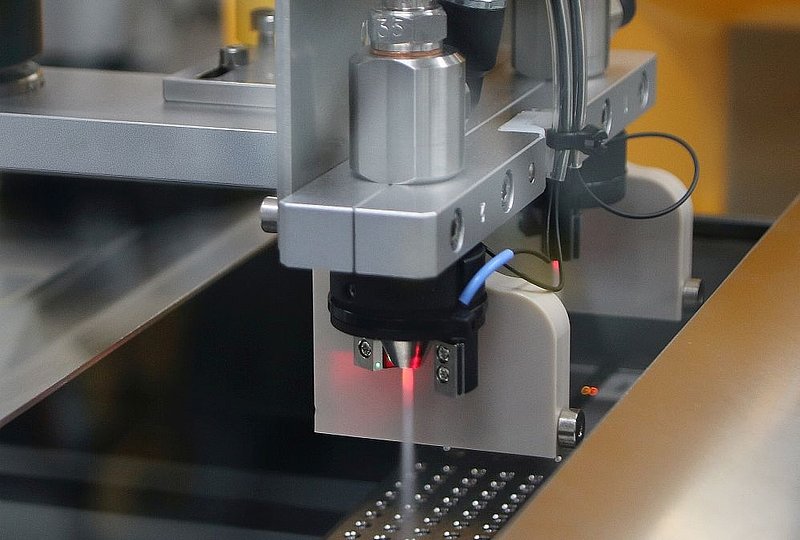
Extensive cleaning tests in the technical center of acp systems AG proved that selective cleaning with the quattroClean snow jet cleaning achieves the cleanliness required for an optimal coating result. The cleaning process uses liquid carbon dioxide as medium. Since the CO2 is produced as a by-product of chemical processes and energy generation from biomass, it is climate-neutral. For the cleaning process, the liquid carbon dioxide is passed through the inner ring of a wear-free two-substance ring nozzle and expands as it exits to form ultra-fine CO2 particles. This snow jet is focused by a separate compressed air jacket jet (second ring) and accelerated to supersonic speed. When the minus 78.5°C cold and easily focusable snow jet hits the surface, a combination of thermal, mechanical, sublimation and solvent effects occurs. The cleaning effect generated by the interaction of these four active mechanisms removes the dried mixture of oil and particles in a process-safe and reproducible manner. The detached contaminants are blown away from the parts by the aerodynamic force of the compressed air jet and sucked out of the cleaning cell together with the CO2 sublimed into the gaseous phase. Recontamination of the parts is thus reliably prevented.
A customized fully automated process
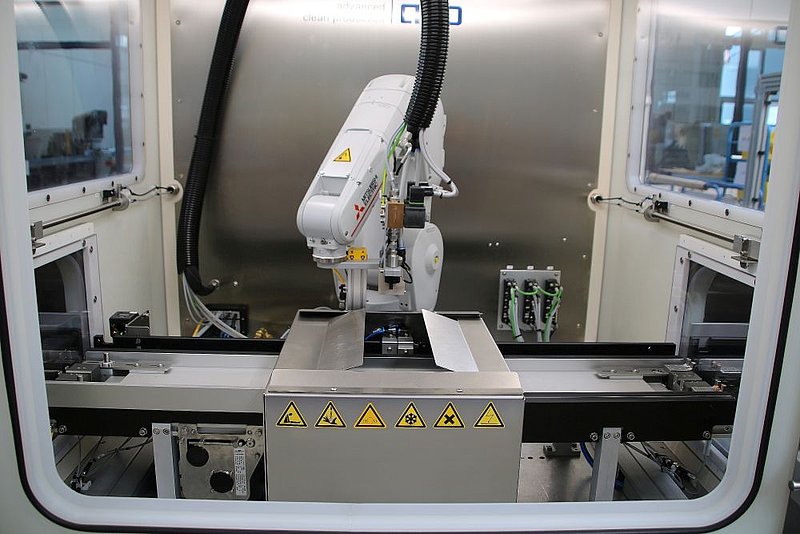
For the cleaning of the valve components, acp designed the fully automated Jetcell cleaning system consisting of standardized modules, tailored to the manufacturer's application and production conditions. In this system, those workpiece carriers are used for cleaning in which the partial PVD coating takes place. The design of the process parameters - such as volume flows for compressed air and carbon dioxide, type of jetting nozzles, jetting range and time, and motion sequence - ensure that the required cycle time of six minutes for cleaning a workpiece carrier fully loaded with around 150 parts is met. To integrate the cleaning system into the existing workflow, there is a buffer for five workpiece carriers on the loading and discharge side. One container at a time is fed into the cleaning booth, which has a digital matrix code for complete documentation of the cleaning process. Once the airlock is closed, the cleaning process starts: a robot guides the cleaning unit with a jet nozzle over the valve components at a defined distance and motion sequence. A sensor system continuously monitors the jet consistency. As soon as all parts have been cleaned, the airlock opens and the workpiece carrier is transported to the encapsulated removal area.
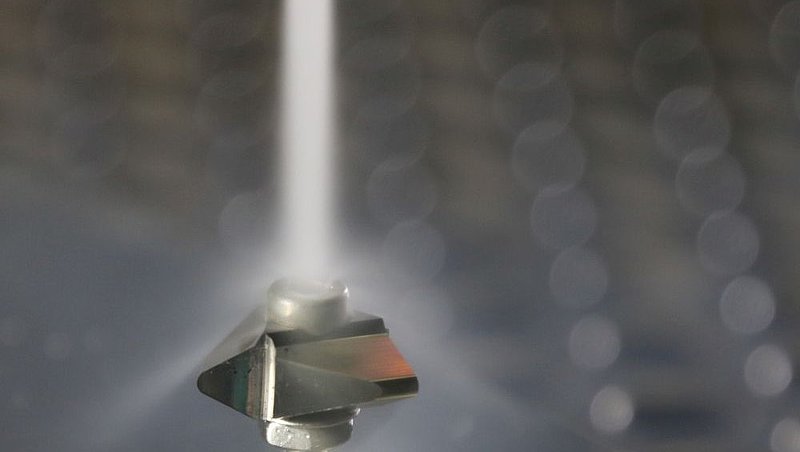
CO2 cleaning integrated into the measuring cell
For indexable inserts, which are manufactured in small quantities with individual geometries and dimensions between ten and 25 millimeters, tolerances of one to two micrometers must be reliably maintained. To ensure the high accuracy, the contour of the parts made of carbide is measured one hundred percent at the manufacturer after grinding. Since impurities present on the surface from residues of the machining medium and grinding dust can cause measurement errors, the indexable inserts were previously cleaned manually at great expense. This process was now to be integrated into automated production. Here, too, the decision was made in favor of the quattroClean process after cleaning trials and definition of the process parameters. In this case, cleaning was integrated as a module in the measuring cell, which is docked directly onto the grinding machine. This solution allows the existing robot to remove the inserts from the grinding machine through a sluice, move them in a defined manner under the snow jet for a short time, and then place them cleanly in the measuring area. Movement sequences and blasting times for the different indexable inserts are stored in the control system as part-specific programs, as are volume flows. Thanks to the possibility of precisely matching the cleaning to the application and cycle time specifications, and of operating it as a standalone system as well as in production-integrated and interlinked production environments, the Industry 4.0-capable quattroClean snow blasting technology can make an important contribution to the automation and digitization of manufacturing. The cleaning system can be easily integrated into and controlled via higher-level master computers using standardized interfaces. For seamless documentation and traceability, all process parameters are automatically recorded and transferred to the master computer.